

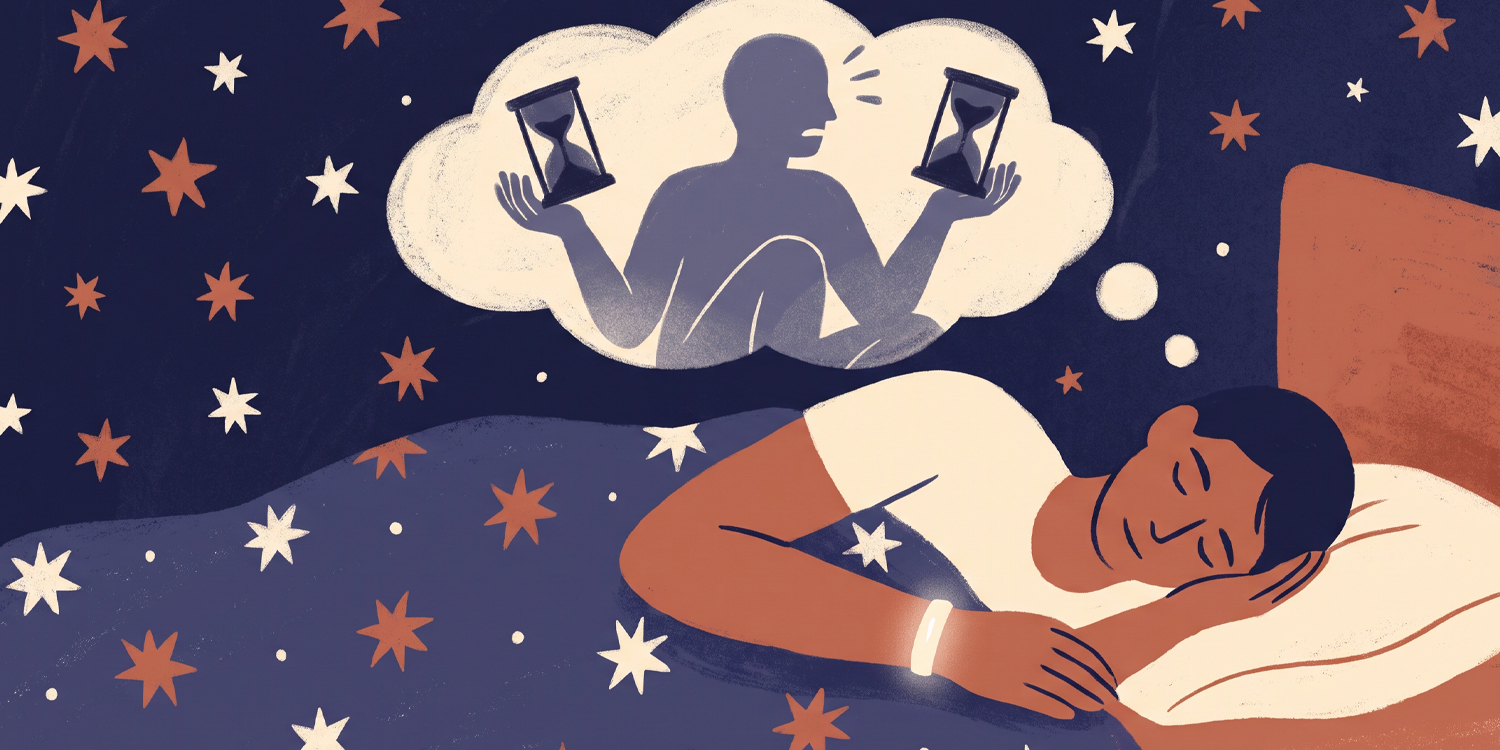
There’s a particular kind of guesswork that kicks in whenever someone asks how many hours you usually sleep. You don’t pull out a spreadsheet — you go by feel, running a quick mental tally of late nights, groggy mornings, and every stretch you remember staring at the ceiling.
For people who naturally lean toward worry, that mental tally often comes up short. It feels obvious enough: a busy, uneasy mind ought to steal hours from your night.
Yet how much sleep you feel like you’re getting and what a wrist-worn tracker logs don’t always line up. And the gap between the two may have less to do with a stressful week than with a steadier part of who you are.
When the numbers don’t match your memory
When you try to judge your own rest, you aren’t reading off an objective clock. You’re piecing together weeks of nights from memory — a process that can easily lean on how restful or restless those nights felt.
To see how personality relates to that estimate, researchers Derick M. DeCamp and Elizabeth J. Pantesco of Villanova University put self-reported sleep side by side with wearable data. Their study, published in Personality and Individual Differences, followed 134 undergraduate students without diagnosed sleep disorders who filled out questionnaires on personality, typical sleep, and symptoms of depression and anxiety while wearing a movement-tracking wrist device for five nights.
A clear split emerged around neuroticism, the personality trait tied to experiencing worry and negative emotions more easily. Students who scored higher on neuroticism consistently reported getting less sleep. The shift was modest — roughly 15 to 20 fewer minutes for every one-point bump on a five-point scale.
The wrist monitors, though, didn’t back up that shortfall. Across the group, higher neuroticism wasn’t linked to shorter sleep duration as estimated by the wearable devices.
What makes that gap especially intriguing is what didn’t drive it. You might guess that a rough stretch of anxiety or low mood was skewing how students judged their nights, yet symptoms of depression and anxiety weren’t tied to either reported or tracked sleep on their own — and factoring them in didn’t weaken the neuroticism link.
Why a lasting trait may tilt the estimate
That pattern suggests something deeper than temporary distress may be at work. In their paper, DeCamp and Pantesco wrote that the results are “consistent with the possibility that neuroticism is more strongly related to how individuals perceive, recall, and report their sleep duration than to actigraphy-assessed sleep duration.”
Why would a lasting tendency toward worry pull someone’s sleep estimate downward? The researchers raised a few possibilities, though they didn’t test them directly. People higher in neuroticism might recall or interpret their nights more negatively, or worrying before bed might make drifting off feel like it takes longer than it actually does.
There’s also a flip side worth keeping in mind: a wrist monitor only infers sleep from movement. Someone who lies still while wide awake in bed could register as asleep on a wrist sensor, even when they know they haven’t drifted off.
For a closer look at how the researchers compared direct sleep estimates against bedtime-to-wake-time math — along with the exact hourly averages across all three measures and the full list of controls, from night-to-night regularity to other personality traits — PsyPost’s full coverage of the study breaks down the complete findings in detail.
What the gap can and can’t say
The study contributes to the scientific understanding of how personality relates to perceived versus device-tracked sleep. However, participants estimated their typical sleep over the past month while wearing the wrist monitors for just five nights, making direct comparisons harder, and the sample consisted of college students — mostly women — at a single private university, so the pattern may not look the same in other groups. Those caveats, along with how knowing you’re being monitored can shift your sleep, are unpacked further in the original in-depth report.
Still, the findings offer a quiet perspective shift the next time you tally up your hours and feel convinced you came up short. Your gut sense of a night’s sleep isn’t always a raw readout of the clock — it may also reflect the steady emotional lens you carry through the rest of the day.