

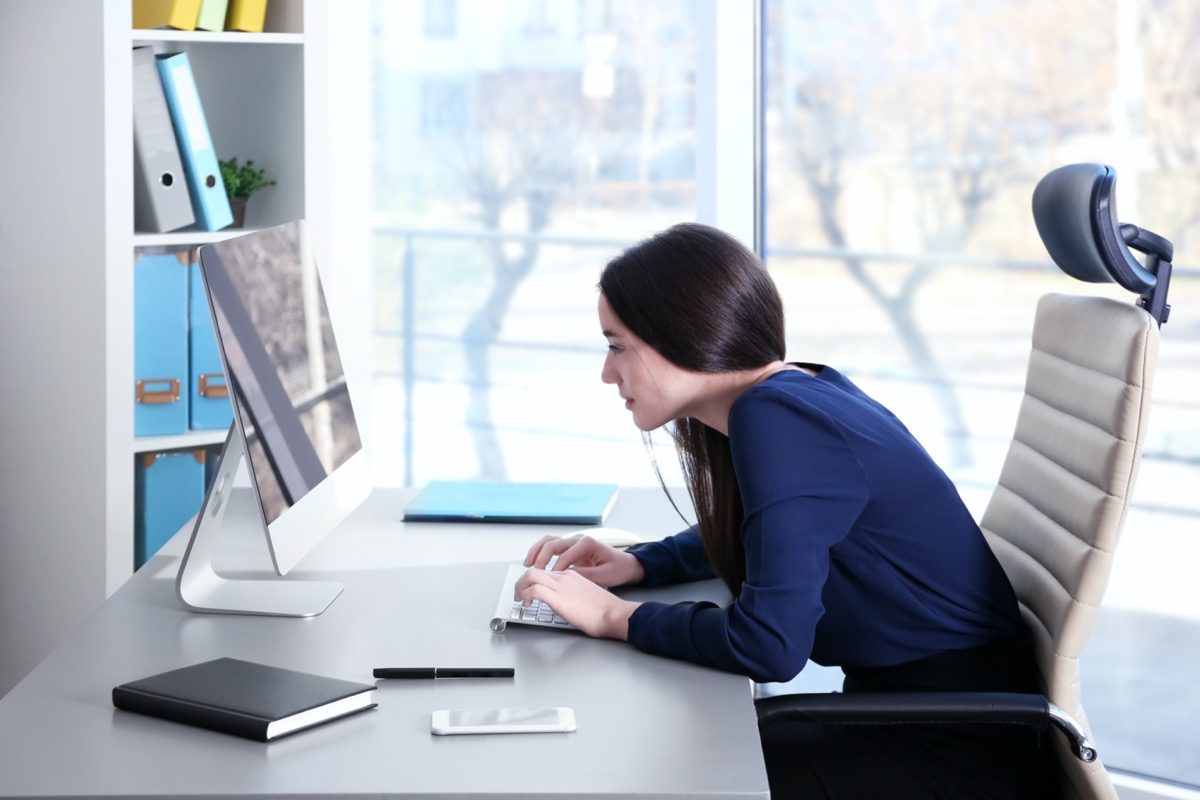
[[{“value”:”Years of sitting tend to show up in the same four places: tight hips, a stiff lower back, rounded shoulders, and glutes that have stopped doing their job. I’ve been a personal trainer for close to 40 years. For the last 25, I’ve been director of TRAINFITNESS, the UK’s provider of personal training courses. In that time I’ve worked with a lot of people over 60. Each of those four problems responds well to a few minutes of strength work aimed straight at it, and these five exercises do exactly that.
Half-Kneeling Hip Flexor Stretch with Overhead Reach
This opens the front of the hip that’s been held bent for years. The overhead reach takes the stretch further up, along the side of the body and into the muscles of the lower back, so you’re loosening the whole chain that sitting has shortened.
How to Do It:
Put a cushion on the floor next to a sturdy chair.
Kneel on your right knee on the cushion, left foot flat in front, both knees at about 90 degrees, holding the chair with your left hand.
Squeeze the right glute and tuck the tailbone under slightly until you feel a stretch at the front of the right hip.
Reach the right arm up overhead and lean very slightly to the left.
Hold for 30 seconds, breathing slowly.
Switch sides.
Use the chair to help you get down and back up.
Avoid These Mistakes:
Don’t lean forward or arch your lower back to chase a bigger stretch. Stay tall, keep the glute squeezed, and keep the movement small.
Sets and Reps: 2 holds of 30 seconds each side.
Form Tip: The stretch comes from the tuck, not from leaning.
RELATED: 5 Morning Exercises That Trim Belly Pooch Faster Than Pilates After 65
Couch Hip Thrust
This works your glutes harder than a floor bridge, because the hips move through a bigger range. Strong glutes take work off the lower back, and they make getting up from a chair easier.
How to Do It:
Sit on the floor with your back against the front edge of a couch that won’t slide, ideally one pushed against a wall.
Rest your shoulder blades on the seat edge, knees bent, feet flat on the floor and hip-width apart.
Squeeze your glutes and push your hips up until your body is level from shoulders to knees.
Hold for 2 seconds.
Lower slowly.
Avoid These Mistakes:
Don’t push your hips too high and arch your lower back. Stop when your hips are level with your knees and shoulders.
Don’t push through your toes. Push through your heels.
Sets and Reps: 2 to 3 sets of 10 to 12 reps.
Form Tip: If getting down to the floor is a problem, do a glute bridge lying on the bed instead.
Pallof Press
This trains the deep muscles around your middle to stop your body twisting, which steadies the lower back without any bending or strain on it. A strong, steady trunk takes load off a back that’s spent years slumped in a chair.
How to Do It:
Anchor a resistance band in a door at chest height, or loop it around a heavy, fixed object.
Make sure the door is closed and locked, or can’t open toward you.
Stand sideways to the door, feet hip-width apart, holding the band with both hands at the middle of your chest.
Step away until the band is taut.
Press your hands straight out in front of your chest, resisting the band pulling you around.
Hold for 3 seconds.
Bring your hands back to your chest.
Turn around and repeat facing the other way.
Avoid These Mistakes:
Don’t let your body twist toward the door. Keep your hips and shoulders facing straight ahead throughout.
Don’t stand so close that there’s no tension in the band. If it feels easy, step further out.
Sets and Reps: 2 sets of 8 to 10 reps each side.
Form Tip: Hold each press for a full 3 seconds before bringing your hands back.
RELATED: 5 Standing Exercises That Improve Balance Better Than Walking After 75
Suitcase Carry
Carrying a weight in one hand forces the muscles on the other side of your trunk and hips to work to keep you upright. That’s training for standing tall, which is the opposite of what a decade of sitting has taught your body to do.
How to Do It:
Pick up a heavy shopping bag or duffel bag in one hand, starting with 7 to 11 pounds, using a good squat to lift it.
Stand tall, shoulders level and drawn down, the other arm relaxed by your side.
Walk slowly and steadily for 30 to 45 seconds around the house or yard.
Put it down carefully.
Switch hands.
Avoid These Mistakes:
Don’t lean away from the weight.
Don’t let the shoulder holding the bag drop. If you can’t stay level, the bag is too heavy, so go lighter and build back up.
Sets and Reps: 3 rounds of 30 to 45 seconds each side.
Form Tip: Keep your shoulders level and drawn down the whole time.
Chair-Back Upper Back Extension
This mobilizes the upper back, which stiffens into a forward curve after years of leaning toward a desk or screen. A more mobile upper back lets the shoulders sit back where they should be, instead of rolling forward.
How to Do It:
Sit on a firm chair with a back that comes up to around the bottom of your shoulder blades.
Sit back so the chair back is in contact with the middle of your back.
Cross your arms over your chest, or put your hands lightly behind your head with the elbows forward.
Gently lean back over the chair back, lifting your chest toward the ceiling.
Hold for 3 seconds.
Return to upright.
Scoot forward slightly on the chair to move the stretch a little higher up the back.
Avoid These Mistakes:
Don’t tip your head back or arch your lower back instead of your upper back. Keep your chin slightly tucked and your butt firmly on the seat.
Sets and Reps: 8 to 10 reps.
Form Tip: The movement comes from the upper back.
RELATED: 5 Exercises That Keep You Independent Longer Than Walking After 70
What Years of Sitting Do
The four problems I see most, tight hips, a stiff lower back, rounded shoulders, and weak glutes, come as a package. The hip flexors at the front of the hip get shortened because they’re held bent for hours at a time, whether that’s at a desk, behind a steering wheel, or on the couch. The glutes get weak because they’re barely being asked to do anything. The lower back gets stiff and achy, partly because those tight hip flexors pull on it and partly because the weak glutes leave it doing extra work.
Up top, the upper back rounds forward and the shoulders roll in from years of leaning toward a screen or a steering wheel. Add a weaker trunk to all that, and you get the thing I hear constantly from clients: getting up from a chair or out of the car becomes slower and stiffer. Plenty of people describe it as having to unfold themselves when they stand.
One thing worth saying about safety: pain that spreads down a leg, any numbness or tingling, or back pain that’s worse at night needs a doctor or physical therapist before you start any of this. Discomfort from a stretch is fine; sharp pain isn’t.
Why This Beats Yoga
I’m not knocking yoga. It’s good for flexibility and plenty of people enjoy it, and enjoyment keeps people going. But the problem with years of sitting is that muscles become weak as well as tight, and stretching on its own doesn’t strengthen weak glutes or a weak trunk.
What targeted strength and mobility work does is pair the two up. You get a stretch for what’s tight and strength work for what’s weak, aimed straight at those four problem areas. It can also be made harder week by week, simply by adding a bit of weight or another set, so you keep progressing rather than plateauing.
And it’s done at home, mostly standing or seated, with only short periods on the floor using a chair or the couch for support. That matters for people whose hips and knees have been stiff for a decade.
RELATED: 4 Standing Exercises That Build a 6-Pack Without a Single Sit-Up After 65
How Often to Do This
Keep it simple. Do the strength moves, the couch hip thrust, the Pallof press, and the suitcase carry, three times a week on non-consecutive days. That’s about 15 minutes a session, which most people can find.
The two stretches, the half-kneeling hip flexor stretch and the chair-back upper back extension, are worth doing every day. They only take a few minutes, and the best time is right after the longest stretch of sitting in your day. If that’s after dinner in front of the TV, do them then, when you’re at your stiffest.
Alongside that, break up your sitting:
Stand up every 30 to 45 minutes. A few seconds standing tall with a squeeze of your glutes helps more than you’d think.
Keep walking, whether that’s to the store or just around the yard, because it adds the general activity these exercises don’t cover.
After two or three weeks, make things harder: a heavier bag for the suitcase carry, a stronger band for the Pallof press, or a third set of hip thrusts. Small jumps every two weeks are plenty.
What to Expect
In the first week or two, most people notice their hips feel looser and their lower back is less achy after sitting. Getting up from a chair stops being quite such an unfold. Those early changes come mostly from the stretches.
By four to six weeks, the glutes and trunk are noticeably stronger. People tell me they’re standing and walking taller, and that there’s less back ache at the end of the day. By eight to 12 weeks, the shoulders sit further back, and getting in and out of the car is easier.
These exercises ease the effects of years of sitting, but they can’t cancel all the health effects of a sedentary decade. Sitting less matters as much as anything you do in the 15 minutes of training. And all of it fades if you stop, so the routine needs to become something you just do, three strength sessions a week and a few minutes of stretching each day, for as long as you want to keep getting out of chairs under your own steam.
The post 5 Exercises That Undo 10 Years of Sitting Faster Than Yoga After 60 appeared first on Eat This Not That.”}]]