

The AI trade can look like a single bet on chipmakers, cloud platforms, and ever-larger data-center budgets. George Seay argues that the same build-out also creates a case for an asset class many growth investors have left behind: Natural gas producers.
Seay, who founded Annandale Capital over two decades ago and serves as the company’s Chairman, sat down with TheStreet’s Caroline Woods last week to explain how he’s betting on both AI spending beneficiaries and natural gas companies as we head into the fourth quarter.
Seay is pairing established AI companies with energy stocks in a barbell strategy, meaning a portfolio split between two different sources of potential return. His energy allocation is meant to protect capital while retaining upside, because he sees natural gas as both a necessary input for data centers and a commodity with additional export demand ahead.
Here is how Seay separates established AI exposure from a natural-gas hedge tied to data-center demand.
Note: The market musings expressed herein are those of the interviewed guest and should not be treated as professional investment advice. Readers should consult a certified financial planner (CFP) for individualized advice based on their available capital, goals, risk tolerance, and time horizon.
Why the AI data center boom matters to natural gas investors
Seay’s central argument begins with the physical demands of the AI build-out. Large data centers need reliable power, and he believes natural gas will remain a meaningful part of that supply for decades, even if cleaner energy eventually expands.
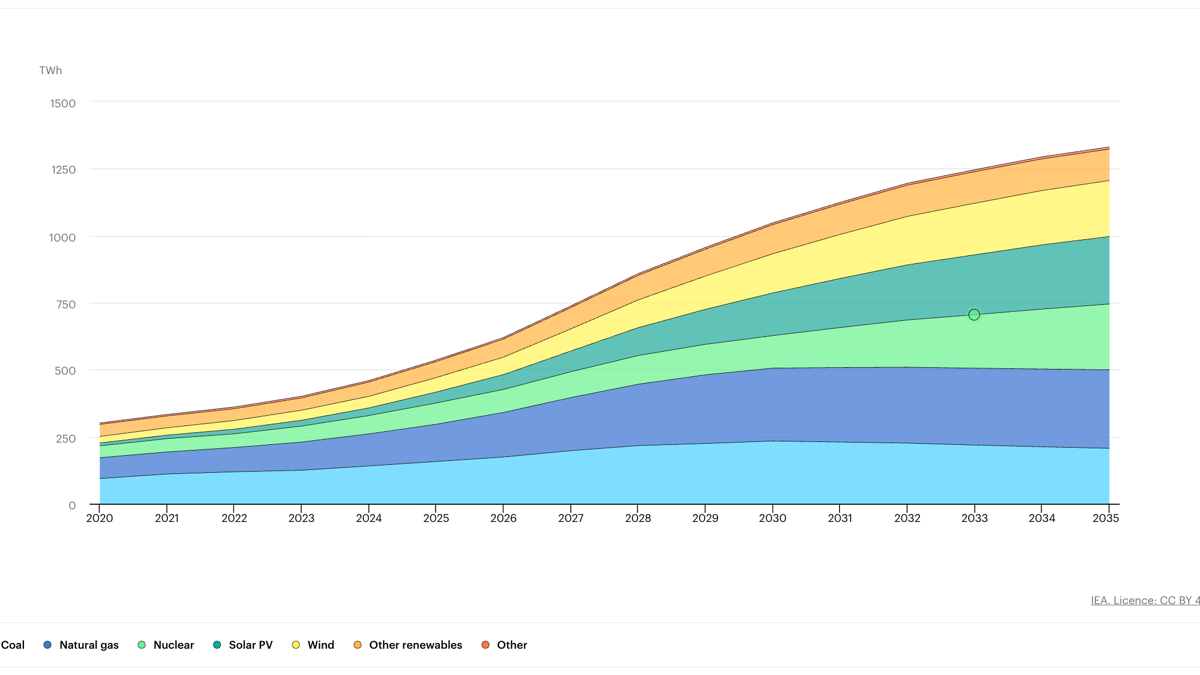
According to the International Energy Agency’s Energy Supply for AI report, he’s not wrong. “Natural gas is the third-largest source today, meeting 26% of the demand” for data centers globally, after coal and renewables.
Natural gas is the third-largest source of electricity for data centers worldwide, according to the IEA. IEA. Licence: CC BY 4.0
He also sees a second source of demand in LNG, or liquefied natural gas, which allows gas to be shipped overseas. Seay said roughly 8 billion cubic feet of future natural-gas demand has yet to come online and could arrive over the next two to three years as LNG infrastructure is completed.
Both. I think they fit both. I think they’re a good barbell to AI, and I think also that they’re a key beneficiary of all this AI build-out.
—George Seay, when asked whether energy is a way to benefit from the AI boom or protect against an AI sell-off
Seay’s point is counterintuitive because energy is often treated as separate from technology. In his view, an investor can own energy for its own valuation and shareholder-return case while also gaining exposure to the power requirements behind AI.
The trade-off is that the thesis relies on demand growth, export infrastructure, and commodity prices. Seay acknowledged that dry gas, meaning gas sold without valuable liquid byproducts, has been pressured by abundant supply.
Why established AI companies and energy serve different roles
The other side of Seay’s barbell is not a wager on every company linked to artificial intelligence. He is constructive on hyperscalers, the largest cloud-computing companies, because he believes investor anxiety over their AI spending has pushed some established names out of favor.
He specifically cited Google and Meta Platforms as companies he does not view as expensive, while also naming Nvidia, Microsoft, Oracle, and Micron Technology among his preferred AI-related holdings.
I’m actually very constructive on the hyperscalers right now. I think they’re tremendously out of favor, and the market’s rotated into other stuff because most stock pickers are scared about them.
—George Seay, when asked how weak guidance after strong big-tech earnings would affect his view
Seay’s distinction is between businesses with durable franchises and more speculative NeoCloud stocks, which he views as too uncertain for his clients. He said he would rather own companies he expects to exist in 10 years.
That does not mean price is irrelevant: Seay called Microsoft his one forever holding, but said it was no longer cheap after its recent run. He owns Apple Inc. but does not want to add to it, illustrating the difference between retaining a position and committing new money to stocks.
Why Antero Resources is a more specific energy bet
Within energy, Seay’s highest-conviction name is Antero Resources. His case rests on the company’s exposure to natural gas liquids, which are higher-value liquid products separated from gas production, rather than dry gas alone. He cited propane prices that had nearly doubled during the year and said Antero Resources’ liquids mix offers insulation from weak dry-gas pricing. He also praised its management and its assets in the Marcellus-Utica region.
Seay does not treat energy as a set-it-and-forget-it counterweight. He called the sector late in its cycle and said pipelines and downstream refinery stocks may be further along than his preferred producers.
He also laid out a condition that would change his positioning: If oil rose above $150 a barrel, he said he would probably reduce oil-and-gas exposure because he would view that level as a serious recession warning.
How to separate an AI investment from an energy hedge
Investors interested in Seay’s strategy must first decide whether they want long-term exposure to established AI leaders, a tactical energy position, or both. Seay advises investors to keep the two jobs separate. His approach assigns AI companies to the long-duration growth case and natural-gas producers to a mix of valuation, shareholder returns, and data-center demand.
Seay also recommends periodically revisiting the evidence behind each position. Watch corporate guidance and AI spending for the technology holdings. For energy, watch LNG infrastructure, natural-gas supply, liquids pricing, and whether oil prices rise enough to threaten the economy.
A barbell only works if each side still serves the role you gave it.
Sources
George Seay on Street Talk · watch the full segment
Cited segments:
Seay said energy can both benefit from the AI build-out and serve as a barbell to AI exposure. (9:40–10:33)
Seay said about 8 BCF of natural-gas demand could come online over the next two to three years as LNG infrastructure is completed. (13:03–14:02)
Seay said he is constructive on hyperscalers because they are out of favor amid concern about AI spending. (3:28–3:56)
Seay identified Antero Resources as his top energy-upside pick, citing management and exposure to natural gas liquids. (11:16–12:13)
Seay said he would probably reduce oil-and-gas exposure if oil rose above $150 a barrel. (14:53–15:17)
Some or all of this content may have been generated by AI. While we strive for accuracy, AI can occasionally produce incorrect information. If you buy something via one of our links, we may earn a commission.