

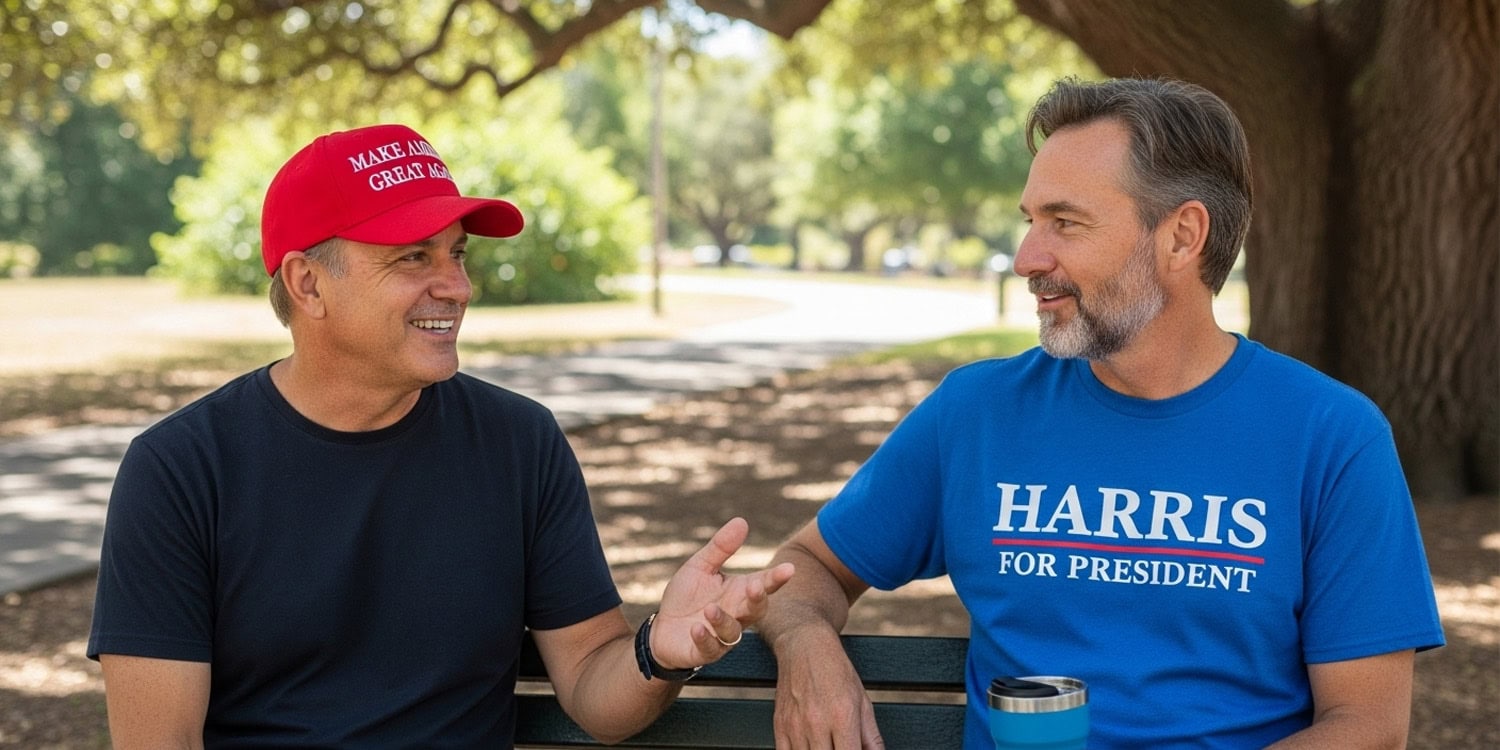
People tend to think that those who support opposing political parties are entirely unwilling to listen to different viewpoints, preventing them from even trying to engage in conversation. A new study reveals that political opponents are actually much more open-minded than people assume, and learning this fact makes individuals more willing to talk across party lines. The findings were published in the Journal of Experimental Social Psychology.
Political polarization is recognized as a major societal risk, contributing to social conflict, science skepticism, and the spread of misinformation. Finding ways to bridge this ideological divide often hinges on encouraging conversations between people who hold different viewpoints. Before two people can debate a specific issue, they must first decide that talking to each other is a worthwhile endeavor. Often, they decide it is not, opting instead to avoid political discussions entirely.
A research team, led by psychologist André Mata at the University of Lisbon along with colleagues from Linköping University, investigated the psychological barriers preventing inter-partisan dialogue. They suspected that a primary obstacle is how people perceive the receptiveness of others. If someone believes that a political opponent is completely closed off to new ideas, they will naturally avoid interacting with them. The researchers designed a series of studies to measure these perceptions and test whether changing them could increase people’s willingness to engage in political conversations.
In the first two studies, the researchers surveyed 198 participants in Portugal and 402 participants in Sweden. They asked the participants to rate their own willingness to listen to contrary opinions on a standardized psychological scale. The participants then answered the exact same questions from the perspective of someone who supports either their most liked political party or their least liked political party. Finally, the researchers asked participants to imagine what it would be like to discuss politics with those individuals and whether they would have any interest in doing so.
The survey results revealed a distinct pattern of social perception bias. Participants generally rated themselves as more receptive to different opinions than the average person. They also viewed supporters of their own political party as more open-minded than supporters of their least liked party. When the researchers compared the participants’ assumptions against the actual self-reported scores of people from those disliked parties, a wide gap emerged. People consistently underestimated how willing their political opponents were to listen to opposing views.
These negative assumptions had direct consequences for social interaction. The less receptive participants expected an opponent to be, the more they anticipated that a political conversation would be frustrating, stressful, and unpleasant. This pessimistic expectation correlated with a lower overall intention to talk with political opponents. The belief that the other side is rigid and unyielding served as a deterrent to even initiating a dialogue.
To see if changing these perceptions could directly alter a person’s willingness to converse, the researchers conducted an experiment with 600 Swedish participants. In this second study, participants read short descriptions of fictional characters who supported the participants’ least liked political party. The descriptions varied one specific detail: half the characters were described by their coworkers as being highly receptive to different values, while the other half were described as being completely unreceptive. Participants then rated their expectations and willingness to interact with these fictional opponents.
Manipulating the perceived open-mindedness of the political opponent changed the participants’ reactions. When the opponent was described as receptive to contrary opinions, participants reported more positive expectations about having a political conversation with them. They also expressed a greater willingness to engage in both political discussions and casual non-political interactions, such as talking about hobbies or buying vintage furniture from the person. The receptive opponents were even rated as being better colleagues and better union representatives.
A final study involving 120 Portuguese university students tested whether a simple intervention could correct misperceptions in real time. Participants were asked to guess how supporters of their least liked political party had answered the survey questions about open-mindedness. For half of the participants, the researchers provided immediate feedback after each question, showing them the actual average scores that those specific opponents had provided in the first study. The control group simply made their guesses without seeing the real data.
Seeing the real survey answers successfully adjusted the participants’ views. Those who received the factual feedback began to rate their political opponents as more receptive to different opinions than the control group did. Upgrading their opinion of the outgroup had a ripple effect, leading these participants to expect that political conversations would be less stressful and more informative. They also became more willing to have non-political conversations with people from the opposing party.
While these experiments demonstrate that viewing opponents as open-minded increases the desire to talk, the reverse dynamic might also play a role in everyday life. A person who already dislikes an opponent and wishes to avoid them might convince themselves that the opponent is closed-minded simply to justify their decision to walk away. The relationship between avoiding conversation and assuming the worst about others can run in both directions, making it difficult to untangle cause and effect outside of a controlled laboratory setting.
Readers should also note that political polarization varies greatly depending on the electoral system and culture of a specific country. These studies focused entirely on European nations with multi-party systems, and the psychological dynamics do not map perfectly onto the two-party system of the United States. For instance, the researchers found that right-leaning participants in these European samples sometimes expressed more optimism about outgroup members than left-leaning participants did. This pattern challenges some assumptions drawn from American political psychology, suggesting that interventions to reduce polarization must account for local political contexts.
The study, “People underestimate how receptive other people are to different political opinions,” was authored by André Mata, Towe Nilsson, Arvid Erlandsson, and Rosário Ferreira.