


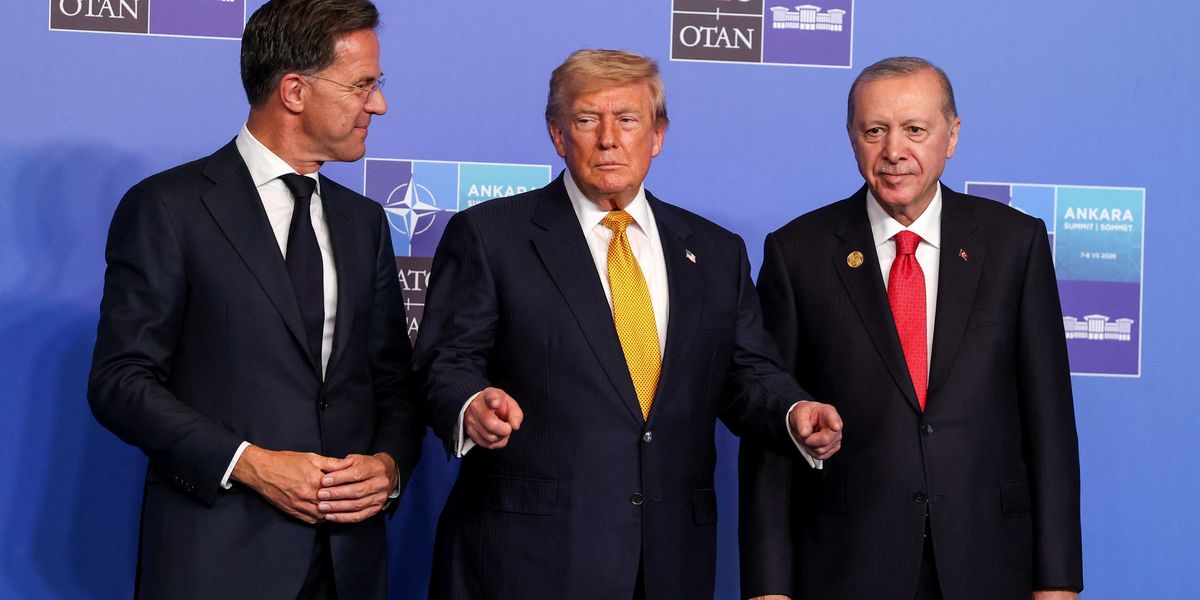
Only two hours after arriving in Ankara, Turkey on Tuesday for the 2026 NATO Summit, U.S. President Donald Trump offended European officials by reiterating his desire for Greenland to be “controlled by the United States, not by Denmark.” Trump is attending the event during a time of considerable tensions between the United States and European members of the North Atlantic Treaty Organization (NATO), which he has been highly critical of. But retired U.S. Army Lt. Gen. Mark Hertling, writing for the conservative website The Bulwark, argues that Trump has a fundamental misunderstanding of what NATO brings to the table.
“The leaders of each of the North Atlantic Treaty Organization’s members are in Ankara this week at one of the most consequential moments in the alliance’s history,” Hertling, a former U.S. Army Europe commander, explains in The Bulwark. “Russia’s war against Ukraine continues with no negotiated settlement in sight, and the lessons of that war are reshaping assumptions about readiness, industrial capacity, logistics, drones, electronic warfare, air defense, and ammunition consumption. NATO members are also confronting instability across the Middle East, growing competition in the Arctic, attacks on critical infrastructure, cyber threats, disinformation campaigns, China’s expanding influence, and uncertainty surrounding the future disposition of American forces in Europe.”
Hertling continues, “These are the issues that should dominate a summit of the world’s most successful political and military alliance. But instead, much of the attention in Ankara has focused on how European leaders will manage President Donald Trump, his animosity toward the alliance, and his continuing demands for greater defense spending.”
Herling isn’t against European NATO members spending more of their tax dollars on national defense, but Trump, he emphasizes, misses the mark badly when he describes NATO as a burden for the U.S.
“Defense spending is not unimportant, as many NATO members neglected their military capabilities for far too long after the end of the Cold War,” Herling argues. “But President Trump’s fixation on percentages — and on money generally — has distorted the discussion of what an alliance is, how NATO generates collective strength, and what the members must do together to address the increasingly complex security environment they face. The spending debate has become a canard, not because nations should spend less on defense, but because the suggestion that a single fiscal measurement can determine whether a country is a good ally, or whether NATO is becoming stronger, substitutes accounting for strategy…. Money matters, but what nations buy, what capabilities they develop, how ready their forces are, how quickly those forces can deploy, how long they can sustain combat operations, and how effectively they can operate alongside the forces of other nations matter far more.”