

With grocery prices remaining high, shoppers are constantly looking for ways to save without sacrificing the quality of products they trust.
Increasingly, this has begun to mean putting more store brands in carts.
U.S. private-label consumer packaged goods sales have reached $330 billion, accounting for 24% of unit sales and 23% of dollar sales, according to Circana.
In food and beverages, private-label products now account for roughly 24% of sales value.
The shift accelerated as high grocery prices pushed consumers to search for less expensive alternatives to national brands.
But new research suggests that price is no longer the only reason shoppers choose them.
Ninety-two percent of U.S. grocery shoppers now have private-brand products in their homes, according to FMI-The Food Industry Association.
Nearly half said they increased their private-label purchases over the past year.
More strikingly, 94% said they would continue buying store brands even if grocery prices declined.
This suggests that some of the shopping habits consumers developed during the inflation surge may be sticking around.
And major retailers like Walmart, Kroger, Costco, and Aldi are investing heavily to make sure they do.
Store brands are more than a cheaper option
Private-label products once carried a fairly simple proposition: a similar product at a lower price.
But retailers are increasingly trying to move beyond that.
Circana research shows private-label growth has expanded into premium, wellness-focused, sustainable, and indulgent products.
Here’s some of my coverage of how grocery retailers are changing to win value-conscious shoppers:
Aldi: The discount grocer is rapidly expanding across the U.S. as shoppers increasingly seek lower prices and store-exclusive products.
Kroger: Kroger is adding exclusive products and new private-brand offerings as competition from Walmart, Amazon, and discount grocers intensifies.
Grocery prices: Elevated food costs continue to pressure household budgets, pushing shoppers toward cheaper brands, promotions and value-focused retailers.
Meanwhile, consumers are increasingly viewing store brands as comparable in quality to national brands.
FMI found a similar shift.
Thirty-nine percent of shoppers who increased their private-brand purchases cited quality, up from 30% in 2023, while 37% cited taste, up from 26%.
Private labels are also influencing where consumers choose to shop.
56% of consumers said their primary retailer’s store-brand selection is very or extremely important when deciding where to shop, according to FMI.
That gives retailers another reason to invest in products shoppers cannot simply find at a competing supermarket.
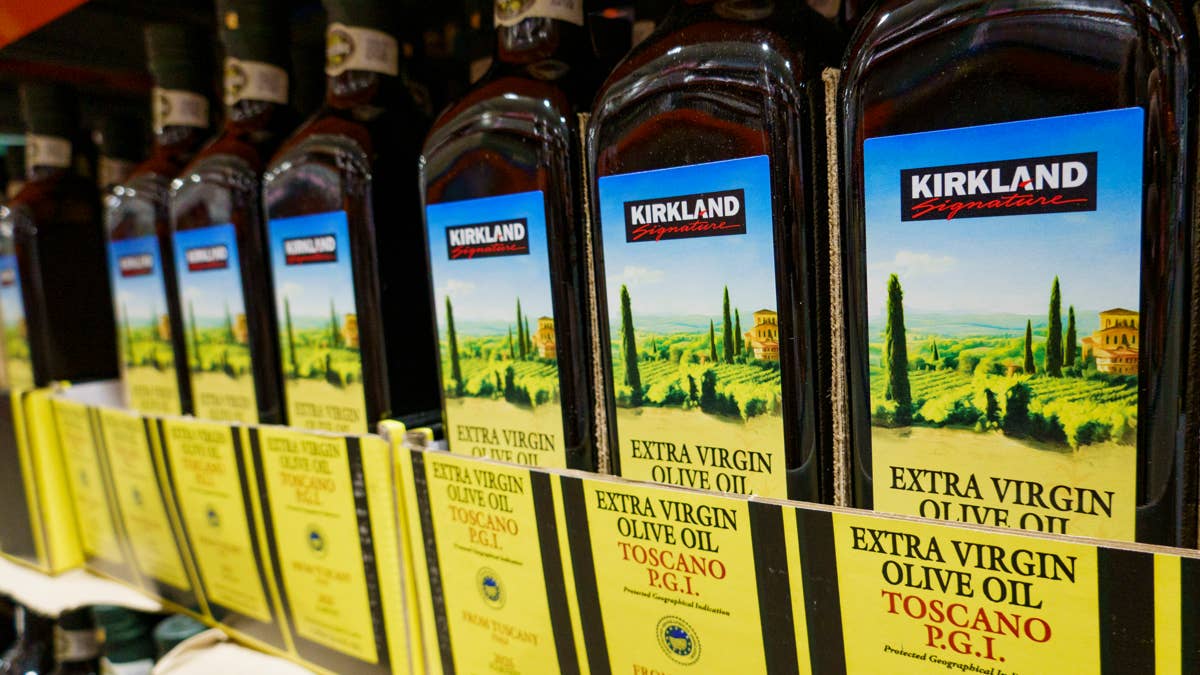
Costco’s Kirkland Signature is the biggest example of private labels’ success.Kevin Carter / Getty Images
Walmart makes bigger push behind Great Value
Few retailers have more at stake in private label than Walmart.
Great Value is Walmart’s largest private brand and, according to the retailer, the largest food and consumables CPG brand in the U.S.
The company says Great Value products are found in nine out of 10 U.S. households.
Earlier in April, Walmart announced the first complete redesign of the brand in more than a decade, covering nearly 10,000 food and consumables products.
Walmart says an average family can save about 35% annually by choosing Great Value products instead of comparable national brands.
But the redesign is not just about price.
Walmart said the new packaging is intended to improve visibility and make products easier to find in stores and online.
This is another sign that retailers increasingly want private labels to compete like national brands rather than simply serve as generic substitutes.
Kroger’s brands growing faster than national brands
Kroger is seeing similar momentum.
During its latest quarter, the grocer said its own-brand sales grew faster than national-brand sales, while sales of its premium Private Selection line increased by more than 14%.
The retailer has been expanding Private Selection, Simple Truth, and Smart Way into additional categories to give shoppers options across different price points.
Private Selection has also moved beyond basic substitutes for national brands.
Kroger has introduced premium and limited-time products, including ready-to-eat meals and seasonal offerings, as it tries to build demand for products shoppers can only buy through its stores.
The strategy reflects a broader shift across the grocery industry.
Retailers increasingly want shoppers to view their private labels as brands in their own right.
Aldi shows how far private-label model can go
Aldi provides one of the direct examples of a grocery business built around that strategy.
More than 90% of the products Aldi sells are exclusive brands, according to the company.
That is far above the private-label penetration of most conventional supermarket chains.
It has allowed Aldi to maintain tight control over its assortment and pricing, something it says sets the retailer apart.
The discounter has also been refreshing its packaging and placing the Aldi name more prominently across many of its store-brand products.
For Aldi, private label is not simply another section of the grocery aisle, but a core part of how the retailer operates.
Costco helped prove model works
Costco’s Kirkland Signature remains one of the biggest examples of how powerful this model can become.
Kirkland products are exclusive to Costco and span food, household goods, apparel, and other categories.
The brand has become a major part of Costco’s value proposition because shoppers cannot buy the same products at Walmart, Kroger, or any other supermarket.
This exclusivity gives private labels an advantage that national brands cannot provide.
A shopper who develops a preference for a particular Kirkland product has to return to Costco to buy it.
Circana said club retailers are now responsible for nearly half of all private-label growth, underscoring how important store brands have become for warehouse chains.
Will shoppers go back to national brands?
High grocery prices helped accelerate private-label adoption.
But the bigger question for retailers is whether consumers will return to national brands if food inflation cools.
So far, the data suggest many will not.
FMI found that nearly all shoppers expect to continue purchasing private brands even if grocery prices decline.
Younger consumers appear particularly receptive.
60% of Gen Z shoppers and 61% of millennials said a retailer’s private-brand assortment is very or extremely important when deciding where to shop.
Inflation may have pushed consumers to experiment with less expensive alternatives.
But quality, taste, and familiarity may be helping keep those products in their carts.
National brands, however, are not disappearing from grocery shelves anytime soon.
Large consumer brands still generate substantially higher total sales and maintain strong loyalty across many categories.
But private labels now account for nearly one-quarter of U.S. CPG unit sales, giving retailers a much larger share of shoppers’ baskets than they once had.
And unlike national brands that can be sold across competing chains, Great Value, Private Selection, Kirkland, and Aldi’s exclusive brands keep customers tied to a specific retailer.
As shoppers continue watching grocery bills closely, retailers have little incentive to slow their private-label push.
What began largely as a way for consumers to save money is increasingly becoming one of the biggest battlegrounds in grocery retail.
Related: Americans are eating out less, but one restaurant chain is surging