

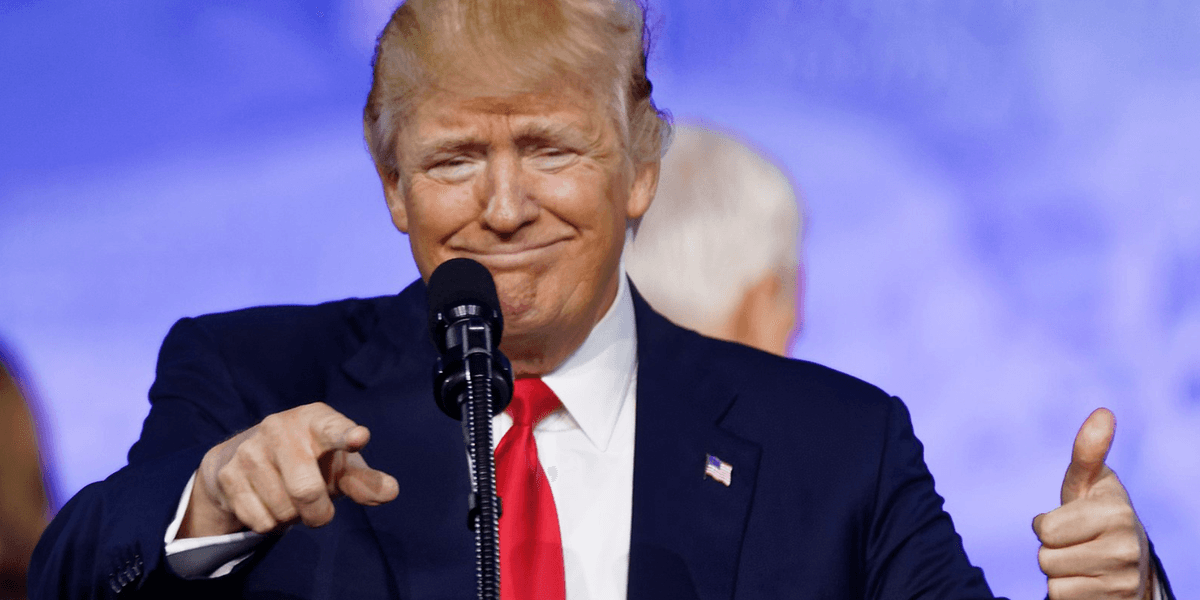
A 50-year-old argument put forward by an Italian historian held that “stupid people” in large numbers were a powerful force that could crash societies, and now, per a new piece for The New Republic, President Donald Trump has proven that argument right and become the embodiment of its ideas.
Writing for the outlet on Wednesday, writer and editor Ross Rosenfield highlighted the treatise of “prolific intellectual” Carlo Cipolla, who argued that stupid people as a demographic within society are “much more powerful than the mafia, or the military industrial complex.”
“Today, as we witness one of the dumbest wars in history unraveling in Iran, an inept health and human services secretary working to bring back measles and polio, a Republican Party wherein only 20 percent view the January 6 attack on the U.S. Capitol as a violent insurrection but 71 percent deny Joe Biden won the 2020 election, and an administration that refuses to properly regulate AI and crypto industries that threaten the economic well-being and safety of all,” Rosenfield wrote, “Cipolla’s contention is as apt now as when he first proposed it in The Basic Laws of Human Stupidity, in 1976—an era when the country, and indeed the world, was similarly roiled by sociopolitical rage and seemed on the brink of a catastrophe.”
He added later: “Cipolla divided people into four groups: the helpless, whose actions harm themselves but benefit others; the intelligent, whose actions benefit themselves and others; the bandits, who enrich themselves while harming others; and the stupid, whose actions harm others while producing no benefit to themselves.”
“No matter how high are one’s estimates of human stupidity,” Cipolla argued in his treatise, “one is repeatedly and recurrently startled by the fact that a) people whom one had once judged rational and intelligent turn out to be unashamedly stupid; b) day after day, with unceasing monotony, one is harassed in one’s activities by stupid individuals who appear suddenly and unexpectedly in the most inconvenient places and at the most improbable moments.”
Breaking down the historian’s arguments further, Rosenfield explained that the “real danger” posed by stupid people, as the world is getting a harsh taste of now, comes when they attain power. In such situations, “the stupid will have at their disposal means of destruction created by the intelligent—armies, weapons systems, monetary levers, media influence—and will oversee industries often controlled or influenced by bandits, weakening the institutions designed to monitor them.”
Cipolla contended, with those ideas in mind, that it is the responsibility of the intelligent to keep the stupid in check. Should they fail, Rosenfield wrote, “societies head downhill fast.”
“It may be too soon to know whether we’re on that course in the U.S.,” he concluded. “We may not know until it’s far too late. But it’s alarming enough that Cipolla’s somewhat tongue-in-cheek theory from a half-century ago seems perfectly apt to the state of America today.”