

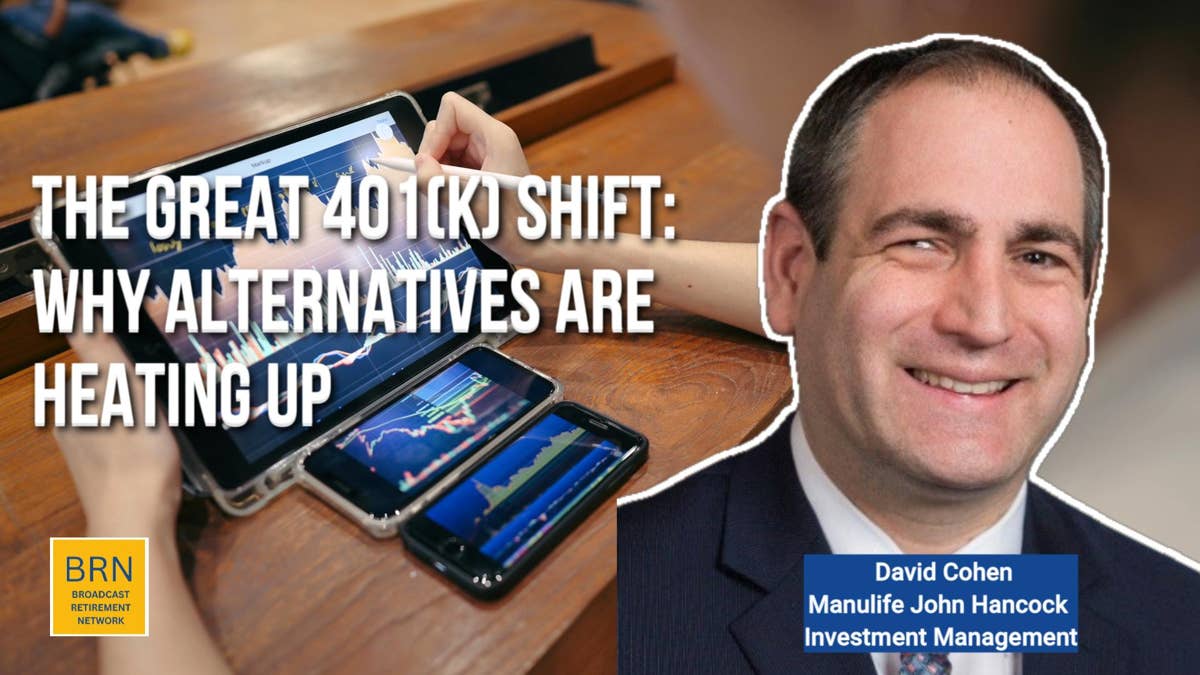
In this conversation with David Cohen—Head of US Retirement Investment Product, Portfolio Manager, and Global Head of Stable Value & Guaranteed Product at Manulife John Hancock Investment Management—we explore the rising role of alternative investments and private markets in 401(k) and retirement plans, a topic that’s quickly gone from niche to mainstream.
Transcript:
Jeffrey Snyder, Broadcast Retirement Network
David Cohen joins me this morning from Manulife, John Hancock Investment Management.
David, it’s always great to see you. Thanks for popping by the program this morning.
David Cohen, Head of US Retirement Investment Product, Portfolio Manager, and Global Head of Stable Value & Guaranteed Product, Manulife John Hancock Investment Management
Thanks for the time today, Jeffrey. Looking forward to having this discussion.
Jeffrey Snyder, Broadcast Retirement Network
Yeah, and I gotta tell you, I like your background. I like that atrium. It’s very, very chill, very relaxed.
Maybe I should have an atrium in my background too. We’ll be thinking about that over the course as we continue to build out the network. But in all seriousness, we’re gonna be talking about alternative investments this morning.
There’s a lot that I wanna break down with you. And I thought it’d be kind of interesting if we do a temperature check, because you are out in the field with your peers, talking to consultants, plant sponsors, maybe even participants. So let’s just start with a temperature check.
Our plant sponsors, are fiduciaries expressing more interest in alternatives in their 401k, 403b, or governmental 457 plan?
David Cohen, Head of US Retirement Investment Product, Portfolio Manager, and Global Head of Stable Value & Guaranteed Product, Manulife John Hancock Investment Management
Yeah, no, great question and a great place to start. From our perspective and what we’ve had with our discussions with all of our various clients, whether it’s plant sponsors, consultants, aggregators, or financial advisors, and in some degree, some participants to your point earlier, I would say the temperature check is going from quiet to warm, to heated in certain spots. And I think that’s more of a reflection of really two forces at work.
Force number one is, is you can’t ignore what you’re seeing in the headlines. This is a hot topic, and it’s been even more of a hot topic and since the executive order came out this past year. And I think that’s really ramped up in terms of the dialogue about why alternatives or private markets alternatives to be specific can deliver additional diversification and deliver more growth and more income for our retirement savers.
And I think that’s why we’re all here, no matter where you’re coming from is, how do you solve for longevity risk? How do you solve for these questions that you’re not gonna outlive your savings? As we all know, people are retiring.
During COVID, people retired even faster than normal. And what you’re finding out is people now have to live off of all their hard work earnings for 10, 20, 30, 40 or longer years. It’s a great problem that we have to solve for.
And we believe private market alternatives can be one of the important tools to deliver on those outcomes.
Jeffrey Snyder, Broadcast Retirement Network
Very well said. Let me ask you, when you’re out with that temperature check and checking in with people, do the various constituencies, the sponsor, the participant, the consultant advisor, the attorney, do they see alternatives as a standalone in the investment lineup? Or are they envisioning it as part of a pooled vehicle, such as a managed account, a collective investment trust, or like a target date fund?
David Cohen, Head of US Retirement Investment Product, Portfolio Manager, and Global Head of Stable Value & Guaranteed Product, Manulife John Hancock Investment Management
No, I think there is some confusion around there. And why is there confusion first and foremost with your question is because, these types of private market strategies have been available on the Wealth Channel now for a little while, right? And so now you’re getting into wealth versus retirement.
And so in some ways I would say that, there is certainly, and in that channel, right, participants or individuals or high net worth individuals to be specific can choose it as a standalone option. However, that is not the case in the retirement industry. And I think going back to the executive order that I mentioned earlier, there’s specific language in there that really points to the fact that it really needs to be managed by a professionally managed solution, which to your point are products like target date solutions or managed accounts or advisor managed accounts.
And the importance of why that’s really important in the retirement space is not because there’s not a huge trust factor with participants that they can’t navigate these waters, but they are complex products. And the products, the complexity of their product really requires somebody who can look at their entire retirement journey and make decisions about liquidity and valuations and other kind of nuances with these private market solutions. Case in point, when you think about private markets, right, there are certain rules, rules when you can invest, rules when you can take out your money and how much.
And I think, you know, when you put it into a professionally managed solution, these fiduciaries who are overseeing these solutions can understand the liquidity needs of a plan sponsor and their participants. They can understand at times plans need to exit these strategies and needing to make sure that the products are, at least, and this is definitely an industry term, which is benefit responsive. When we mean benefit responsive, it simply just means that participants or plans can take out their money when they need to, not when the product tells you you have to.
So I think that’s the importance and kind of why the executive order spelled out, hey, if you’re gonna use private markets, yes, they may be complex. They may be even more expensive. However, they really need to be treated carefully and really a professional managed individual who understands those dynamics and more importantly, understands somebody’s retirement journey can really give that kind of oversight that will deliver, again, the best possible outcomes for these participants.
Jeffrey Snyder, Broadcast Retirement Network
One of the, I guess, one of the, you mentioned being in the news and one of the things in the news is a recent Supreme Court case. I don’t know the exact case name, but it has to do with the Intel retirement plan. And I’m wondering if the fact that this is being taken up by the Supreme Court, they’re just getting into the deliberations and the conversation and the question answering period.
So it’s kind of hard to take anything away from that. We don’t know what the ultimate outcome will be, but I’m just curious, as part of that temperature check, are you hearing anything? Is that shaping or reshaping any of the conversations that you and your peers are having out there?
David Cohen, Head of US Retirement Investment Product, Portfolio Manager, and Global Head of Stable Value & Guaranteed Product, Manulife John Hancock Investment Management
Well, so first of all, the case is Intel versus Anderson. So- Thank you for that clarification. I’m not the attorney, but I play one on TV.
Yeah, me neither. And that’s why you have to be careful about what we can and can’t share here. Because again, to your point, there’s a lot that’s in discoverable mode, but at the heart of what they’re trying to get at, I think is critical in terms of this discussion that we’re having.
And I just want to draw a focus here because at the end of the day, that case is about benchmarking and whether there’s an approved benchmarking so that participants truly understand what they’re getting into and whether it’s going to deliver on whatever those performance objectives are. So, do we have a proper benchmark to compare against? And I think for us and many like John Hancock, in terms of how we’re thinking about these products within the retirement space is, education and having the tools that planned fiduciaries need to make fiduciary decisions around utilizing these types of solutions is certainly a critical path in keeping an eye on what’s happening with this case.
Because essentially, if we can’t create the right tools or the industry can’t create the right tools to be able to do, well, really two things. One, what is this strategy supposed to accomplish and what are we benchmarking that performance against? And candidly, is there good transparency into that?
That’s part of it. But two, for an intermediary or a planned fiduciary or a consultant, when they’re recommending these solutions, right? Are we providing them enough tools and databases so they can do an apples to apples comparison, hopefully, and also net of fees to really understand whether it’s really, truly a prudent decision for the fiduciary to make on behalf of those participants.
So, really exciting times. The fact that it’s in the Supreme Court just adds to the importance of it. It was a split decision in the lower courts.
And I do think that in a lot of ways, these types of things are critically important. We’re in a tough environment right now, right? The environment has been for the last several years, very litigious, candidly in the DC space.
And I think cases like this or private letter rulings and other kind of key roadmaps here will really help shape what our industry really needs to do to really support this, really with a mindset of what’s best ultimately for the client here. And I think that’s why this case is really important. Obviously, we’re all waiting to see the outcome, but more importantly, it shines a light on the importance of education, tools and transparency for these types of solutions.
Jeffrey Snyder, Broadcast Retirement Network
Yeah, and we’re gonna talk about education kind of a little bit further down the line. You bring up, but I do wanna talk about, you talked about benchmarks and the case. How do you perform, or for the fiduciaries, the plan sponsors and their proxies, the investment consultants, how do you perform the right due diligence to make sure that A, you understand the product, and also determining whether or not it is appropriate for your retirement plan?
David Cohen, Head of US Retirement Investment Product, Portfolio Manager, and Global Head of Stable Value & Guaranteed Product, Manulife John Hancock Investment Management
It’s a great question. And I would say that there’s still quite a bit of discussion about that, but I think at the core of it, you shouldn’t do things differently just because they’re private markets, right? So a lot of these key firms, and in case we’re also fiduciary, so we follow these processes as well, but understanding people, process, philosophy is gonna be critically important when you’re evaluating these strategies and obviously performance.
What’s unique, I think, about private markets is what’s different about private markets, whether it’s private equity or private credit or private real estate or private infrastructure is what additional data points are really required and understood to kind of add to your already existing process. Because one thing I’d say about our industry, we have a really great process typically on how we evaluate things. What’s net new to a certain degree is for firms that traditionally have not used private markets.
And these are firms that technically have not probably overseen defined benefit plans because historically speaking, defined benefits have actually had at least private real estate in them over the years. But how do you democratize this in a way where they’re following their due diligence process because you don’t wanna change things just because of the asset class, but what are the additional questions that should be asked? And I would think about four or five kind of key questions.
And a lot of them are more, are either operational or fee-based. So from an operational perspective, how does validation work? Is it daily priced?
Is it monthly priced? Is it quarterly priced? Three, how do, as I mentioned earlier, the deposit and redemption schedules work?
Are the solutions closed products? Are they semi-liquid? Are they evergreen?
And when we say evergreen, we’re meaning they’re fully liquid. And so I think there’s some new questions, if you’ve never asked this, that are gonna be kind of embedded into the process. And I would also say, asking questions about, okay, well, if I’m investing in your solution, what is your growth potential for the strategy that I’m investing in?
Because as I mentioned earlier, size and scales matter. A lot of these products may have a rule in place that says, hey, you’re only allowed to redeem out from the entire fund for all the clients that are in these products. How much am I allowed to take out per quarter?
And for a lot of products, it’s about 5%. Well, 5% on a $60 billion solution is far more appetizing. Then if it’s a brand new solution and 5% is not something, and then you’re getting into concerns, right, from a fiduciary perspective that if a plan decides to move their money out or if participant flows are so heavy, the worst thing we could possibly do is say, no, you have to wait three months, six months or nine months for that money to come out of the strategy.
So I think some of those questions are gonna be operational in nature. The other side of it is generally around fees, right? And again, just to be clear about fees, right, we’ve certainly been in an industry, as we all know, where fees have compressed.
They’ve come down quite a bit over the years. I would hate to say it’s a race to zero, but at the same time, you’re getting strategies that maybe 10 years ago are 10, 15 or 20% cheaper, right, than the way they were 10 years ago. Unfortunately, investing in privates are more expensive.
And I think understanding the value you’re getting for that cost point is important. And that’s also should be part of the fiduciary. And what I would say is this is just to kind of keep it a little more high level here is, remember when somebody is originating a private deal within any of these asset classes, they’re doing valuation, they’re doing underwriting, they’re doing a ton of analysis, they’re pricing it.
If it’s in a public markets, those things are already done for you in a lot of ways. So you’re really paying for quite a bit of extra work to even decide to invest or to originate those kinds of private deals. And from my perspective, these should always be evaluated net of fees, right?
And then you should compare it apples to apples from a net of fee perspective. But the other question is, what kind of fees make up these products? It’s not like a public market fund where there’s typically an investment management fee and an operational fee, right?
With these products, you do have a management fee, you have an operational fee, but you may have performance fees. You might have interest expense fees, you might have leverage fees. And so disclosure around the fees of these and how they can sometimes be variable should always be a key question that I would say an advisor, an intermediary should ask.
I think the industry as a whole is gonna try to find ways to mitigate some of those complexities. I think there’s a few products out there where you don’t have to worry about performance fees. However, I think those are gonna be very key questions that we have to ask along this process here.
Jeffrey Snyder, Broadcast Retirement Network
Well, we’re coming up towards the end of our time together, but that doesn’t mean we can’t bring you back for another session. Let me ask you about education because I do wanna kind of conclude on that. You mentioned maybe, I know you, I thought I heard you say that, maybe if you’re an advisor or consultant and haven’t worked in the DB space, you may not have familiarity.
So is there a sense that there’s needed education for these fiduciaries to get up, quote unquote, I’m not saying they’re not sophisticated, but they get up to speed to be able to do the benchmarking and the due diligence, right? So is that something that you think that would need to be done and is something the industry is looking at?
David Cohen, Head of US Retirement Investment Product, Portfolio Manager, and Global Head of Stable Value & Guaranteed Product, Manulife John Hancock Investment Management
Yeah, I would say, absolutely. That’s our number one priority from an industry perspective and at the core of what we’re trying to do at Manulife, John Hancock, we’ve actually stood up, I would say an introductory website that would help, again, just getting everybody candidly on the same baseline on what these products are and what they can deliver. And really, and we’ve talked about a lot, you’ve asked some really great questions about myths, facts or fiction about these.
And we’ve really tried to, at least personally, we’ve tried to, as a company, try to understand those dynamics and get it down on paper. And I think the entire industry is really trying to do that. Now, the education has to be different for different audiences, right?
That’s right. So we have to make sure that things are appropriate, they’re consumable, and to your point, people are coming at this from very different angles. And so I think it’s really critical to really get a strong baseline.
And then depending on how deep you wanna go, there’s enough tools and education tools out there. And I would just say this, and I really do mean it, I would say the industry has really come together really nicely to agree on these topics and agree to these standards. And so, looking at ourselves and a lot of our peers in the industries, we’re all trying to deliver similar information out there.
But to your point before, what would be important for a participant to understand, right, versus a planned fiduciary, versus an advisor, versus, well, consultant, advisor, aggregator, I’d say are all one pocket. Even within those groups, a lot of them do have very different ends in terms of how they understand these products. And so for me, I think it’s really important that everything should start with education.
And I think in terms of the commercialization of these products, it will only go as far as how well we educate.
Jeffrey Snyder, Broadcast Retirement Network
Yeah, I tend to agree with you. I think everything kind of starts there, whether you’re trying to figure out the best way to use a retirement plan, or whether or not you’re trying to use a certain investment product or set of products. Well, David, it was a great conversation.
Really appreciate you joining us this morning. And look, extend the invitation to have you back on the program again very soon. Thanks so much.
David Cohen, Head of US Retirement Investment Product, Portfolio Manager, and Global Head of Stable Value & Guaranteed Product, Manulife John Hancock Investment Management
Appreciate your time today, Jeff. Take care now.