

When the market drops, many investors watch their portfolios shrink and feel a strong pull to sell everything before things get worse. DALBAR’s decades-long research into investor behavior identifies that instinct as the costliest impulse in personal investing today.
Scott Galloway, a clinical professor of marketing at New York University (NYU) Stern School of Business, admitted on September 28, 2026, that one emotional trade cost him dearly.
He estimated the decision erased roughly 40% of his liquid net worth in stocks, a loss driven by panic.
Two major research reports confirm his experience is not unique, and the performance gap between calm investors and reactive ones has grown to near-historic levels.
Also Read: Warren Buffett’s rules for investors starting with $10,000
Galloway’s panic sell cost him 40% of his stock wealth
The NYU professor detailed the episode on the “Office Hours” edition of his Prof G Pod, calling it his largest investing mistake. After the 2016 presidential election, he said fear about the country’s direction overwhelmed every rational signal in his portfolio.
“I sold all my stocks. That was stupid. The market ripped for the next year,” Galloway said.
The selloff would have triggered capital gains tax liability on realized gains, with state and city taxes in Galloway’s home state of New York adding to the cost.
Suze Orman, personal finance expert and host of the Women & Money podcast, has seen that pattern repeat across decades of advising investors and used her May 3, 2026, episode to confront it directly.
<strong>The biggest mistake you will ever make, and you probably are making it, or you have made it, is when, in fact, you stop investing,</strong>
Galloway’s experience proved Orman’s point. He returned to the market about six months later, but the S&P 500 posted a total return of 21.83% in 2017, DQYDJ reported, compounding his losses
He was paying taxes on realized gains while those same assets kept climbing to new highs without him in the position.
The combined toll of capital gains taxes on the way out and a sharply higher re-entry price six months later turned a single emotional decision into his most expensive investing mistake, Galloway said on the podcast.
Average equity investors trailed the S&P 500 by 848 basis points in 2024
Galloway’s story would be a one-off cautionary tale, except that industry data shows millions of investors repeat the same mistake each year.
DALBAR’s 2025 Quantitative Analysis of Investor Behavior (QAIB) report, which analyzes 2024 investor data, found the average equity fund investor earned 16.54% while the S&P 500 returned 25.02%.
That 848-basis-point gap ranks as the fourth-largest shortfall since the firm began tracking investor behavior in 1985, trailing only 1995, 1997, and 2021, Plan Adviser reported.
That streak now stretches 15 consecutive years, with 2009 the last time average investors outpaced the index.
More Scott Galloway:
Scott Galloway issues grim forecast for SpaceX stock
Scott Galloway, Morgan Housel Raise Red Flag on the American Dream
Scott Galloway fires scathing rebuke at $30M tax break
Galloway warned on his Podcast that timing market peaks is dangerous, noting that economies keep grinding forward regardless of which party holds power.
DALBAR attributed the gap to withdrawals in every quarter of 2024, with the largest outflows preceding a major equity rally. The firm has identified nine behavioral biases driving poorly timed trades, including loss aversion, herding, and media response.
The damage from those emotional exits grows clearer when measured in missed trading days.
JP Morgan data analyzed by Visual Capitalist found a hypothetical $10,000 S&P 500 investment grew to $64,844 from 2003 to 2022. Missing the 10 best trading days cut it to $29,708, while missing 40 left just $8,048.
Visual Capitalist reported that seven of the 10 best trading days occurred during bear markets. Many strong sessions followed the worst declines, placing sharp recoveries just after the steep drops that often trigger panic selling.
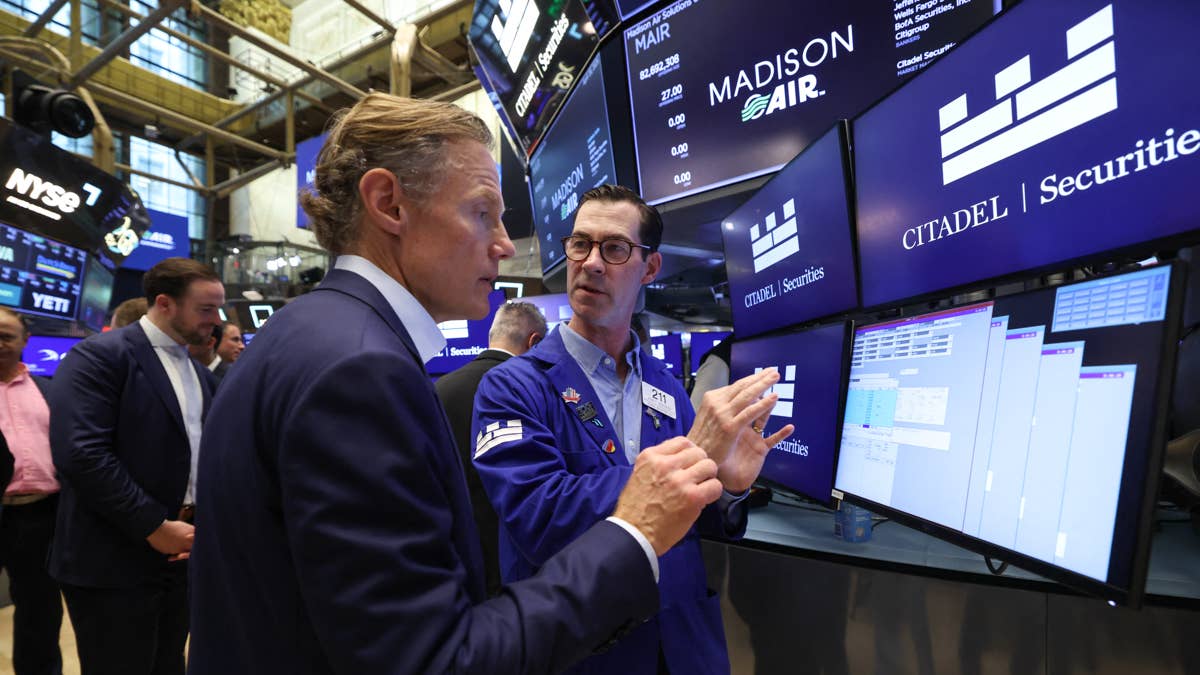
Average equity investors earned 16.54% in 2024, trailing the S&P 500 by 848 basis points as emotional decisions hurt returns.TIMOTHY A. CLARY / Getty Images
What Galloway’s mistake means for investing decisions
Galloway’s experience, DALBAR’s investor tracking, and JP Morgan’s market data reported by Visual Capitalist all reach the same conclusion: the costliest investing mistake is not a bad stock pick but an emotional exit.
Galloway said the experience reshaped how he thinks about market signals, noting that even compelling reasons to sell rarely justify the cost of exiting.
DALBAR’s 15-year streak shows the behavior gap is persistent, not a one-off tied to any single crisis. The firm attributed it to psychological traps, loss aversion, herding, and media response, that push investors to sell at the worst possible moments.
Charles Schwab reinforced that approach in a July 2026 article, recommending automated 401(k) or IRA contributions alongside an emergency fund covering three to six months of expenses, to reduce the pressure to sell holdings during a downturn.
Related: 5 money mistakes to avoid according to Scott Galloway