

[[{“value”:”Your core strength after 65 includes your abdominals and your whole central kinetic chain. Your back, glutes, and hamstrings keep you upright when you get out of a chair, when you carry groceries, or walk to your car. After 65, your endurance is incredibly important. I use the glute bridge with my clients over 65 to test overall core endurance along with the plank test. The ability to perform and hold a correct hip bridge will also reduce lower back fatigue, because you develop the ability to keep the glutes engaged. This will lead to less knee pain as you age.
The test below gives you a clear idea of your overall core strength after 65. Keep your form perfect so you can actually use your number to correlate with your actual core strength.
How to Properly Perform the Glute Bridge Hold
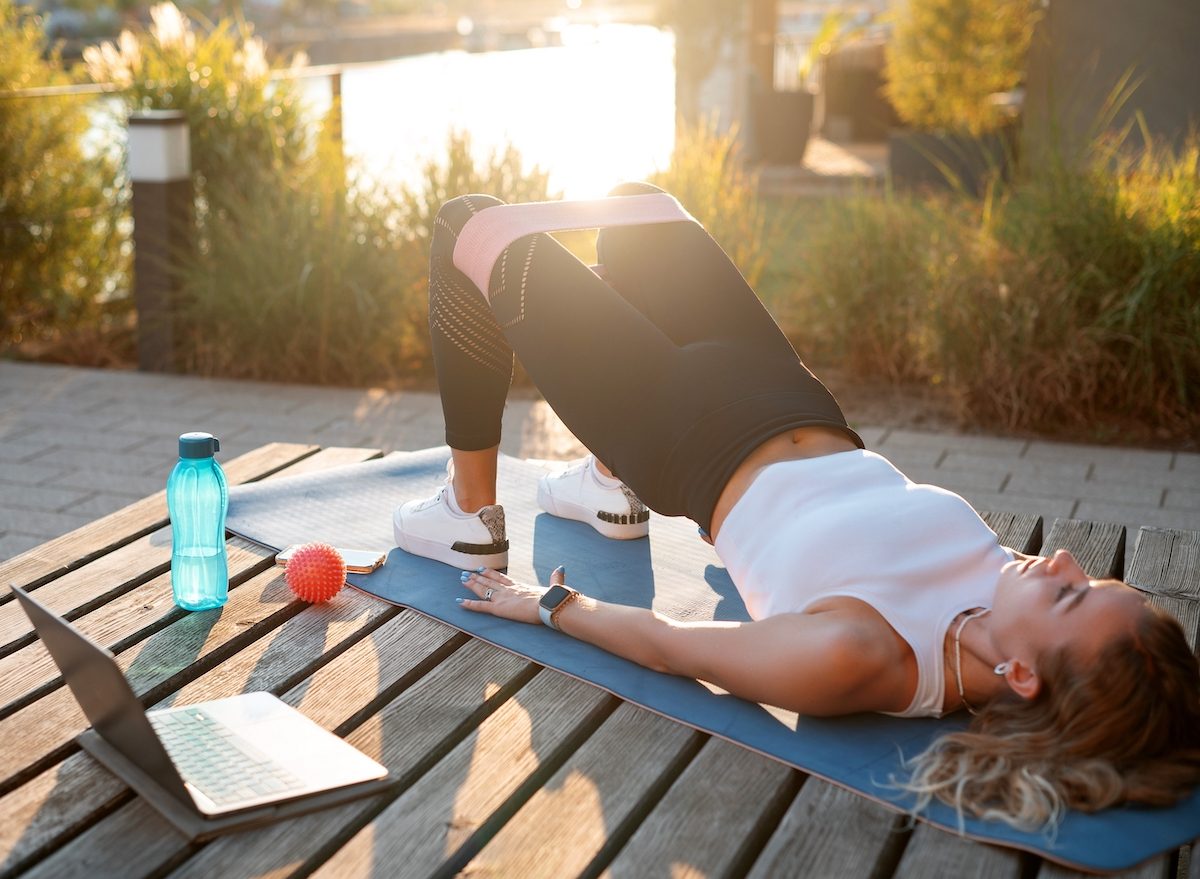
Start lying on your back on a mat. Bend your knees at a 90-degree angle, place your feet flat about hip-width apart, and slide your heels to roughly a hand’s length from your glutes. Place your arms at your sides, palms facing down. Place a folded towel under your head if needed for support
Start with a handful of easy bridges to warm your hips up first. Then, brace your abs, press through your heels, and squeeze your glutes as you raise your hips. At the top of the movement, there should be a straight line from your shoulders to your knees.
Breathe normally, keep your hips level, and keep engaging your core. Holding still is the entire challenge. Stop if your hips sag, one hip sinks below the other, your lower back starts taking over. Take one timed go after warming up. Stop immediately if anything feels sharp, numb, or tingly; get down to and up from the floor however feels safest for you.
What Your Time Means After 65
The below times represent my coaching benchmarks.
Under 20 seconds: Still building your base
20–45 seconds: Functional starting point
45–90 seconds: Solid core strength for daily living
90 seconds–2 minutes: Strong core strength
2 minutes or more: Elite core strength
If you can hold a bridge with excellent form for 2 minutes or more, you have some seriously strong glutes and abs. Anything beyond the 90-second mark represents a top-tier performance. If you’re lower than these times, don’t worry, that just means there’s room for improvement.
How to Improve Your Bridge Hold Quickly
Use short, repeated efforts rather than all-out attempts to improve your bridge time. I recommend a few short sets at 60-75% of your max time. For instance, if your best time is 40 total seconds. Start with 2 to 3 sets of 25-30 seconds with a minute or rest in between sets. Practice this movement three times per week and try to add a few seconds each week.
You can use the marching bridge to build the control it takes to keep your hips level. Press into your bridge, float one foot an inch or two off the floor, set it back down, and switch sides. Your hips will want to tip toward the floating leg. By resisting that you build control and strength. Aim for 6–10 slow marches per side.
The prone back extension targets the muscles along your spine directly, the ones tied to balance and mobility. Lie face down with arms at your sides and your forehead on the floor. Squeeze your glutes, and lift your chest a few inches off the ground while keeping your neck long and your gaze down. Hold 10–20 seconds, lower with control, and repeat three or four times. Keep the lift small. Correct body tension is more important than height.
As you build endurance, your bridge time increases and you should feel stronger in daily activities. Getting out of a low chair, moving bags in and out of the car, less back pain getting out of bed in the morning.
Retest your bridge time to view your progress every three to four weeks with the same setup. Each clean second you add will make everyday movement easier and increase your core stability.
The post If You Can Hold a Bridge This Long After 65, Your Core Strength Is Elite appeared first on Eat This Not That.”}]]