

[[{“value”:”A stronger core can change how your midsection feels. It helps you brace better, supports your spine, and gives the muscles under your belly more shape as they strengthen. After 60, keeping those muscles working is worth it, even if you don’t see changes in the mirror right away.
Flattening belly sag takes a little more than building stronger abs, though. Body fat plays a big role in how much definition you can see, and looser skin can affect how the area looks, too. Exercise can strengthen the muscle underneath and help improve body composition, but it can’t tighten excess skin on its own.
That’s where the rest of your routine comes in. Regular physical activity increases how much energy you burn, while your nutrition largely determines whether body fat starts to come down. Strength training also helps you hold onto muscle during that process, which is especially important as you get older.
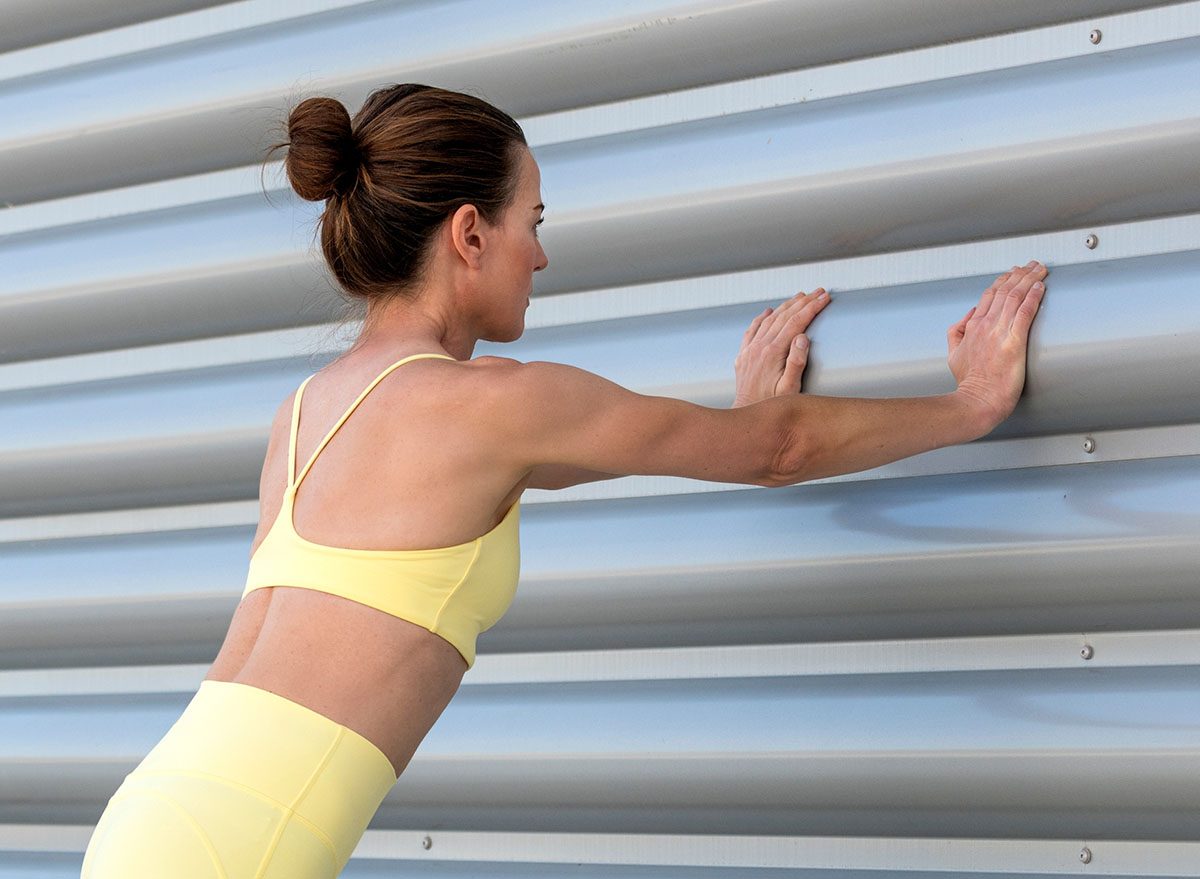
The wall makes this routine easy to scale while still giving your core plenty to do. You’ll hold strong positions, work from the side, and add faster movement once you’re ready for it. That gives you more variety than another round of sit-ups and makes it easier to keep the whole session moving.
Wall Plank
The wall plank gives you a simple way to practice bracing without starting on the floor. Your abs keep your body in one straight line as gravity pulls you toward the wall. Moving your feet farther back increases the challenge when the basic version starts feeling easy.
Muscles Trained: Abs, shoulders, chest.
How to Do It
Stand facing a wall.
Place your forearms against it around shoulder height.
Step your feet backward.
Brace your abs.
Keep your body straight from your head through your heels.
Hold the position while breathing normally.
Recommended Sets and Reps: Perform 2 to 3 holds of 20 to 40 seconds. Rest for 30 seconds.
Best Variations: Higher wall plank, feet-farther-back wall plank, wall plank shoulder taps.
Form Tip: Keep your body straight without letting your hips drift toward the wall.
Wall Side Plank
Turning sideways changes where the core has to work. The obliques along the sides of your midsection have to keep you from folding toward the wall, giving them a more direct challenge than a regular front plank. The upright position also makes the exercise easier to adjust than a side plank on the floor.
Muscles Trained: Obliques, abs, shoulders, glutes.
How to Do It
Stand sideways beside a wall.
Place your forearm against the wall with your elbow under your shoulder.
Step your feet a little farther away.
Lean into your forearm.
Brace your core and hold your body in a straight line.
Finish the hold, then switch sides.
Recommended Sets and Reps: Perform 2 to 3 holds of 15 to 30 seconds per side. Rest for 30 seconds.
Best Variations: Closer-foot wall side plank, longer hold, wall side plank with top-arm reach.
Form Tip: Keep your shoulders and hips stacked as you hold.
RELATED: 5 Exercises That Restore the Posture You Had at 40 After 65
Wall Mountain Climber
This is where the routine starts to pick up the pace. Driving the knees forward keeps the abs working while your breathing rate rises, which gives you more total activity than holding a plank alone. The wall angle keeps the movement manageable and controlled as you speed up.
Muscles Trained: Abs, hip flexors, shoulders, chest.
How to Do It
Face the wall and place both hands against it around shoulder height.
Step your feet backward.
Brace your abs.
Drive your right knee toward your chest.
Return your foot to the floor.
Switch sides and continue alternating.
Recommended Sets and Reps: Perform 2 to 4 rounds of 20 to 40 seconds. Rest for 30 seconds.
Best Variations: Slow wall mountain climber, faster wall mountain climber, higher-hand position.
Form Tip: Keep your torso steady as your knees move.
Wall Cross-Body March
Cross-body marching adds rotation control without turning the movement into a crunch. Reaching the knee toward the opposite side engages the obliques while the standing leg keeps working underneath you. Start at a steady pace, then speed up once the pattern feels natural.
Muscles Trained: Abs, obliques, hip flexors, glutes.
How to Do It
Stand facing a wall with your hands lightly against it.
Step back far enough to stand comfortably.
Lift your right knee toward your left side.
Bring your left hand slightly toward that knee.
Return to the starting position.
Switch sides and continue alternating.
Recommended Sets and Reps: Perform 2 to 4 rounds of 30 to 45 seconds. Rest for 30 seconds.
Best Variations: Slower cross-body march, faster cross-body march, cross-body march without wall support.
Form Tip: Stay tall and bring the knee up without folding forward.
RELATED: 4 Standing Exercises That Restore Calf Strength Faster Than Treadmills After 65
Build a Stronger, Leaner Midsection After 60
These exercises can strengthen your core, but your flatter-belly goal still depends on what happens outside the routine. Use the wall work as part of a broader plan that supports fat loss and helps you keep muscle.
Keep your daily activity up: Walking and other movement add to your total energy expenditure.
Pay attention to nutrition: A consistent calorie deficit may be needed if your goal is to reduce body fat.
Keep strength training in the week: Full-body resistance work helps maintain muscle while body fat comes down.
Progress the wall exercises: Move your feet farther away or extend the work intervals as you improve.
Prioritize protein: Adequate protein supports the muscle you’re trying to maintain.
Give the process time: Stronger abs can develop before they become more visible.
References
Rodríguez-Perea, Ángela et al. “Core training and performance: a systematic review with meta-analysis.” Biology of Sport vol. 40,4 (2023): 975-992. doi:10.5114/biolsport.2023.123319
Harris, M Brennan, and Chia-Hua Kuo. “Scientific Challenges on Theory of Fat Burning by Exercise.” Frontiers in Physiology vol. 12 685166. 6 Jul. 2021, doi:10.3389/fphys.2021.685166
The post 4 Wall Exercises That Flatten Belly Sag Faster Than Sit-Ups After 60 appeared first on Eat This Not That.”}]]