

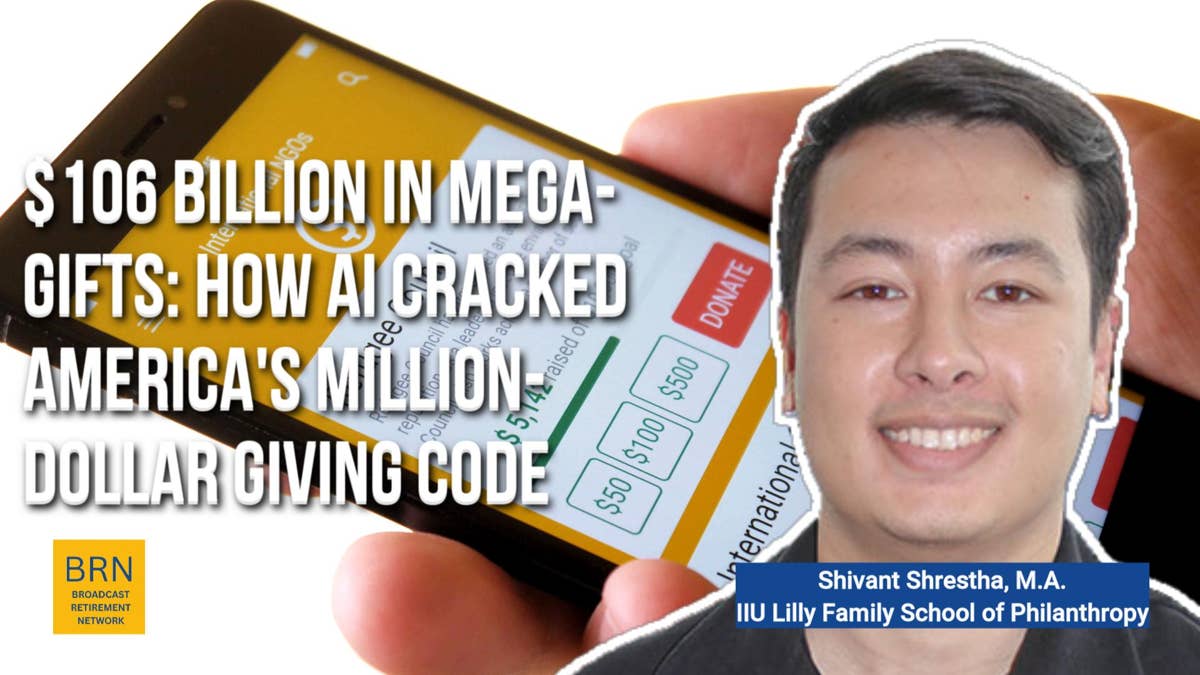
In this episode, we sit down with Shivant Shrestha of the Indiana University Lilly Family School of Philanthropy to explore the new AI-powered methodology behind the latest Million Dollar List.
Transcript:
Jeffrey Snyder, Broadcast Retirement Network
Well, Shivant, it’s great to see you.
Thanks for joining us on the program this morning.
Shivant Shrestha, MA, Indiana University Lilly Family School of Philanthropy
Thank you for having me.
Jeffrey Snyder, Broadcast Retirement Network
Really appreciate you coming on, and like I told you before in the green room, I’m always excited to talk about charity. I think charitable donations, and I think Americans are some of the most charitable people. We’re gonna talk in detail about the study, but before, and the work that you all did, but before we get into it, let’s talk about the School of Philanthropy and also the meat and potatoes about the research.
How did you perform it, and who sponsored it?
Shivant Shrestha, MA, Indiana University Lilly Family School of Philanthropy
So, the research project is called the MDL, or the Million Dollar List. It’s compiled by the Indiana University, Lilly Family School of Philanthropy, who are at work, and it documents publicly announced gifts of $1 million or more. So, while it’s not a comprehensive record of all million dollar plus gifts, it is the nation’s most complete dataset on donation level giving of $1 million or more.
This particular report was sponsored by the Gates Foundation, and we conducted this research with the help of a new AI-assisted methodology. So, artificial intelligence helped collect, scrape, and sort the data from publicly available sources online, media sources, articles, various other sources online.
Jeffrey Snyder, Broadcast Retirement Network
Yeah, so before we get into, I’m very curious about the artificial intelligence or super intelligence, depending on who you talk to. We don’t want to go down that road, but I’m interested, how did artificial intelligence help you and the team? Did it speed up the going through the data?
How was it meaningful in terms of the research you provided?
Shivant Shrestha, MA, Indiana University Lilly Family School of Philanthropy
Sure. So, before this phase of the research, this research covers 2021 to 2023. Back then, the million dollar list data was compiled from IRS Form 990s, media reports, and it was all researched by the school through humans.
So, historically, the data was collected through the researchers at the school, reviewed news articles, press releases, issued by donors and recipients, and other manually entered relevant information into the database. So, while this was still effective, this approach required significant time and human resources and was still not able to capture the full picture due to the limited scope of media coverage or just the time requirements on our researchers. So, starting with this new data, the data collection was modernized through the use of an AI-driven model.
So, it not only sped up the initial data collection process from these sources, the AI was able to broaden and expand the search for these sources, but it also helped track maybe other sources that humans could not have tracked because the internet has grown, there’s just so much information out there.
Jeffrey Snyder, Broadcast Retirement Network
Yeah, I mean, without getting into the details, I think it would actually make the information, the study probably more accurate. So, I applaud you for doing that. And of course, someone is doing the checking, right?
I mean, you don’t just do it and just take it for granted, you have to actually go through and validate and plug it into your own way of actually conducting the research. Let’s talk about some of the key takeaways here. I thought this was really interesting.
First of all, a million dollar donation, that’s pretty generous and it’s very sizable. About how many donations are we talking about here? I mean, the number of, what’s the number that we’re talking about here?
Is it in the tens of thousands, hundreds? What are we talking about?
Shivant Shrestha, MA, Indiana University Lilly Family School of Philanthropy
From 2021 to 2023, the million dollar list recorded 6,003 donations of a million dollars or above, which amounted to around a total of $109 billion for those three years. So, you’re looking at quite a sizable amount.
Jeffrey Snyder, Broadcast Retirement Network
Yeah, I was gonna say that’s not a small chunk of change. What types of organizations or what types of, these are all individuals, right? But what, these are obviously people that are, I guess, have the resources to do this.
Where are they allocating their monies? Is it in research and technology? Is it in medical research?
Do you have an idea of where people are making their donations? I’m sure they have lots of different interests.
Shivant Shrestha, MA, Indiana University Lilly Family School of Philanthropy
Sure, so actually the million dollar list captures donations from four different sources. Individuals, foundations, so charitable foundations, whether that’s private foundations, family foundations, corporate foundations, and also corporations. So, major corporations, but also businesses, different forms of them.
Finally, we have another category called other, which is new forms of philanthropy. So, it might be a pooled funds or intermediaries. So, people giving their money to these organizations that are then directing their resources to others as they see fit.
And, but you’re right, individual donors. So, families, individuals in the US constituted the largest source of million dollar plus giving, giving a total of 48.5 billion across over 2,500 gifts during the three years.
Jeffrey Snyder, Broadcast Retirement Network
Okay, so that’s, I guess, the GDP of a small country. That’s pretty powerful, you know, anecdotally, of course. But I think it, what is your takeaway from the study?
I mean, is it that Americans continue to be very charitable, especially maybe more affluent Americans giving back into areas of interest? What are some of the key takeaways here?
Shivant Shrestha, MA, Indiana University Lilly Family School of Philanthropy
Sure, so I think I’ll break this down in two different points. So, going back to your earlier questions, most of this giving was directed to a sector called human services. So, this would include food banks, emergency services, shelters, different other kinds of services provided in the community and society.
And they receive both the, human services receive both the largest number of gifts, around 1,300 gifts, and also the highest value of them. So, around $23 billion, which was followed by public and societal benefit, and then by higher education. So, that’s one of the big key takeaways that the sub-sectors that we’re seeing, it aligns with other broader research conducted by the school, that these are the sub-sectors receiving kind of the bulk of the charitable giving in the US.
And the second point, which you pointed out again, is that, yes, affluent Americans give, are very generous, but we’re seeing this phenomenon called dollars up, donors down, which means that on average, American households are donating less, but the households that are giving, are giving more.
Jeffrey Snyder, Broadcast Retirement Network
Okay, and so how does that, and I know this, maybe this is kind of, not aligned directly with the topic, but how does this information instruct not-for-profit organizations, or does it? Does it provide, to your last point, does this help them, these not-for-profits kind of frame their ask? Because I would think you want these big donations, but you probably also want smaller donations.
It all adds up, it’s all helpful. So how can, are not-for-profits using, or leveraging this information to streamline how they ask for donations?
Shivant Shrestha, MA, Indiana University Lilly Family School of Philanthropy
So the Million Dollar List has proven to be a valuable resource for several audiences. So fundraisers and nonprofit professionals are using it for prospect research, to identify donors, to identify affluent Americans who like to support certain causes maybe, or are just broad donors who want their funds to go towards supporting different organizations and different causes. It also helps academics and researchers in the academic space study trends in major philanthropy.
It gives journalists and the general public free access to a record of charitable donations. So it’s being used in many different ways, but certainly nonprofit professionals and nonprofit organizations can use this information to identify donors, understand what kind of trends are ongoing, to see maybe which donors are giving to certain causes, how are they giving, also the timeline. So this report looks at a pivotal time in American history, the world history, actually, 2021 to 2023.
We were facing, we were in the middle of an ongoing COVID-19 global pandemic. There was significant economic and socioeconomic disruption. So it tells us how donors were responding at that particular time, where they wanted their funds to go to support certain causes or certain things, where they wanted to see impact during this time.
Jeffrey Snyder, Broadcast Retirement Network
So let’s talk about some next steps in terms of the research. We’ve talked about the million dollar list, but how do you build, artificial or super intelligence is always iterative, it’s iterative, it’s always learning. So how do you build on what you’ve done?
I think you mentioned that this is the first time that you’ve used large language, not you, but the team has used large language models to sift through the data. Could you see an expansion into different categories? How would you envision this data being used in the future?
Shivant Shrestha, MA, Indiana University Lilly Family School of Philanthropy
Sure, so definitely, I think the biggest difference we’ve seen through this new methodology is the scale, speed and consistency of the data that we’ve collected. We probably captured gifts that weren’t reported prominently in the media or were buried in large volumes of data. So while it can scan and connect information across sources much more efficiently, at the end of the day, manual collection or human review is definitely required as you pointed out earlier, because at the end of the day, AI is built by humans.
It still makes mistakes, it has a mind of its own. So at the end of the day, human review is still required to kind of sift through the information, make sure what is being collected and displayed to us is accurate and also to identify the broader patterns from it. So we still need to see where this methodology and AI in general will take us, but it doesn’t replace human verification, but it does allow us to spend more time validating and understanding the data rather than trying to find it.
Jeffrey Snyder, Broadcast Retirement Network
Yeah, I would imagine, and I’m not trying to dump more work on you, but you could actually maybe speed up the delivery of a report. Maybe instead of annually, it could become quarterly. Again, I’m not trying to dump on you, but I think having more data, as you said, having more data in real time probably would be very helpful to assessing the trends.
I guess, it’s really interesting, Siobhan, if we take a step back and maybe we’ll conclude here, I wanna get your perspective. Obviously you’re a researcher, but artificial intelligence really has permeated every part of society. I wanna get your reaction to that.
And you’re in an academic setting, so I’m sure you’re seeing it all over the place in the classroom, in the work that you do, et cetera.
Shivant Shrestha, MA, Indiana University Lilly Family School of Philanthropy
For sure. I mean, it’s become, as you mentioned, it’s permeated every level, every sector that we see today. But I think it’s important to make sure that the human aspect of it remains.
There’s, and also to make it work for us, make it work with us, rather than kind of hand off all of the data collection or analysis to artificial intelligence.
Jeffrey Snyder, Broadcast Retirement Network
Yeah, really well said. Well, Siobhan, we’re gonna have to leave it there. It’s great to see you.
Thanks for making a few minutes. Good luck on the future research, and we look forward to having you back on the program again very soon.
Shivant Shrestha, MA, Indiana University Lilly Family School of Philanthropy
Sure, thank you so much, Jeff.