

GE HealthCare Technologies (GEHC) has had a rough year, and investors have been asking whether the selling is over, or whether more losses lie ahead.
Needham & Company gave investors their opinion on Sept. 22. The firm started coverage of GEHC with a Buy rating and a $93 price target, pointing to a roughly 44% increase from the Monday, Sept. 21, close near $64.81.
The stock had already lost about 20% of its value since January, due to tariff costs, a struggling division, and weakness from China.
But on the day of the note, shares climbed close to 2.5%, and the stock closed at $66.09 on Wednesday, Sept. 23. Needham argued that the market has already priced in a worst-case scenario, and the potential reward from here looks larger than the remaining downside.
Needham’s $93 GE HealthCare target and what it actually means
Needham analyst David Saxon started GEHC coverage with a bull case.
“Our Bull-Bear analysis of GEHC suggests shares are largely pricing in a Bear case, which creates an attractive risk/reward,” Saxon wrote in his note to clients, according to CNBC.
Saxon set a $93 target price because he believes the stock should be valued at 17 times its expected 2027 earnings. Right now, investors are paying a much cheaper price of about 12.6 times.
Right now, GE HealthCare is 30% cheaper than its competitors. Similar companies trade at an average price of 18.8 times their expected earnings.
Needham expects GE HealthCare to catch up to its rivals over the next year. They believe this discount will disappear because the company is on track to grow its sales by around 4% to 6% and its profits by 7% to 9% over the next 12 months. Its Advanced Imaging Solutions division is also expected to rapidly accelerate by 2027.
Needham is not the only one supporting the bull case. TheStreet data shows that 10 of 15 analysts covering GEHC rate the shares a Buy, with a consensus price target of $80. That means most of Wall Street believes in the company’s fundamentals.
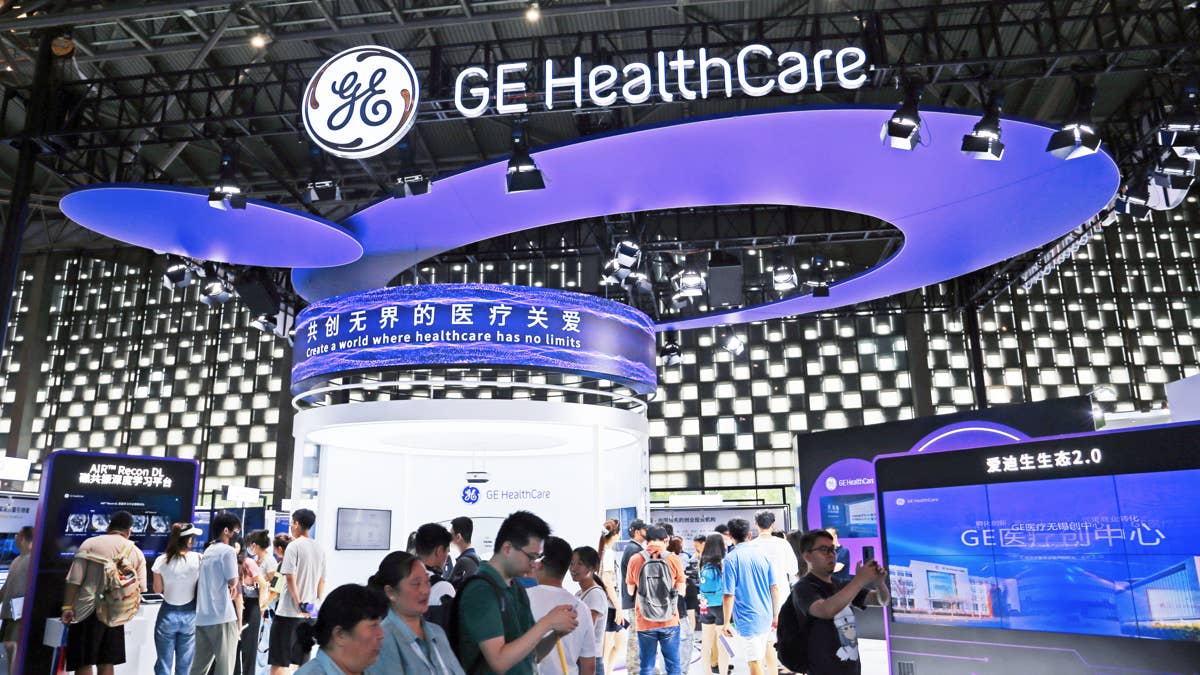
GE HealthCare’s imaging systems, including MRI, CT, and ultrasound machines, sit at the center of Needham’s bull case for a 44% rebound.CFOTO / Getty Images
What actually pushed GE HealthCare stock lower this year
GE HealthCare does a lot of business in China, but hospitals there have temporarily stopped buying new scanning equipment.
CFO Jay Saccaro said on the fourth quarter earnings call that “tariffs accounted for about half of the year-over-year gross margin decline,” a profit loss the company has been offsetting with pricing and cost actions, Yahoo Finance reported.
The company’s Patient Care Solutions division, which makes monitoring and anesthesia equipment, also posted weaker first-half results. GE HealthCare‘s management confirmed in its second-quarter 2026 press release that PCS is under strategic review, which often points to a possible sale or spin-off.
More Health Stocks:
Morgan Stanley flags Amgen’s edge after heart-drug rival stumbles
Why Morgan Stanley likes Gilead’s HIV prevention play
Novo Nordisk CEO opens the door to major move for U.S. investors
GE HealthCare beat expectations in the second quarter, growing revenue by 5.75% year over year to $5.3 billion and topping earnings-per-share estimates by 9.09%.
On the call, CEO Peter Arduini said the company had “delivered record orders and backlog in the second quarter, with orders growth across every segment.” However, investors wanted stronger assurance about when the China and PCS issues would change, so shares kept falling.
How GE HealthCare makes money and why the valuation looks cheap
GE HealthCare designs and sells the imaging machines that hospitals rely on, including MRI scanners, CT machines, ultrasound units, and X-ray systems. It also produces contrast agents, which are the injectable dyes that make scans clearer, along with patient monitoring equipment and pharmaceutical diagnostics.
The company separated from General Electric in early 2023 and now serves customers in more than 160 countries.
Related: Jim Cramer sends strong 5-word message on surging biotech stock
Roughly half of its revenue comes from long-term recurring streams such as service contracts and consumables, which keep cash flow steady, even when new equipment orders slow down.
That steady revenue stream is why the current valuation looks unusual. Insider Monkey noted that GEHC “is priced below its peers despite dealing with imaging that hospitals cannot operate without,” adding that new AI features on the company’s scanners help defend its pricing power.
Two upcoming dates that will test the turnaround call
Two upcoming dates will support Needham’s bull case. On Oct. 23, investors who own the stock before the deadline will qualify for a cash payout. While this dividend payment is small at a 0.21% yield, it proves that the company’s management is dedicated to rewarding shareholders, even while navigating a tough recovery.
Also, on Oct. 30, GE HealthCare is scheduled to release its 2026 third-quarter results. Investors will be watching for improvement in China orders, an update on the PCS strategic review, and any margin recovery from tariff mitigation actions. If the company beats growth expectations, it will prove Saxon right.
While the potential gain looks great for new investors, the risks still remain. If China’s economy stays weak or the company’s internal restructuring disappoints, the stock could drop back down to its $58.75 low.
Because the analyst’s $93 target is just a forecast, a safer strategy might be to buy in slowly around the Oct. 30 report, rather than investing all your money at once.
Related: Lilly looks beyond obesity with $2.88B autoimmune buyout