


Every retirement plan is really just a bet on a number. For the past century, that number has been about 10%, the average annual return U.S. stocks have delivered through wars, recessions, inflation scares, and at least two full-blown manias. An entire generation built its financial life on that figure. The 401(k) system assumes it. The famous 4% withdrawal rule assumes it. Most retirement calculators quietly assume it, too.I have covered markets long enough to know that the most dangerous input in any financial plan is the one nobody questions. Change the assumed rate of return, and everything downstream shifts with it: withdrawal schedules, required minimum distributions, tax planning, how long the money lasts. A plan built for double-digit returns does not bend gracefully when reality delivers half of that. Instead, it breaks.It makes one recent projection uncomfortable for anyone approaching retirement or already living off a portfolio. This is not a permabear newsletter talking, and it is not a hedge fund manager selling a doomsday trade. The projection comes from Vanguard, the firm that taught tens of millions of Americans to buy index funds, hold them, and trust the long run. What its economists now expect from U.S. stocks over the coming decade looks nothing like the century that came before it.Why Vanguard expects stock returns to fall by halfThe firm released its annual economic and market outlook on Dec. 10, 2025, under the title “AI exuberance: Economic upside, stock market downside,” according to Vanguard.The headline number sits in the fine print. The firm now projects U.S. stocks will deliver 4% to 5% average annual returns over the next five to 10 years, a forecast driven almost entirely by its assessment of large-cap technology stocks. Against the roughly 10% a year the S&P 500 has averaged over the past century, the company that popularized index investing is telling clients to expect about half the compounding they grew up with.More Personal Finance:Dave Ramsey, Vanguard warn Americans on housing costsFidelity reveals giving mistake quietly costing donorsUBS doubles down on a record wealth boom for AmericansThe picture did not improve much this spring. Stock valuations declined enough in the first quarter to lift the firm’s 10-year U.S. equity outlook by about one percentage point, but prices remain “significantly above long-term fair value,” according to Vanguard’s April 22 update.To be clear, this is not a crash prediction. Vanguard’s economists still expect solid gains in 2026 itself, powered by artificial intelligence (AI) investment. The warning is about the decade, not the year. Thin returns spread across 10 years do less damage to headlines and more damage to retirement plans.
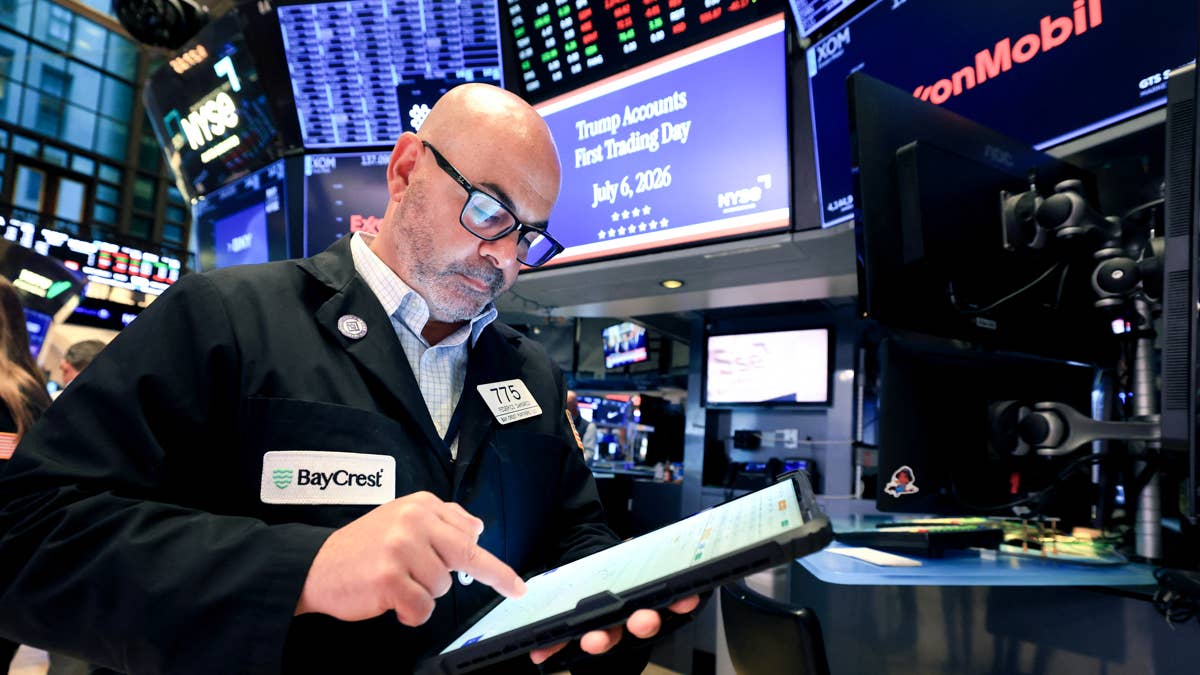
Vanguard projects U.S. stocks will average just 4% to 5% a year over the next five to 10 years.TIMOTHY A. CLARY / Getty Images
A stock market carried by roughly 70 companiesThe reason for the muted outlook is concentration. Vanguard’s strategists track a group of roughly 70 firms they call the “AI complex,” spanning hyperscalers Alphabet (GOOGL), Amazon (AMZN), Meta (META), Microsoft (MSFT), and Oracle (ORCL), plus the chipmakers and data center suppliers behind them.They expect that group to generate more than half of all U.S. earnings growth this year and next, according to Vanguard’s June 24 market perspectives.Related: Vanguard warns that investors lose control without incapacity planThink about what that means for an ordinary retirement account. A retiree who owns an S&P 500 index fund is not holding a neutral slice of the American economy. They are holding a concentrated wager that AI spending keeps compounding, with everything else along for the ride.If the AI trade delivers, the decade could surprise to the upside, and Vanguard concedes as much. If it stalls, the engine responsible for most of the market’s earnings growth stalls with it. Either way, a retiree’s outcome now hinges on a handful of tickers they never consciously chose.Valuations and dividend yields tell the same storyThe market’s own gauges back up the caution. The Shiller CAPE ratio, which compares stock prices with 10 years of inflation-adjusted earnings, stood at 41.6 as of the July 2 close, according to Multpl, which tracks Nobel laureate Robert Shiller’s data.Only one stretch in market history has been more expensive:The record CAPE of 44.2 came in December 1999, months before a collapse that eventually cut the Nasdaq by roughly 78%, according to Shiller’s historical data.The 1929 peak, which preceded an 89% slide in the Dow, arrived with the CAPE in the low 30s, the same dataset indicated.Today’s reading sits in the top 10% of all valuations recorded since 1988, according to Vanguard’s full outlook report.Income confirms the squeeze. The S&P 500’s dividend yield has fallen to about 1.05%, a whisker above the lowest level on record, and the yield drought traces to “the largest companies by market cap having low/no dividends,” Trivariate Research founder Adam Parker wrote in a note first reported by Yahoo Finance.The practical translation is stark. A $500,000 index portfolio now produces roughly $5,250 a year in dividends before taxes. For most of the 20th century, when the index yielded 3% or better, that same portfolio would have generated about $15,000. Investors are paying record prices for some of the smallest payouts stocks have ever offered.What retirees can control when returns run thinNone of this calls for panic selling, and Vanguard is not recommending any. Instead, it calls for different inputs. The firm’s own retirement income research, published June 2, found that the withdrawal rate matters more than any other variable, and that trimming withdrawals from 5% to 4.5% of a portfolio can extend its life by roughly five years. In a 4% to 5% return world, that half point becomes the difference between money that lasts and money that does not.I ran the basic math myself, and it is sobering. A $1 million portfolio earning 10% absorbs a 4% withdrawal, inflation adjustments, and required minimum distributions with room to spare. Drop the return to 4.5% and add one bad early year, and the same plan can fail inside 25 years. Sequence risk, the danger of taking losses while withdrawing, grows sharply when average returns shrink. And the cushion is thinner than most assume, since the median 401(k) balance sits near $44,000.Vanguard’s suggested response is unglamorous. High-quality bonds, which the firm projects will return about 4% annually over the coming decade, now compete with stocks for the first time in a generation. U.S. value stocks and non-U.S. developed markets screen better than U.S. growth in its outlook, and the firm has even begun making a case beyond public markets entirely.The 10% century was real, and nobody should apologize for enjoying it. But retirement plans do not run on nostalgia. They run on the next decade’s returns, and the firm that built the buy-and-hold era just told its customers, in writing, to expect half of what they are used to. Retirees who adjust their withdrawal rates, income sources, and expectations now will never have to learn what happens to those who did not.Related: Vanguard’s 25 years of data upend major retirement myth