

For decades, older workers in their peak earning years have relied on workplace 401(k) catch-up contributions as a reliable double play: socking away extra retirement savings while trimming their immediate federal income tax bill.
Yet under federal rules enacted through the SECURE 2.0 Act, higher-income savers age 50 and older can no longer take an upfront tax deduction on those extra workplace deferrals — and overlooking how the income test actually works can disrupt both paycheck budgets and retirement tax plans.
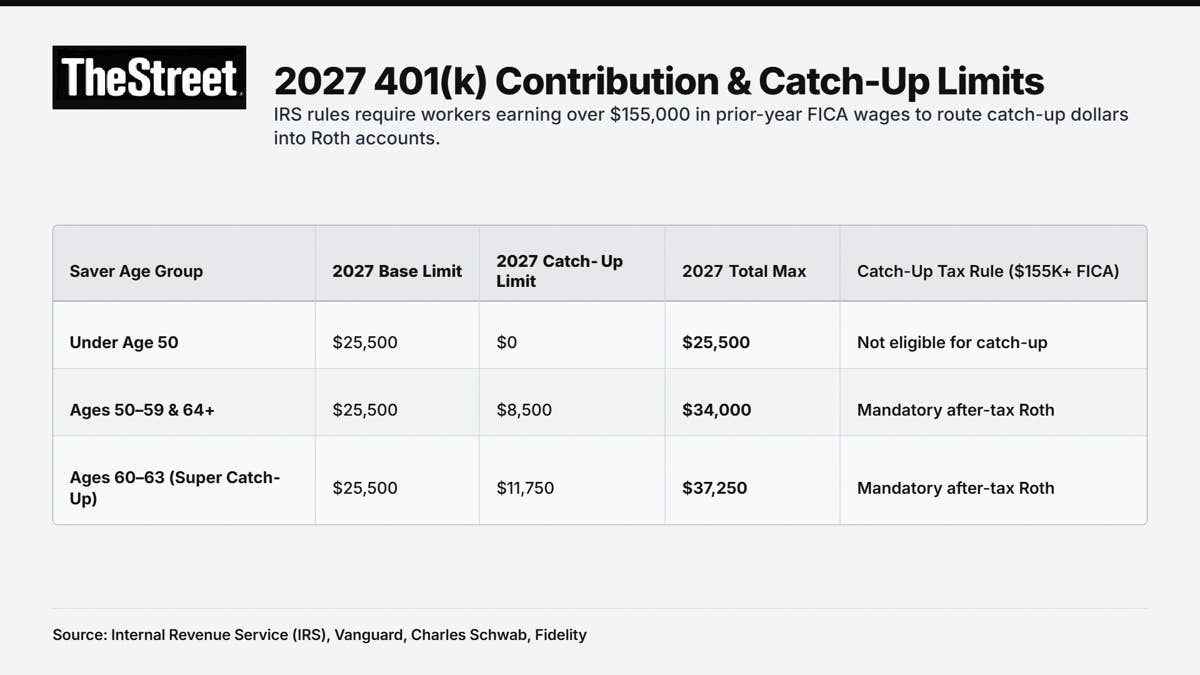
Vanguard highlights how the IRS now requires workers whose prior-year FICA (Federal Insurance Contributions Act) wages crossed the federal threshold to direct all 401(k), 403(b), and governmental 457(b) catch-up dollars into after-tax Roth accounts.
Meanwhile, Charles Schwab and Fidelity Investments warn that crossing that wage line by even a single dollar — or working at a company that lacks a Roth 401(k) option — can shut down workplace catch-up contributions altogether.
Vanguard spotlights the loss of the upfront tax deduction
Under federal retirement rules, employees age 50 and older can contribute extra money above the standard annual 401(k) deferral limit.
For 2027, the standard employee 401(k) contribution cap to $25,500 and increases the general age-50-and-over catch-up limit to $8,500 — or $11,750 for workers ages 60 through 63 — allowing older savers to put away up to $34,000 or $37,250 a year, according to the Internal Revenue Service (IRS).
While workers below the federal wage threshold can still choose between pre-tax and Roth catch-up dollars, Vanguard emphasizes that higher earners lose that pre-tax choice on their catch-up slice, even though their regular base deferrals can remain pre-tax.
“An additional change under SECURE 2.0 will affect higher-income earners starting with tax year 2026. If you earn more than $145,000, any catch-up contributions you make in an employer-sponsored retirement plan will need to be made with after-tax dollars and go into a Roth account. In other words, you won’t get a tax deduction for your catch-up contribution,” Vanguard wrote in its catch-up guide (the IRS later indexed that prior-year FICA wage threshold upward for inflation, reaching $155,000 for 2027).
Even so, Vanguard notes that shifting catch-up dollars into a Roth account isn’t necessarily a setback if your tax bracket stays high later in life.
“If you expect your current income to be higher in the near future, a Roth IRA catch-up contribution can provide tax-exempt income during retirement, when your tax rate might be higher,” Vanguard noted.
Source: Internal Revenue Service (IRS), Vanguard, Charles Schwab, Fidelity
Charles Schwab warns on the one-dollar cliff and plan gaps
Charles Schwab underscores a critical detail that catches many high-earning professionals off guard: The IRS test is an all-or-nothing cliff based on prior-year Social Security wages (Box 3 on Form W-2) from your current employer, not your current year’s salary or household income.
“If your FICA income exceeds the limit by even one dollar, your entire catch-up contribution must go into a Roth account,” Schwab’s Hayden Adams wrote.
Schwab also warns of an operational trap inside employer plans: If a company’s 401(k) does not offer a designated Roth option, high-earning employees subject to the rule cannot simply fall back on pre-tax catch-ups — they are barred from making workplace catch-up contributions at all until the employer adds a Roth feature.
When workplace catch-ups are blocked or less attractive, Schwab points savers toward alternative tax-advantaged buckets, such as funding an IRA (where the annual limit remains $7,500 in 2027 plus a $1,100 catch-up for savers 50 and older, without the Roth catch-up mandate), maxing out a health savings account, or investing in a taxable brokerage account.
“No matter the method you choose, saving more is always worthwhile,” Adams added.
Fidelity flags smaller paychecks and W-2 traps
Fidelity Investments echoes those warnings while urging workers approaching 50 or already making catch-up deferrals to check their paystubs and prior-year tax forms before payroll systems automatically reroute their contributions.
Because Roth contributions are deducted after federal income taxes are withheld, shifting $8,500 or $11,750 of catch-up savings from pre-tax to Roth reduces take-home pay during the year.
“Roth contributions are taxed now, so your paycheck might be a bit smaller than you’re used to. Planning ahead will help you stay on budget,” Fidelity wrote in its catch-up guide.
More Retirement:
Annuities can be a retirement safety net to prevent outliving savings
Vanguard flags a retirement fear built into 401(k) plans
Suze Orman has a serious retirement warning for 2027
Fidelity also highlights a key distinction between workplace plans and individual accounts: The mandatory Roth catch-up rule applies only to employer-sponsored plans such as 401(k)s, 403(b)s, and governmental 457(b)s.
“If your plan doesn’t offer Roth, you may lose the ability to make catch-up contributions once the rule kicks in. Check your plan soon!” Fidelity warned.
For savers age 50 and older, all three brokerage giants agree on one practical step before setting annual deferral elections.
Be sure to confirm with human resources whether your plan supports Roth deferrals so an unexpected tax shift doesn’t derail your retirement savings pace.
Related: Fidelity flags key 401(k), IRA rule; Vanguard, Schwab warn on facts