

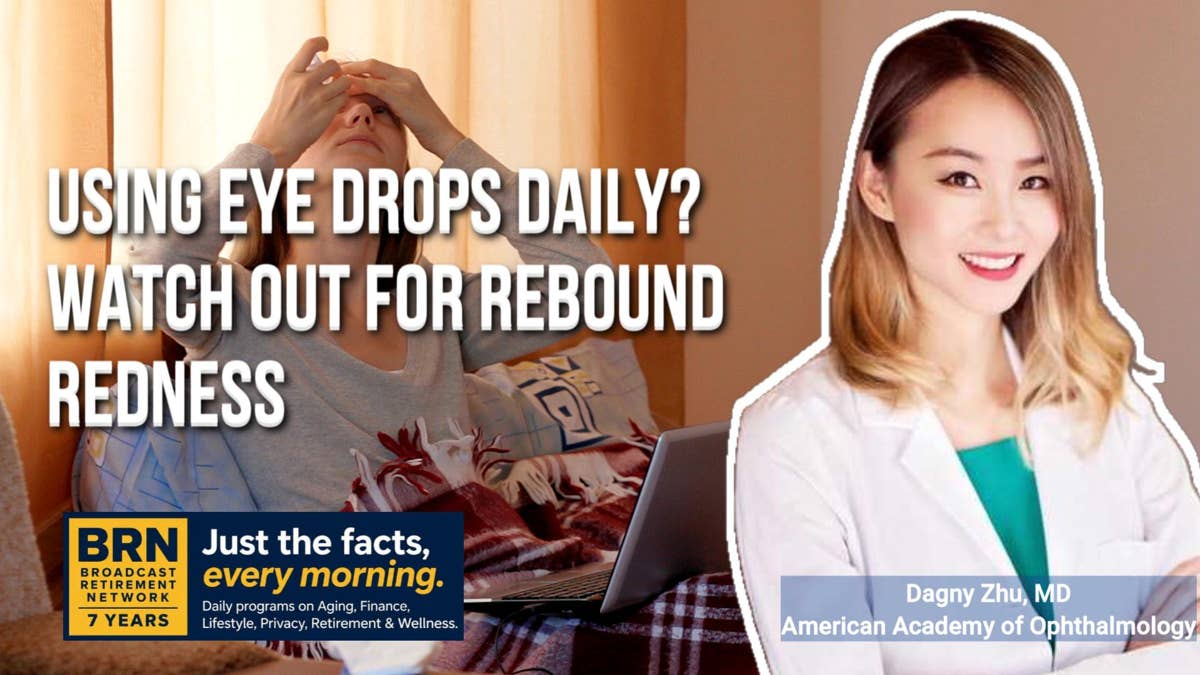
Dr. Dagny Zhu, ophthalmologist and American Academy of Ophthalmology spokesperson, shares practical advice on daily eye-drop use, screen-related eye strain, and when to see an eye doctor.
Jeffrey Snyder, Broadcast Retirement Network
Dr. Zhu, it’s great to see you. Thanks for joining us in the program this morning.
Dagny Zhu, M.D., American Academy of Ophthalmology and Zhu Vision
Hey, thank you so much for having me. It’s an honor.
Jeffrey Snyder, Broadcast Retirement Network
Yeah, it’s a pleasure to have you. And really, we appreciate our partnership with the American Academy of Ophthalmology and having you on as a spokesperson to talk about what are very important issues. The eyes are the windows to the soul.
They’re also the windows to health. So it’s important to take care of your eyes. We’ll get into that in a couple of seconds.
But let me ask you, the fall weather is here, at least on the East Coast. I know it’s changing around. And a lot of people are looking at their screens.
They have a change of weather. They may have some allergies. They’re developing some redness in their eyes.
And they’re going to the drugstore and getting eye drops. And I guess my question to you as a first question, we can explore that topic in greater detail, is it okay to take those eye drops or put eye drops in your eyes every day, all throughout the day?
Dagny Zhu, M.D., American Academy of Ophthalmology and Zhu Vision
So the answer is really, it depends on what that eye drop is. If you’re going to the drugstore, there are certain drops that are healthier than others. So for example, the most harmless drop that you could use is an over-the-counter lubricant that’s preservative-free.
And so for those drops, it’s really to diminish some of the symptoms, irritating symptoms you might have from allergies, from screen time, dryness, poor body sensation. Perfectly safe to use those around the clock. Sometimes it’s good to start four times a day, but I tell patients you can use it up to every hour if you’d like.
But it has to be the preservative-free artificial tear. So some of the ones that come in bottles and don’t say preservative-free, they have other additives in them that can actually cause toxicity if you’re using it too often, more than four times a day. But if you find that you need more relief, then definitely look for that preservative-free label on the bottle, and you can use those around the clock every one or two hours as needed for comfort.
Now, the drops that you should not be using too often are the ones that specifically have instructions that say use once or twice a day. Those might be anti-allergy medications. So typically those are for when you have symptoms of redness plus a lot of itching and maybe a runny nose.
You know, it kind of just corresponds with your other allergy symptoms. Typically those are once or twice a day, so you want to follow the instructions on the box. And then there are ones that are just for redness, redness relievers.
So those are the ones that I would say stay away from because they simply make your eyes look less red. It’s cosmetic. And how it does that is it constricts the blood vessels that are feeding your eyes.
And so you’re putting them in, they’re actually cutting off blood flow and oxygen to your eyes. So I definitely don’t recommend those, you know, you might see them as visine or clear eyes. Those are ones to stay away from because they’re not addressing the underlying problem.
And actually, once you start, the redness comes back and even worse. We call it a rebound redness because once you’ve constricted those blood vessels, they dilate even further and your eyes look even worse. So stay away from those.
Jeffrey Snyder, Broadcast Retirement Network
And thank you for that. And my apologies for interrupting. I didn’t intend to do that.
Let me follow up and ask you, we were talking a little bit about allergies. It seems like more and more Americans and individuals around the world are looking at their devices. They’re sitting and staring like I am right now into a camera.
That I would imagine has a deleterious or negative effect. It can, what types of maladies can that cause if you’re always looking at the screen? Does it dry the eye out?
Does it, can it lead to other problems that you may need to see someone like yourself, an ophthalmologist to address?
Dagny Zhu, M.D., American Academy of Ophthalmology and Zhu Vision
Yeah, absolutely. So the increased screen time is causing a lot more issues with our eyes. We have a name for it.
It’s called digital eye strain. So because we’re staring at those screens, we actually blink two to four times less than normal. So if you’re not blinking, the tears in your eyes just evaporate and they’re not getting lubricated as they should.
And so definitely you get symptoms of dryness, which comes with burning, tearing, foreign body sensation. But also that strain of focusing on something up close on a screen can cause headaches. You know, it can cause your eyes to feel fatigued.
So all of that kind of feeds into this digital eye strain or computer vision syndrome. So we definitely recommend from the Academy of Ophthalmology, follow that 20, 20, 20 rule. Every 20 minutes, take a 20 second break by looking 20 feet into the distance.
Or sometimes just close your eyes, let your eyes rest and reset and lubricate. Every time you’re blinking, it’s like windshield wipers on the window of a car and you’re providing fresh tears that are refreshing the surface of your eye. You’ll feel better too.
Jeffrey Snyder, Broadcast Retirement Network
Really, really good advice there. In terms of going to your ophthalmologist, I wanna ask about regular eye care. You know, if you’re having kind of the itchy eyes or some of these allergies, I would assume it’s best that you don’t rub your eyes.
Going to someone like yourself can help suggest the right course of action, whether it’s eye drops, whether it’s some other remedy.
Dagny Zhu, M.D., American Academy of Ophthalmology and Zhu Vision
Right, so the most common reasons that you’ll get eye irritation or redness are like allergy, like you mentioned, or dryness from screen time. But if you’re finding that you’re using those, you know, drugstore drops several times a day, you’re not getting relief, the redness is not going away. Maybe your vision’s even getting blurrier.
Maybe it’s associated with pain, especially. Those are definitely red flags and signs that you should be seeing an ophthalmologist. So I would say if you have extreme pain with vision loss or just what you’re doing is not helping and relieving your symptoms, go ahead and make that appointment so we can figure out what the underlying problem is.
So there are other conditions that can be potentially sight-threatening that we wanna address, including infection or elevated eye pressure from glaucoma. All of those can cause redness and eye discomfort as well. So we wanna make sure we’re not mistreating our own eyes with over-the-counter drops and that we’re actually seeing a professional.
Jeffrey Snyder, Broadcast Retirement Network
And is it recommended to see a professional like yourself, an ophthalmologist, annually, semi-annually, once every two years, how frequently? Because you pick, as an ophthalmologist, you’re a physician, so you would probably pick up other things in the eyes beyond just, hey, your eyes are red, right? I mean, you’re gonna pick up other maladies that, so it probably makes sense to go more frequently.
Dagny Zhu, M.D., American Academy of Ophthalmology and Zhu Vision
Absolutely. So at minimum, we recommend routine exams at least every one to two years. But if you have an underlying condition that we’re monitoring, for example, glaucoma, if you have a family history of macular degeneration and you’re at greater risk for things like that, we may wanna see you more often.
If you have chronic dryness that requires not just over-the-counter medications, but prescription medications, we might wanna see you every three months to make sure that we’re responding to those prescription medications and we don’t need to elevate care. So it depends on what we find on that exam, but definitely making that first appointment to get that routine checkup to see if there’s anything that we should be monitoring more closely is the most important.
Jeffrey Snyder, Broadcast Retirement Network
I wanna ask you about a specific segment of our audience. I call them mature Americans, so people maybe 40 and over. Are there anything in particular, you know, younger people, they bounce back real quick.
I’m sure they have their own challenges, but are there things that maybe in my age category that we should be thinking about even more that maybe might show up? I’m thinking about, you know, I’m holding reading glasses here. I have definitely been challenged reading close now.
My eyes no longer can focus that close, so I need reading glasses. But are there things that as we age we should be thinking about?
Dagny Zhu, M.D., American Academy of Ophthalmology and Zhu Vision
Yeah, certainly. So it could be for things as benign as just needing reading glasses. And when we do enter that age 45 range, I think some people are unaware that that happens and they really think something’s wrong with their eyes.
Right? So it’s always a good idea to get checked with your ophthalmologist to make sure there’s nothing more, I guess, dangerous underlying that loss of vision. But typically that age-related vision loss, you know, inability to read up close is pretty normal, but at least we can give you a better prescription there and advice on what to do.
There are also surgical options now. But beyond that, the medical conditions that could lead to, you know, vision loss and sight-threatening issues, if not caught early, those are the things that you wanna see an ophthalmologist for because we’re trained to screen for those conditions. So after the age of 40, we’re looking for things that are more common in that age group, including glaucoma, macular degeneration, which is the most common reason for permanent vision loss in people over the age of 50, cataract development.
Typically that doesn’t happen until over the age of 60 or 65, but, you know, some people develop it as early as in the early 40s. It’s genetic, it’s a combination of how much they’ve spent outdoors under UV light all those years. So there are things that don’t always fall within that range of where we typically see things.
So I agree with you, age 40 and above, definitely get that routine eye exam so that we can rule out some of those chronic conditions that tend to pop up a little later in life.
Jeffrey Snyder, Broadcast Retirement Network
I was saying earlier that, you know, when you have the ability as a physician to kind of see other maladies and things that can impact somebody, are there things that we can do other than, you know, making sure that you don’t rub your eyes, that you’re properly lubricating, that you’re doing the 20, 20, 20 rule as you were talking about earlier? Are there things that we can do to prolong our sight? I mean, is it a foregone conclusion that we will, as we age, lose our sight?
Like am I destined at some point, whether it’s age 60, 70, 80, 90, 100 to lose my sight?
Dagny Zhu, M.D., American Academy of Ophthalmology and Zhu Vision
Well, there are certain things that just increase in incidence just based on our age, but there are definitely things that we can do in our day-to-day life to slow those things down or reduce the risk of those things, including just kind of, you know, simple things that we all do, eating healthy, right? Leafy greens, bright, colorful fruits and vegetables. A lot of those are packed with vitamin A, E, Lutein, Zeaxanthin, kind of antioxidants that really strengthen the function of our retina, which is that film in the back of our eyes, like the film of a camera.
And so that can decrease your progression or risk of developing macular degeneration or age, which is age-related, especially if you’re at risk. So I would look into supplements that have been validated by clinical studies like the ARED study. So those ingredients in particular really help to decrease your risk of developing macular degeneration as you age.
Wearing UV-protectant sunglasses whenever you’re outdoors, even on cloudy days. That’s gonna protect you from things like cataract formation at least maybe you won’t get it as early as you would have otherwise. Protects your retina again from sun exposure, UV exposure.
Eating healthy and getting diet and exercise is gonna control your blood pressure and your blood sugar so that you don’t develop bleeding or blood vessel, I guess, hardening in the back of your eyes because remember everything that affects our bodies everywhere else, including high blood pressure, high blood sugar, it’s damaging the walls of those blood vessels. And we have tiny blood vessels in the back of our eyes that are serving our vision. And so those same issues that we have elsewhere can manifest in the eyes.
And sometimes it’s the first place where we identify diabetes or high blood pressure because on a routine dilated exam, we see little spots of blood, little bleeds and letting us know that, hey, have you checked with your primary care doctor in your blood sugar lately? And sometimes we’re the first to diagnose diabetes often. And that can lead to very, very serious causes of vision loss, including retinal detachment.
And so these are major things that we need to be looking after that aren’t only good for the rest of our body but particularly for our eyes as well.
Jeffrey Snyder, Broadcast Retirement Network
And last question, I promise I know you’re very busy but I do have a question. I mean, all the things that we’re talking about, whether you’re on Medicare, if you have a work insurance plan or your own insurance plan, generally a lot of these things, seeing a physician like yourself, an ophthalmologist would potentially be, could be covered and you should look into your coverages to find out whether it is covered. But they should be covered.
Dagny Zhu, M.D., American Academy of Ophthalmology and Zhu Vision
Yeah, especially if you have an underlying condition like diabetes and those eye screens are covered. Typically everything else, you just have to have some sort of health complaint. Blurred vision is really all it takes or irritated eyes.
You have to have a medical reason to see a medical physician specializing in the eyes, which is the ophthalmologist. And then the insurance should cover almost all those pieces.
Jeffrey Snyder, Broadcast Retirement Network
Yeah, so that no one, my point is, no one has an excuse who’s watching this. Dr. Giroux, we really appreciate you coming on the program. Thanks for sharing your expertise.
And look, we look forward to having you back on the program again very soon.
Dagny Zhu, M.D., American Academy of Ophthalmology and Zhu Vision
Thank you so much for having me. I hope it was helpful.