


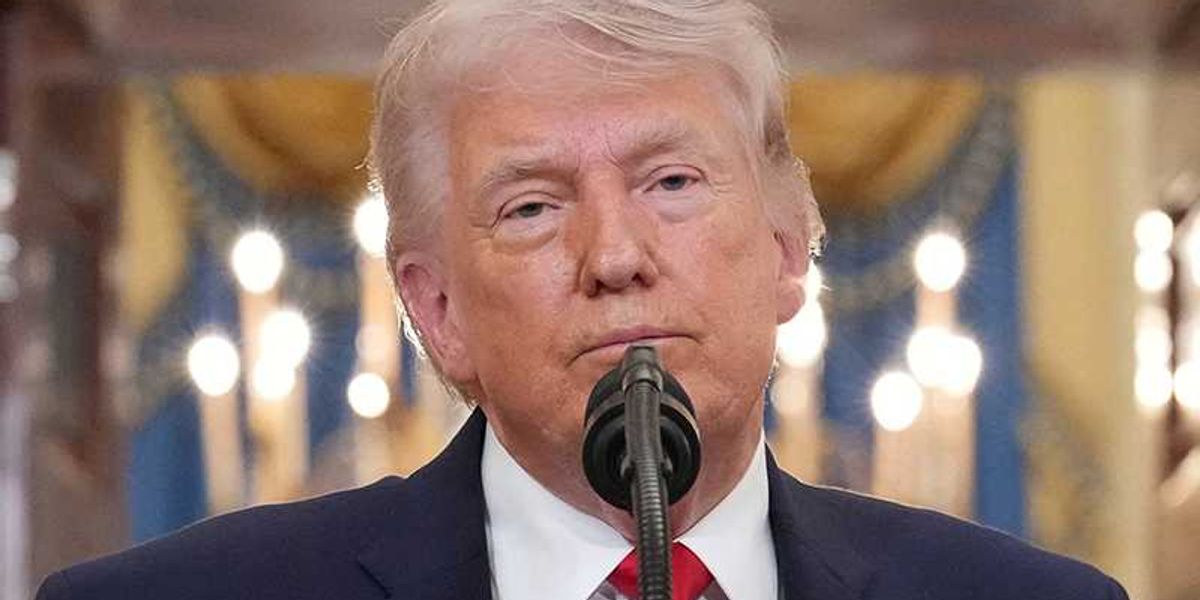
President Donald Trump is reportedly weighing the details of a “massive” new attack on Iran, but as two legal scholars warned for The Hill, his typical approach of threatening “apocalypse now, or in a few hours” is doomed to backfire once again.
The Trump administration’s much-hyped “memorandum of understanding” peace deal with Iran has imploded in recent weeks, putting the countries on another collision course for war. Amid reports that he is considering the options available to him and plotting an immense new round of airstrikes against Iran, Trump has also gone back to his previous tactic of threatening to target key civilian infrastructure, like bridges and power stations. Critics are also, once again, warning that such attacks would constitute war crimes.
David Wippman is the emeritus president of Hamilton College, and Glenn C. Altschuler is the Emeritus Professor of American Studies at Cornell University. Together, the pair of legal scholars published a new piece on Sunday for The Hill, in which they warned that this approach was doomed to backfire on Trump, even while admitting the escalation from military to civilian targets “is not unusual” in modern conflicts. While international law forbids the intentional targeting of civilian infrastructure, certain targets, such as train lines or airports, can be “dual use,” meaning they could also serve military needs. In that case, an army would need to show the “definite military advantage” of their strike to avoid repercussions.
In the case of Trump and his war with Iran, the pair noted that, while this plan might not be out of the ordinary, the targeting of civilian infrastructure by itself will not be an effective strategy, citing experts who have argued that “bombing alone rarely compels capitulation.”
“Instead, attacks that inflict widespread civilian suffering often strengthen national resolve, as Britain’s response to the Blitz, North Vietnam’s endurance during Operation Rolling Thunder, and Ukraine’s response to Russia’s attacks on its electrical grid all illustrate,” they detailed. “During the 1991 Gulf War, coalition forces attacked Iraq’s electrical grid, bridges and transportation networks, oil facilities and defense industries. Although most of these installations supported Iraq’s military, their destruction also crippled food systems, hospitals, water treatment facilities, sewage plants and economic life, at enormous long-term cost to civilians. But it took a ground invasion to force Iraq out of Kuwait.”
They concluded: “U.S. policymakers would do well to ask whether upping the ante with bombs is likely to end this conflict, or deepen it by dragging in other countries in the Middle East and dragging down the global economy. And even though Iran’s government, which is no stranger to war crimes, may not care if its own civilians suffer, we should.”