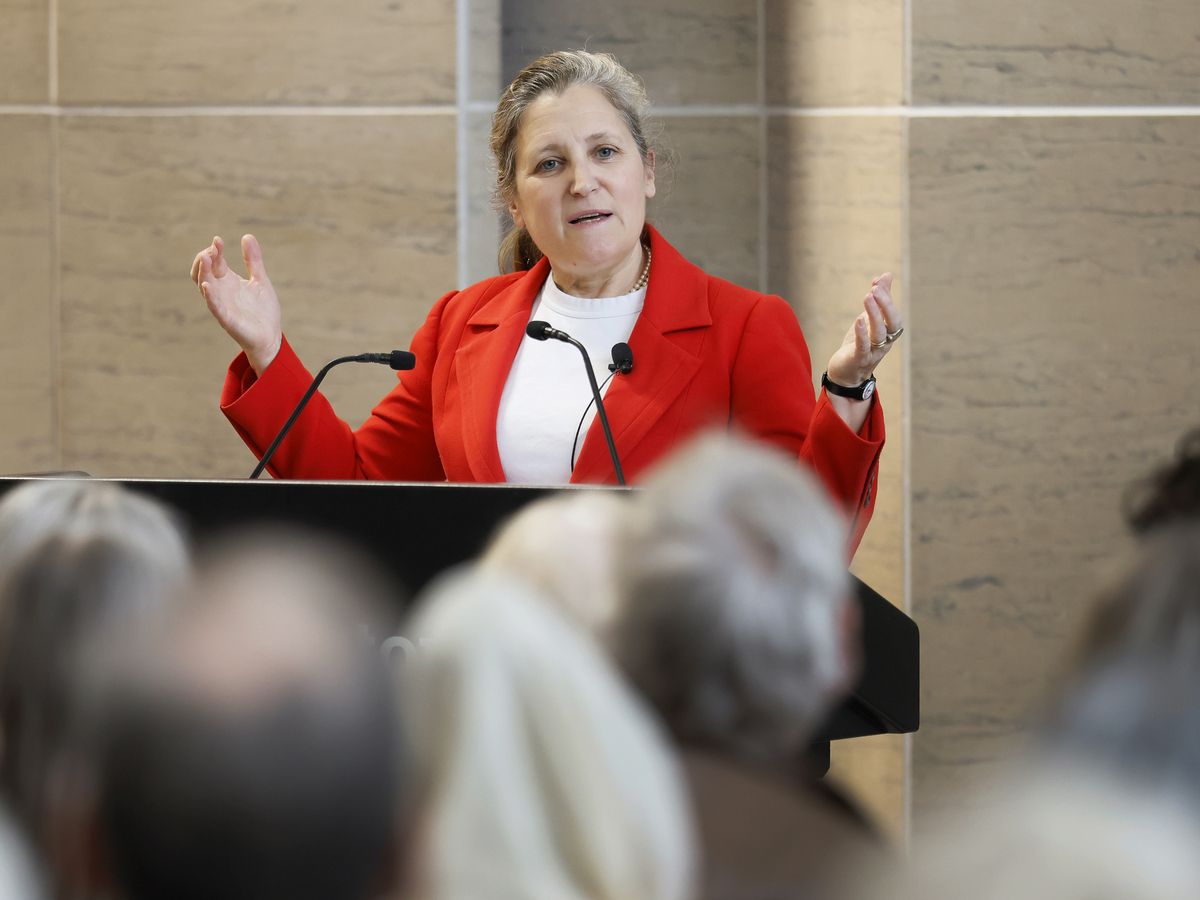
U.S. President Donald Trump ’s administration privately pressures foreign chief executives and business leaders to bring their governments into line with the White House’s demands, Canada’s former deputy prime minister says in a new memoir. “The Trump team is swaggeringly, rudely aggressive, even behind closed doors,” writes Chrystia Freeland , who also served as finance minister, foreign minister and trade minister during Justin Trudeau’s nine years in power. “Trump’s cabinet secretaries miss no opportunity to warn foreign CEOs of the dire consequences if their leaders don’t fall in line.” The book is titled Unreliable Boyfriend: An Insider’s View of Dealing with a Chaotic Superpower, Plutocrats, and Other Complicated People . It combines behind-the-scenes accounts of her dealings with Trump and other U.S. officials with a retelling of her dramatic split from Trudeau in December 2024. The book’s central argument is that America’s allies have too often rewarded Trump’s bullying with concessions that fail to produce results. Freeland makes it clear she was frustrated with people who complained privately but capitulated to Trump publicly — and warns that China is gaining greater power as a result of U.S. policies. “Too often today, America’s allies perform the Trump-era equivalent of woke virtue signaling — too many of us talk tough about the United States, but carry a small stick. Too much is at stake for that sort of quisling behavior,” Freeland writes. She praises Prime Minister Mark Carney , her longtime friend, in whose cabinet she served for several months before her exit from politics. But she criticizes the government’s decision in June 2025 to drop a digital services tax that would have affected U.S. tech firms, only for Trump to hike tariffs on Canadian goods weeks later anyway. While the most visible fight between the U.S. and its allies is over tariffs, “the more consequential battle may be over Washington’s insistence that Big Tech be allowed to operate freely around the world without being meaningfully taxed or policed,” she writes. The administration brings its demands directly to foreign business leaders. After Carney’s famous “middle powers” speech at the World Economic Forum in Davos in January, Treasury Secretary Scott Bessent hosted a dinner with business executives. One guest at that event later delivered a stark message to Freeland, according to her. “They are pissed,” the person told Freeland. “They will take it out on us. They think we need to be cut down to size. They hate Canada.” One of the more startling anecdotes in the Freeland book involves Ontario Premier Doug Ford ’s decision to briefly impose a surcharge on electricity exports to the U.S. as retaliation for tariffs in early 2025. According to Freeland, a Canadian business leader told her that Commerce Secretary Howard Lutnick had privately threatened to send U.S. troops across the border unless Ford backed down. (Freeland notes in the book that Lutnick has no military authority.) “Canada was offered the most generous trade deal of any of America’s trading partners despite being overwhelmingly reliant on access to the American economy, which is over 12 times larger than Canada’s economy. Canada rejected that deal to demand continued one-sided access to the American market with no reciprocity,” Taylor Rogers, a spokesperson for the White House, said in an emailed statement. “President Trump pledged to put always American workers, farmers, and businesses first and he has delivered by leveling the playing field for Americans.” ‘Here, Angela’ Freeland’s memoir also revisits some memorable episodes from Trump’s first term. Freeland recounts the 2018 Group of Seven summit in Quebec, during which leaders persuaded Trump to sign a joint communique, only for him to withdraw support hours later after he was angered by comments from Trudeau. Toward the end of the summit, she writes, Trump pulled candies from his pocket, tossed them onto a table in front of German Chancellor Angela Merkel and said: “Here, Angela, don’t say I never give you anything.” Freeland describes the gesture as “astonishingly contemptuous.” Yet her portrait of Trump is complicated. Although the president repeatedly referred to Freeland as a “nasty woman” while she led Canada’s side during trade negotiations, she says he could also be disarmingly personable in private — calling her “the killer” as a compliment. Freeland credits Canada’s eventual success in reaching the Canada-U.S.-Mexico Agreement with a strategy that many business leaders opposed: retaliating against American tariffs rather than accommodating them. Trudeau breakup While the “unreliable boyfriend” in the book title refers to the U.S., Freeland names the chapter about the collapse of her political relationship with Trudeau, “Breaking Up Is Hard to Do.” Trudeau recruited Freeland into politics and eventually made her the first female finance minister in Canadian history. While she writes that history will be kind to him for his actions to fight climate change and social inequality, she paints a less flattering picture of his governing style. “Crying was routine at cabinet meetings. There were always boxes of Kleenex on hand, and really sad colleagues would sometimes get a hug from the PM,” she says. She says Trudeau’s lecturing at times veered into bullying. After one colleague casually described something as “crazy,” Trudeau scolded her because the term was insulting to people with mental health issues. Ministers were encouraged to use the word “bananas” instead, she writes. Despite his image as an empathetic leader, Freeland describes Trudeau as an aloof boss who rarely spoke with his ministers one-on-one. Their relationship finally unravelled in December 2024 — and Carney was at the centre of it. For months, rumors had circulated that Trudeau planned to replace Freeland with Carney as finance minister. During a Zoom call, he informed her she would lose the portfolio but remain deputy prime minister, in a role focused on Canada-U.S. relations as Trump prepared to return to power. Freeland writes that it was the “third-worst” day of her life, after her mother’s death and her parents’ divorce. Weeks before that call, Freeland was given advice about Trudeau by former Prime Minister Jean Chretien. “As long as you support him, he will stay on as PM. And he will lose the next election,” Chretien told her. “If that happens, it will be partly your fault.” Those words lingered. On Dec. 16, 2024, hours before she was due to deliver a major fiscal update in Parliament, she quit with a scathing public letter instead. The move blew up Trudeau’s administration. He resigned weeks later, triggering a party leadership race in which Freeland placed a distant second to Carney. “The painful personal irony is that, while my resignation ultimately forced Trudeau to step down, my close association with him hamstrung my own political prospects,” she says. Chrystia Freeland: Trade deal to leave ‘bad outcome’ for Canada and U.S.Janet Yellen: ‘Important for Canada … to retaliate,’ against Trump’s protectionist moves Freeland now serves as an economic development adviser to Ukraine and is a contributor to Bloomberg News. “Mark Carney is an excellent prime minister,” she concludes. “I am proud my decision helped him get the top job, even though I ended up paying a pretty steep political price.” Bloomberg.com
Trump threatens CEOs as tactic against allies, Freeland says