


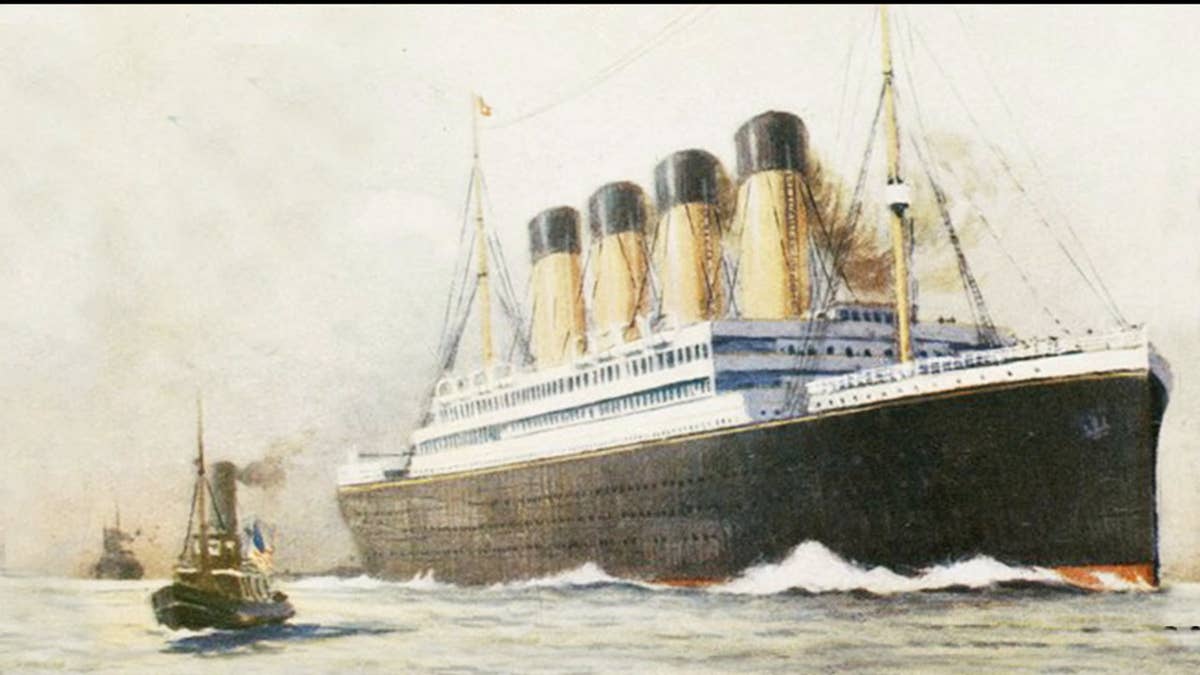
Henry Price Hodges never made it to Boston.
Hodges, 50, a musical instrument dealer from Southampton, England, paid £13, or about $63 at the time, for a second-class ticket to America, where he planned to visit family.
While onboard the doomed ship, Hodges wrote what would become his final letter to his friend, Hector Young of the Newtown Conservative Association in Southampton.
He mailed it from Queenstown, now known as Cobh, Ireland, the Titanic’s final port of call before heading into the North Atlantic.
“We have had a fine time up to now,” Hodges wrote. “You do not notice anything of the movement of the ship, but the weather is very fine. On the top deck there are about 200 boys (from 20 upwards) marching round & singing, others are playing dominoes & cards in the saloons, some reading, some writing, everything is quite different to what you would expect to see at sea.”
Hodges ended the letter, written on official Titanic letterhead: “I feel as tired as a dead dog.”
Five days later, the Titanic struck an iceberg shortly before midnight and sank in the early hours of April 15. Roughly 1,500 people died, including Hodges, whose body was later found and buried in Halifax, Nova Scotia.
More than a century later, Hodges’ letter sold for a record £60,000 ($82,000) at an auction held July 26 by Henry Aldridge & Son, exceeding its initial estimate of £35,000.
‘A historically priceless snapshot’
“The letter itself was written by a second-class passenger so very rare indeed,” Andrew Aldridge, managing director and auctioneer, told The Telegraph. “But it is a record price for an onboard letter written by a second-class passenger.”
“This letter gives us a historically priceless snapshot into what life was like on board the most famous ship ever to take to the seas, for a second-class passenger.”
UK: RMS Titanic being fitted out at Harland and Wolf Shipyard, Belfast, 1911-1912. (Photo by: Pictures from History/Universal Images Group via Getty Images)Pictures from History/Getty Images
Hodges describes the ship and fellow passengers and how they passed the time, Aldridge added, noting that “a little over four days, later the Titanic was lying at the bottom of the North Atlantic.”
The sale is the latest example of the extraordinary prices Titanic memorabilia can command more than 114 years after the ship sank, as time and tragedy turn common items into treasures.
In April, a Patek Philippe pocket watch belonging to John Jacob Astor IV, the richest passenger on the vessel, sold for $1.024 million, while a gold pencil case belonging to Astor sold for $204,800.
A separate Waltham gold pocket watch recovered from Astor’s body sold for nearly $1.5 million in April 2024.
And on Nov. 22, 2025, an 18-karat gold pocket watch belonging to Isidor Straus, the co-owner of Macy’s department store who perished with his wife, Ida, became the most valuable Titanic artifact ever sold at auction, fetching £1.78 million, or about $2.3 million.
James Cameron’s 1997 film became the first movie to cross the $1 billion mark worldwide, introducing the Titanic story to a new generation. But interest in the disaster started almost immediately after the ship sank.
“The continuing appeal of the Titanic is best explained by the way in which the story has passed from history into myth,” said Richard Howells, Emeritus Professor of Cultural Sociology at King’s College London, and author of The Myth of the Titanic.
‘An incredible story’
“Its mythical significance transcends its historical importance. By obtaining a Titanic artifact, you are buying a physical connection with a myth.”
Interest in the Titanic became a commercial reality within days of the sinking, Howells said, noting that “it was a myth transmitted by popular culture stretching back to 1912.”
“There was money to be made from the start,” he said.
Howells said that genuine artifacts are harder to obtain — for obvious reasons — “and therefore hugely expensive.”
“There is a vigorous ethical debate about artifact retrieval from the wreck site,” he said.
Over the past century, Titanic memorabilia, including letters, personal possessions and survivor items, has passed through public auctions.
“It’s such an incredible story — if it weren’t true, we would not believe it,” said Stephanie Barczewski, chair of the Department of History and Geography at Clemson University. “The world’s largest and most luxurious ship hits an iceberg and sinks on its maiden voyage? Really?”
Barczewski, author of Titanic: A Night Remembered, said the disaster “reminds human beings of our limitations, despite all of our technological advancements” and “that aspect of it gets more relevant all the time.”
“Most of all, that 2 hours and 40 minutes that elapses between the collision and the final disappearance of the stern beneath the waves allows many, many things to happen, involving all facets — from noble to craven — of human behavior,” she said. “That’s very unusual for a shipwreck. The Lusitania, for example, takes only 18 minutes to sink.”
“Most of the famous episodes from the Titanic story occur in that time frame. It’s what makes the story really distinctive.”
The wreck of the Titanic was found on Sept. 1, 1985, on the floor of the North Atlantic Ocean, about 370 miles southeast of Newfoundland, Canada.
RMS Titanic Inc., which was granted salvor-in-possession rights to the wreck site in 1994, has conducted multiple research and recovery expeditions and says more than 5,500 artifacts have been recovered from the official wreck site.
However, the company ran into a legal obstacle recently when a federal judge blocked a plan to auction off artifacts after the U.S. government and preservationists raised concerns about the sale and the company’s care of the items, according to The Washington Post.
The company proposed auctioning more than 100 items, including gem-studded jewelry, tableware and a bronze cherub that once adorned the vessel’s grand staircase.
‘The Titanic is always news’
RMS Titanic Inc. argued that the artifacts were not subject to the court’s jurisdiction, but U.S. District Judge Rebecca Beach Smith rejected that argument and ruled that any sale would require court approval.
She also raised concerns about the condition of RMS Titanic’s collection, citing the company’s “financial difficulties,” and ordered that an inventory of the artifacts and their condition be filed with the court.
RMS Titanic Inc. did not immediately respond to a request for comment.
Henry Aldridge & Son has scheduled an upcoming sale in November featuring an artifact known as “The Titanic Ring,” which belonged to first-class passenger and fashion designer Lady Lucy Duff-Gordon.
She survived the disaster with her husband, Sir Cosmo Duff-Gordon, aboard Lifeboat 1, which carried only 12 people despite a capacity of 40. Newspapers subsequently dubbed it the “Money Boat.”
Barczewski said that the enduring fascination with the Titanic story, which shows no sign of abating, “means that there will be a continuing appetite for artifacts related to the ship and the sinking.”
“Some people will view these sales as the desecration of a gravesite, but the desire to own a piece of the world’s most famous shipwreck means that there will continue to be plenty of buyers and sellers,” she said.
Howells shares that opinion.
“I don’t see interest in the Titanic fading,” he said. “The Titanic is always news.”