

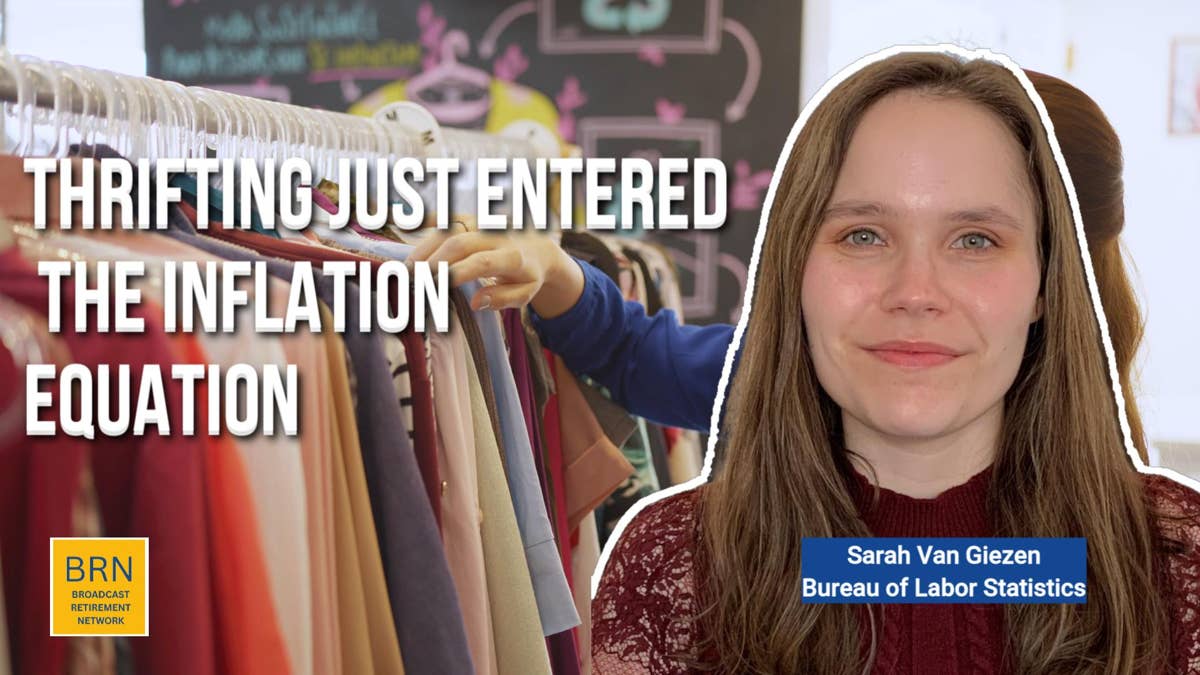
Sarah Van Giezen of the U.S. Bureau of Labor Statistics offers a fascinating behind-the-scenes look at how inflation is measured. She explains why secondhand apparel and thrifting were added to the Consumer Price Index in early 2025, how data collectors gather prices from stores across the country, and the rigorous multi-step review process that ensures accuracy before each monthly CPI release.
Jeffrey Snyder, Broadcast Retirement Network
Well, Sarah, it’s great to see you. Thanks for making time for us this morning.
Sarah Van Giezen, U.S. Bureau of Labor Statistics
Thank you for having me.
Jeffrey Snyder, Broadcast Retirement Network
I’m excited because, you know, we love having members of the federal government on the program and the Bureau of Labor Statistics. You guys are all things data, and I love data, so we really appreciate it. I wanted to jump in because I know, obviously, inflation’s a big conversation.
We’re not going to get into the actual inflation data and what that all means, but what I think’s really interesting, and I want to get your rationale and some understanding, according to reports, secondhand shopping, so thrifting, things like that, are being included now in the calculation, and I just wonder, maybe we can start with the who, the how, and the why. So why did this get incorporated into the index?
Sarah Van Giezen, U.S. Bureau of Labor Statistics
Yeah, so we started to include secondhand apparel in early 2025, and that was a little bit of a two-fold reason that allowed us to do that. So first, just changes in consumer behavior. We’re seeing more people are buying secondhand apparel, both just looking at market research and in our surveys.
So the Consumer Expenditures Survey has been catching people. It reported spending more secondhand, or spending on secondhand clothing. And the second, oh, sorry.
Jeffrey Snyder, Broadcast Retirement Network
No, no, thanks for your thought.
Sarah Van Giezen, U.S. Bureau of Labor Statistics
Yeah, thank you. And the second reason is the changes in the controls of quality within the secondhand market. So the Consumer Price Index, or CPI, follows a basket of goods over time.
So to have an accurate measure of price change, we need to have a normalized set of goods. So if one month I’m looking at the price of a silk blouse, and the next month I’m looking at a cotton t-shirt, that’s not price change due to the market. That’s just quality.
So for secondhand apparel, now you see stores, especially online, you’ll see categories like fair quality, good quality, like new quality. So that allows us to follow an item more accurately over time.
Jeffrey Snyder, Broadcast Retirement Network
It’s fascinating because a lot of people that I know thrift, and they do it not only for the prices, but it’s also kind of hip. Things that I wore in the 70s and 80s apparently are coming back. So I think it’s rather fascinating.
Let me just ask you, if you don’t mind, maybe a little bit of inside baseball, how does the Bureau of Labor Statistics collect the data? So I’m just kind of interested in that. I know that you’re calculating things, but how do you get the data from all the thrift stores to help with your calculation, if I can ask?
Sarah Van Giezen, U.S. Bureau of Labor Statistics
Yeah, absolutely. We’re still in early stages. The CPI is a voluntary survey, so we need stores to agree to participate with us.
But we send people out to go to stores. We have data collectors across the country who will go into a store, look at an item, and write down the price.
Jeffrey Snyder, Broadcast Retirement Network
So it’s almost like very grassroots. And do you do this with other goods that are in the basket? For example, I’ll use eggs or other…
Do you go to the stores to figure out what they are?
Sarah Van Giezen, U.S. Bureau of Labor Statistics
Absolutely. We do also, like for online stores, we’ll go onto the website. Or in special and expanding cases, we’ll work with companies or work with other entities that collect prices, we call it alternative data, to fill in our data.
But yes, we absolutely just will send people to a store and just look at it.
Jeffrey Snyder, Broadcast Retirement Network
And forgive me, because I don’t know the details, so I’m just asking questions that come into my brain. But does it vary by geographic reason? So you and I are both on the East Coast of the United States, but what about in the Midwest or in the Southwest part of the United States?
Do you have people that go into those stores too? And then do you homogenize the numbers or put that into your calculation?
Sarah Van Giezen, U.S. Bureau of Labor Statistics
Yeah. So the CPI is focused on urban populations. So we do have a collection of metropolitan areas that we collect from.
And the smaller areas are then used to represent a larger area. That information is available on our website if you want to learn more about our geographic coverage.
Jeffrey Snyder, Broadcast Retirement Network
Yeah, that’s, I mean, it’s fascinating. I think what’s interesting, if I could just go back to the thrift spending for a second, is the dynamic change. I mean, a lot of people would think that the bag of goods is very static, but in reality, your organization, you’re collecting data based on changing consumer needs.
I think maybe that’s something that possibly could be a misconception. I certainly didn’t know that, and presumably many people in the public probably didn’t know that as well.
Sarah Van Giezen, U.S. Bureau of Labor Statistics
So yeah, there’s definitely a balance of allowing new goods in while just fleeting goods, you don’t want to spend too much time on it. But yeah, absolutely. We have new goods entering the basket all the time.
Like I know, especially electronics, those are constantly updating to incorporate new goods.
Jeffrey Snyder, Broadcast Retirement Network
So like, for example, when the new iPhone or the new Android phone comes out, your team goes out and looks at the prices at the store and sees what they are for each item.
Sarah Van Giezen, U.S. Bureau of Labor Statistics
Yeah, we definitely, we maintain, especially in electronics, a mix of like older goods and the new goods that are coming in.
Jeffrey Snyder, Broadcast Retirement Network
I mean, it’s absolutely fascinating. And how, from the point of data collection, again, I’m just asking more inside baseball things just that come to me, but in terms of the data collection, so you collect all the data, I guess, on a monthly basis, and then how long does it take to then do the calculation? I mean, I would imagine there’s, you have spreadsheets, right?
I mean, there are probably spreadsheets and spreadsheets on top of spreadsheets, but in all seriousness, how long does it take to get the data in and then create the calculation?
Sarah Van Giezen, U.S. Bureau of Labor Statistics
Yeah, so we are constantly collecting the data. But as you said, from the first of the month to the last of the month, that’s our data for that month. And then it usually takes a little over a week to go through, make sure everything is verified and analyzed.
The CPI usually releases between like the 10th and the 13th of the following month.
Jeffrey Snyder, Broadcast Retirement Network
And the process to get that approved, I mean, approved probably is not the right word, but you said it’s probably a rigorous process to validate the data. It’s not like I just, it’s not like one person just sitting there typing and doing it and it’s done, right? There’s checks and balances for the data that is put out to the public.
Sarah Van Giezen, U.S. Bureau of Labor Statistics
Oh, absolutely. Like the lower people on the ladder like me, we’re coming at it from the bottom, making sure that the lower level numbers make sense. And then our supervisors confirm that that makes sense.
And then we have more people looking at from the top down of are these making sense for that geographic area or for this overall item? So there’s dozens of people who put in a great deal of time and effort to make sure the numbers are as accurate as possible.
Jeffrey Snyder, Broadcast Retirement Network
Sure. And I mean, so many, you know, you can’t help but turn on the read a paper or maybe not a paper, but look online and you see the number. I mean, it’s pretty much, everyone I think waits with bated breath for your number.
So I guess you’re a very popular person, not just you, but the team is very popular. Sarah, we’re going to have to leave it there. It’s great to see you.
Thanks for making a few minutes for us and giving us a little bit of the inside and baseball to how it all works. Thanks for joining us. And we look forward to having you back on the program again very soon.
Sarah Van Giezen, U.S. Bureau of Labor Statistics
Absolutely. Thank you so much for having me.