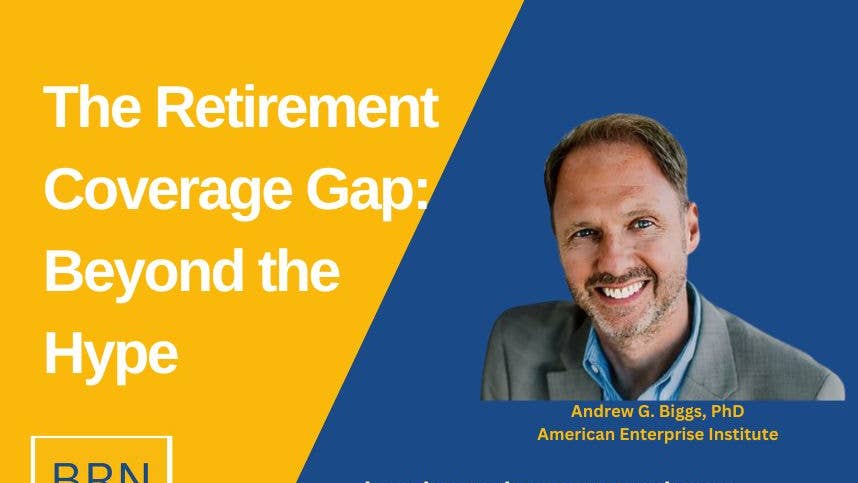


A measured, myth‑busting discussion about retirement coverage, affordability, and policy with Dr. Andrew Biggs of the American Enterprise Institute. We dig into whether a true “coverage gap” exists, why many low‑income and younger workers may not need to save aggressively today, how state auto‑IRA programs are changing participation, and where policymakers should focus—on cost‑efficient retirement supports rather than headline-grabbing participation metrics.Jeffrey Snyder, Broadcast Retirement NetworkJoining me now is Dr. Andrew Biggs of the American Enterprise Institute. Dr. Biggs, Andrew, it’s so great to see you. Thanks for joining us on the program this morning. Hey, great to be with you. Thank you.What I thought we would do, I think last time when you came on, we talked about social security. I don’t think we’ve gotten any solutions. I think there’s been a couple of different things or many different solutions kind of talked about in the public policy world, but nothing that we’ve kind of set on.So what I thought we’d do today is talk about the coverage gap or the so-called coverage gap. Let me start off with a baseline question for you, and you always are writing great stuff, great research. Is there a coverage gap problem in the United States for most American workers?Andrew G. Biggs, PhD., American Enterprise InstituteI guess the question you wanna frame in that is how many people who want to save for retirement are unable to do so? Now, you could say, in a sense, there’s no coverage gap because everybody could open an IRA on their own. But we also know that workplace retirement plans tend to be more effective in getting people saving because the contributions are automatic.It’s a simpler thing to do. So if you look out in the employer space, how big is this coverage gap? And some people claim it’s huge.Some people throw on data saying only around a third of private sector workers are offered a retirement plan. Those data are basically just wrong. But then you can get even more reliable data, say the Bureau of Labor Statistics for the private sector says 72% of workers are offered or work for somebody who offers a retirement plan, about 53% are participating.So you can say, well, the coverage gap of people who are not covered, when you say, well, it’s 100 minus 72 is 28%. But that still doesn’t quite answer the question because there’s a couple of things I would think about. First is you want to think about who really needs to be saving for retirement.If you’re a young worker, low income, part-time, to be honest, if you think about the sort of textbook economics, those are people who probably shouldn’t be saving for retirement. They should wait until their wages rise, save later in life. If you’re very low income, you’re gonna get a high replacement rate from Social Security.So to be honest, the lowest income workers, maybe the bottom fifth, really shouldn’t be saving for retirement. So there is this issue of when you restrict that data to people who reasonably should be saving for retirement, they’re a little bit older, they’re a little bit higher income, they’re working full-time rather than part-time, your coverage goes from 72% to a higher number. But there’s also the issue of, we want to think of the household basis.An example, my wife works for a nonprofit, they don’t offer a 401k or 403b, my own employer does. And the contribution limits for 401ks or other retirement plans are really pretty high, which means even if only one spouse has a retirement plan, you know, to be honest, they could probably contribute enough to save for both, for most, you know, households of reasonable income levels. I mean, just to give you an example from, this is IRS data, because they write good data who’s participating.When they look at married couples, so, you know, that tends to be people who are gonna be a little bit older, you know, they’re not fresh out of college, often a little bit higher income. I think the current data is around 83% of married couples have at least one of the spouses actively participating in a retirement plan. So you say, okay, if the participation is 83%, the coverage, the availabilities could be well over 90%.What that gets at is, you know, most households who really should be saving for retirement or that stage of life do have access to a plan. That doesn’t mean we shouldn’t be trying to eliminate the gap, but it also means as with all things about retirement preparation in the US, we have to put it all in context. Everything is better than most people claim.There’s this tendency towards panic, towards saying, oh, we have a retirement crisis and so forth. When you start pulling at the strings of those arguments, it’s almost never the case. And with a coverage gap, it is the same way.Jeffrey Snyder, Broadcast Retirement NetworkYeah, well, a lot of times those headlines are looking for clicks because let’s face it, that’s how the media companies get paid. Well, precisely. By views and that’s how it works.So to that point, let me ask you about affordability. So is it really, because we have, you know, we’ve got social security, that’s like this baseline that everyone, I believe everyone is eligible for because they just passed- Practically everyone. Practically everyone.They just passed the WEP, right, I think, where they allowed government employees in. So everyone’s got that baseline. It doesn’t cover everything, we know that.And hey, there’s solvency issues that you and I will continue to talk about. But then on top of that, we’ve got where you are in Oregon, they had the first state-run auto IRA program, but that has kind of proliferated to other states. And now the city of Philadelphia, I believe, just voted for a similar type of program for Philadelphians.And then to go a little bit further, now we have the Trump IRA, which was a result of the executive order. And on top of that, one more thing, pooled employer plants, which joined their MEP, multiple employer plant cousins. So it seems to me, just not the policy expert, that there are a lot of options out there.Andrew G. Biggs, PhD., American Enterprise InstituteOh, sure. And there’s, you know, different efforts kind of going at these same issues. I do live in Oregon, which as Oregon says, which was really the first and most fully implemented of the, what they call auto IRA plans, where if you’re not offered a retirement plan at work, then you would be automatically signed up for an IRA.This sort of administered by the state. Now, in theory, that should close the coverage gap. Going in, I forget the precise data, but there’s, you know, there’s these numbers coming from data saying, well, we have this, you know, several million people in Oregon who are non-covered, who, you know, would be eligible and would likely be signed up for these retirement plans.Now, if you look at where Oregon Saves is today, you don’t have anything like several million people. I mean, you have several hundred thousand people who’ve been signed up, some levels of contributions. It’s, so it’s one of those things I’m fine with it, but the issue isn’t that, you know, Oregon Saves is not addressing the retirement gap.I think part of it is the retirement gap is a lot smaller than people originally thought it was. And a lot of people get signed up, say, look, I’ve just got other things to do. You know, I’m not very high income.I’m, or maybe my spouse has an account, a 401k with a matching contribution. We prefer to do that. So the, you know, again, I don’t want to say bad things about sort of the auto IRA industry, I guess, the way you put it, but the states are doing this, but, you know, they’re celebrating, okay, we have, you know, $3 billion of assets in these plans nationwide now.Annual contributions to retirement plans are close to a trillion dollars. So it’s putting in scale that just, you know, it’s fine to have, but it’s, you know, most people are saving retirement. You know, we’re saving more for retirement now than we ever have before.So again, it’s putting it all in context. And I would just make one last point on these various plans, particularly as they’re aimed towards lower income workers, that, you know, higher income workers, people who work for big companies, almost all of them are offered a retirement plan. Lower income workers often aren’t.At the same time, it really doesn’t make sense for a lot of low income workers to save for retirement. I know that sounds kind of weird, but first, if you’re saying the bottom 20% of the earnings distribution, you’re going to get a social security benefit equal to about 75%, or sometimes more, of your pre-retirement earnings. That’s pretty close to what you need.But on top of it, a lot of lower income folks are, when they reach retirement, they’re going to get Medicaid for their health needs. Some of them will rely on Supplemental Security Income, SSI. If they build any sort of retirement savings, it’s going to disqualify for them for those benefits.So some people might think, well, you know, that’s good. We should make them be more self-sufficient. But what I would say is, if you were a financial advisor talking to somebody, I’m not sure you should be recommending they save if it’s simply to disqualify them, if they’re going to lose more in benefits than they get in savings.The issues are a lot more complex than people think they are. And so we have to have a more nuanced view of this than simply, hey, more savings is better, more people saving is better. It’s more complex than that.Jeffrey Snyder, Broadcast Retirement NetworkBut, and maybe I’m throwing myself under the bus here as a member of the retirement industry, but, you know, there’s myopia. This is what I’ve done for a living for the last 32 years is think about saving for retirement, helping, you know, it’s front and center for myself and my peers. So I can understand why in particular the financial services and retirement industry would be focused on this particular thing.Let me, I’m not going to get you to comment on that, but let me get you to comment on one more piece, affordability. Obviously we’re going through some challenges now with the geopolitical events, the war, the blockade, the gas prices, oil prices, all that kind of stuff. But it would seem to me that I think by and large, people want to save.I think if you were to talk to people in the street, you’d probably talk to more people than I do, by the way. I’m sitting in a studio all day long, but I think people know that they need to save, that there’s a future and they need to put money away. I think that they’re just challenged to pay for things.I mean, as we all are, we’re paying more for food, we’re paying more for fuel, all the other things. So isn’t that really the issue is we just need to pay people more money and then they’ll be able to afford to save for retirement.Andrew G. Biggs, PhD., American Enterprise InstituteI don’t want to reject it completely. I was saying that tongue in cheek, but. But yeah, I mean, it’s because in a sense of a lot of the discussions of retirement savings adequacy, retirement income, talk about things that could go wrong.And in some cases are, but then I don’t think young people are saving less for retirement today than young people did in the past. And so we do hear, okay, inflation, rents are going up and I’m spending too much of my latte or whatever. But you also have increased use of say automatic enrollment for 401k plans.We do have higher coverage today for retirement plans than we had in the past. I think we are at a record high now. So a lot of younger people are in fact being signed up for plans and saving.And so it’s, these things are impediments, but if you went back 10 years or 20 years or 30 years, there’d always be something saying why people can’t save for retirement. The reality is we are saving more for retirement now than we ever did before. So it’s, despite all these things, something is working right.So, and as people get older, they tend to save more as well. So if somebody is 25 and they’re not saving a lot for retirement, that’s not a huge worry. If they’re 45, then that can become more of an issue.Jeffrey Snyder, Broadcast Retirement NetworkYeah, I was gonna interrupt and say 100% isn’t really possible, right? I mean, that’s just like a fictitious number. You’re never gonna get 100% of the population to do anything.Andrew G. Biggs, PhD., American Enterprise InstituteLet me ask you- Nor, and here’s the point, nor should you. The idea that 100% of the population should be saving for retirement when 100% of their careers is just factually incorrect. Again, probably your bottom 20% of people in terms of lifetime earnings shouldn’t save for retirement at all because of what they’re gonna get from social security or what they would lose from means-tested programs.But then really in sort of your kind of lifecycle model, econ stuff, probably people should start saving for retirement when they’re between 35 and 40. That’s the point when the earnings have risen enough that they can start putting more aside. So if you take out, okay, people who are the bottom fifth of the population in terms of incomes, but then also take out people who are under 35, you’re gonna have half of the people not saving for retirement at any given time, even if everybody were in fact saving optimally for retirement.So it’s just, this is one of the things that people really have a tough time handling, but it’s, you know, it’s like you shouldn’t be going to your doctor every day even, you know, in order to stay healthy. It’s the, there’s times and places for this stuff. And so it’s people who look at the data in a more nuanced way, I think, get this.But a lot of times what you read in the newspaper is, oh, half the people aren’t saving for retirement. And that itself is not evidence that people are under saving for retirement.Jeffrey Snyder, Broadcast Retirement NetworkSo if you could wave a magic wand, this is my hypothetical question to you, where would you, rather than maybe focus on coverage, where do you think, and we can walk and chew gum as a country, right? We can do multiple things, but where should policymakers spend their efforts and time among the other many things that they have to do? But, you know, when it comes to retirement, the retirement industry, where should they be focusing their attention?If you could advise them.Andrew G. Biggs, PhD., American Enterprise InstituteWell, you know, I kind of, I’m not really an industry person, I’m a public policy person. So that’s, and there are differences there. And one of the differences that I think about how much everything costs, that the retirement in America has largely been a serious successful transition in the sense retirees, if you go back to the 1970s, were in fact a disproportionately poor population, a poor part of the population.They’re more higher poverty rates than everybody else, more lumped in the bottom income distribution. That is in fact no longer true. They’re disproportionately in the higher end of the income distribution.They have disproportionately low poverty rates. If you look even at surveys, sort of subjective feelings of financial security, retirees are better off. I mean, the Federal Reserve just put out its survey of household economics and decision-making in the past couple of weeks.And they asked people to rate their financial security on sort of this one to four scale. And the lowest one is one, where you say I’m really finding it difficult to get by. If you look at people 65 and older, it’s like three or 4% of them saying that.And retirement or financial security is high. It’s been rising in that group. So you say, well, what is the possible problem?Well, one of the possible problems is our retirement problems are gonna bankrupt us. And social security is gonna be insolvent in less than 10 years. The cost has risen from 4% of GDP in 2000.There’ll be up to 6% of GDP. We’re spending another one, one and a half percent of GDP on tax preferences for retirement plans. This stuff is really expensive.And so we need to start thinking of not just how do we increase retirement savings or increase retirement incomes, is how do we do it cost-efficiently? Because social security is going broke. Medicare is going broke.We have huge deficits. We have to find ways of doing this more cheaply. And so that’s something where I think the industry can contribute to this in the sense of saying, okay, what is really effective here?What are things we can kind of live without? And on the public policy end, Congress has got to start thinking with social security. What do we really need?What are the nice-to-haves versus the must-haves? What do we have to be doing here versus stuff, $100,000 in benefits for a high-income couple is kind of not on the must-have list. So it’s thinking about the cost side of the equation.It’s gonna become increasingly important over the next decade.Jeffrey Snyder, Broadcast Retirement NetworkDo you remember the movie, Dave? Do you remember when Kevin Kline was in that budget meeting and he brought in his accountant and they were able to save the first lady played by Sigourney Weaver, her character’s children’s program that supposedly he cut? That’s probably need a whiteboard now to put all this down.And I think if people got into a room, probably figure it all out. Dr. Biggs, it’s always great to see you. Thanks for listening to my questions, humoring me, and I always appreciate your perspective.And look, we look forward to having you back on the program again. Andrew G. Biggs, PhD., American Enterprise InstituteI’m happy to come back anytime. Thank you very much.