


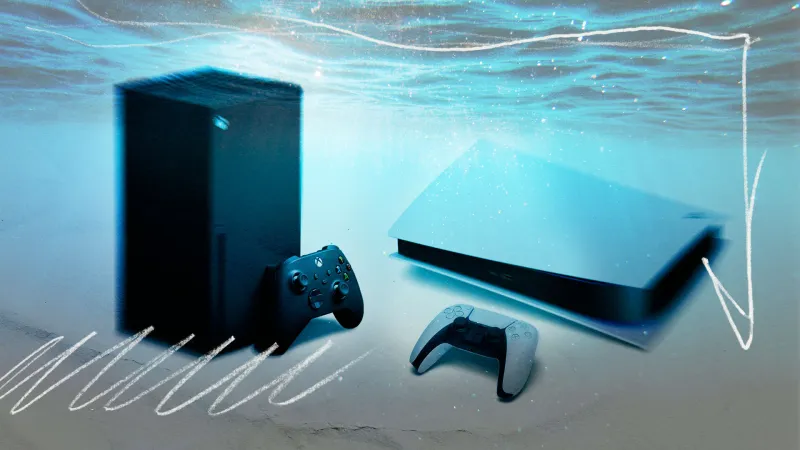

Coming into this generation, we were given lofty promises about the value to the consumer and what the new technology could afford developers. Now that we’re nearing the end of this era for both PlayStation and Xbox, it’s clear this generation will not be defined by the incredible games that released during the PS5 and Xbox Series X’s lifecycles (of which there were many), nor by the powerful technology that has all but eliminated load times and allowed for unprecedented performance and graphical fidelity. Instead, the ninth console generation will be defined by corporate greed, mismanagement, and anti-consumer practices that could very well alter the course of the games industry itself.
If you pay attention to the news within the games space, you couldn’t possibly miss that we have been in the midst of persistent layoffs and closures for the last half decade. Beloved, successful studios with storied histories have been forced to lay off tens of thousands of workers in aggregate as the corporate pursuit of eternal profit has disenfranchised millennia of collective institutional knowledge. When you factor in how many of those long-tenured games industry workers may simply never return because they can’t find steady or secure work, as well as how many younger would-be developers have simply decided to pursue other careers in the name of not having to look over their shoulders in fear of their jobs, the damage to this industry by the shareholder-appeasing corporations has been immense and, likely, irreversible. That, in and of itself, is enough to potentially kill the entire industry, but that’s far from the only dramatic downturn gaming has faced this generation.
 Former Microsoft Gaming CEO Phil Spencer at XO19 in 2019
Looking at just this last year, PlayStation and Xbox truly seem to be racing towards the bottom. After all but killing the value proposition of Xbox Game Pass by skyrocketing the subscription price, Xbox leadership underwent a huge shake up at the top, which saw Phil Spencer and Sarah Bond – the two most prominent figureheads at Xbox, and the architects of this generation’s strategy – depart the company. This opened up the door for sweeping changes, and that is precisely what has happened, as new Microsoft Gaming CEO Asha Sharma has come in with a “reset” mentality, that seems to involve adopting the move-fast-and-break-stuff approach often seen tech startups.
Sharma’s new leadership brought the price of Game Pass back down and re-instilled the long-missing notion of exclusive games for Xbox, but the rest has either been inconsequential (like changing the official name of Xbox to all-caps or minimalizing competing platform logos on streams) or seemingly shortsighted moves, like reportedly considering the closures of renowned and award-winning studios like Ninja Theory, Compulsion Games, Double Fine, Undead Labs, and Arkane Studios. And that’s after the platform holder already shuttered its apparent ace-in-the-hole studio, The Initiative, and canceled its Perfect Dark reboot last year. What good is restoring exclusivity if you close some of the best studios under your umbrella? If Xbox wants to “give people a reason to own an Xbox again” after an extremely underwhelming generation, it needs more than just Halo Studios, Playground Games, and The Coalition to deliver the content.
But each time Xbox steps on a metaphorical rake, PlayStation seems ready and willing to rescue its competitor from the negative news cycle. Whether it’s the closure of studios like Shadow of the Colossus and Demon’s Souls remake developer Bluepoint Games or massive layoffs of Destiny developer Bungie, PlayStation has wreaked more than its fair share of havoc within the games industry as of late, as well. But it did so at a time when it continues to triple down on its commitment to live-service games.
To be fair, many publishers and studios pivoted from single-player content in the pursuit of live-service glory in the wake of Fortnite’s success last decade, but few more than PlayStation. PlayStation has seemingly mortgaged its entire future on the notion, and it isn’t letting up. Even putting aside its house-cleaning at Bungie, one of the historically most successful live-service studios, PlayStation has witnessed firsthand the collapse of its live-service endeavors through the massive flop that was Concord, which was shut down and its studio closed mere weeks after launch. These knee-jerk decisions when it comes to closing live-service games so shortly after launch neglect to remember that not even Fortnite was the wild success that it eventually became right at launch; its PvE mode was originally set to be its flagship content, but when it didn’t hit the way Epic Games had hoped, the publisher gave the team the ability to pivot to the Battle Royale format (a direct response to PUBG: Battlegrounds’ success) that made it one of the most-played games in history. That didn’t happen until two full months after launch; PlayStation only gave Concord two weeks before throwing in the towel.
Then comes the all-digital future that nobody wants but the corporations. I’m someone who hasn’t bought a physical game in years, but I have plenty of friends who still love going to stores and perusing the new releases. PlayStation’s confirmation of its all-digital future starting in 2028 is yet another anti-consumer practice that will further push the industry down a dark path. We’ve already learned time and again that content you purchase on these digital storefronts is not yours to own, but rather a rented license to play said content. PlayStation itself reaffirmed that earlier this week, when it delisted and removed hundreds of digital movies customers purchased.
We are rapidly heading down the path to not only a lack of ownership with our entertainment media (even more so than we already are nearly 20 years into the movie and TV streaming era), but also a crisis of game preservation. Frank Cifaldi, director of the Video Game History Foundation, put out a statement in the wake of PlayStation’s announcement of its all-digital future, calling it “a hit to consumer rights, the resale market, and game creators whose businesses rely on the physical market.”
 The latest console price hikes do not bode well for future game consoles
And that’s all without mentioning the skyrocketing cost of being a gamer in 2026 and beyond. We’ve already accepted that most triple-A games will cost $70, but Nintendo broke the $80 seal with Mario Kart World. And it’s not just individual games, as the cost of the consoles are going up, too. Normally, early adopters pay a premium for getting new tech right when it comes out, while those who wait can score a discount. Due to a confluence of events, including international trade policies like the implementation of tariffs and the over-consumption of tech components by the AI industry, the ninth console generation is raising prices for the same technology rather than dropping it over time.
The PS5 Pro felt expensive when it was announced as a $700 premium gaming experience, but that price feels tame in comparison to its current $900 price tag. In fact, the closest system to what I bought for $500 in 2020 – the current PlayStation 5 Slim Disc Edition – is now priced nearly at that original PS5 Pro price at a staggering $650. Xbox also raised its prices for the third time in 13 months, with an acknowledgement that it will likely continue to become more expensive next year. It’s not difficult to imagine the new consoles on the horizon that are either announced (in the case of Xbox) or reported (in the case of PlayStation) could cost even more. And when the best alternative to PlayStation and Xbox – PC gaming – is also impacted heavily by tariffs and AI-induced shortages, therefore jumping in price right alongside its console contemporaries, it paints an even bleaker picture of the current and future states of gaming.
I’d have some level of sympathy for Xbox, as it continues to blame component shortages for the price increases, but when its parent company, Microsoft, has invested $146 billion in AI, it’s hard not to feel like this is not a self-inflicted wound. Instead, it feels like, at best, a case of one hand not talking to the other on Microsoft’s part or, at worst, a cannibalistic calculation wherein Microsoft thinks that sacrificing the games industry in pursuit of the ever-prophesized-yet-still-unrealized eternal profit growth through AI infrastructure is a worthy sacrifice.
Additionally, when PlayStation says it will no longer offer physical sales starting in 2028, and Xbox may reportedly be not far behind, we will be beholden to the digital storefront sales going forward when it comes to saving money. Those discounts are often good now, but when you remove the brick-and-mortar competition, what’s to stop these digital shops from keeping prices inflated for longer?
PlayStation and Xbox aren’t the only companies struggling during this stretch, but when platform holders make such hard pivots after unchecked expansion and acquisition sprees, it spiderwebs out to impact more than just the localized in-house changes. Sure, PlayStation and Xbox studios are being shuttered or impacted by massive reductions in workforces, but we also saw the immediate impact of Xbox’s withdrawal from its partnership with IO Interactive’s Project Fantasy; that studio just released the successful and acclaimed 007 First Light earlier this year, and now, it’s contemplating necessary layoffs. We saw it with Xbox’s scaling back with its longtime PR agency, Assembly; just as that news hit, several tenured employees were laid off. And now, with PlayStation’s announcement of the end of physical media for its upcoming hardware, we will likely see even more fallout.
Soon after that news hit, retro and physical-game vendor iam8bit put out a statement saying it was “profoundly disappointed” in PlayStation’s decision to phase out physical media – likely a bad sign for its core business. But it’s going to go deeper than that, as online vendors and brick-and-mortar shops that rely heavily on physical game sales will struggle even more than they have in the modern video game landscape. None of this is Sony’s concern, nor does it need to be, but it’s another example of how these seismic shifts in policy and partnership can impact the broader games industry, even beyond the anti-consumer implications. Both Microsoft and Sony are rewriting its places and legacies within the games industry, and their reputations may not recover for a very long time, if the industry even survives their nosedives.

And though I’m largely leaving Nintendo out of this, it’s been far from perfect, with price increases and the controversy surrounding Game Key Cards. But when compared to the practices of PlayStation and Xbox during this stretch, Nintendo’s operations have looked downright ethical. And, perhaps not coincidentally, the sales of Nintendo platforms during this time have lapped those of PlayStation and Xbox. The Switch and Switch 2 have consistently sold well, with the first Switch earning its spot among the best-selling video game platforms of all time.
Though Nintendo’s policies might only play a small direct role in that, the benefits of its employee retention, calculated acquisitions, and more measured approaches to policy changes that impact consumers and the broader landscape are likely directly responsible for its sustained affluence. Nintendo has the advantage of having the best first-party developer in the history of video games (itself) exclusive to its platforms, and it’s likely not a coincidence that it has retained that title by not laying off its most important development team members after an underperforming game or a lull in releases. Sure, Japan’s labor laws make layoffs more challenging, but Nintendo likely could have conducted massive layoffs during the sluggish early years of the 3DS, but it didn’t. Instead, the late Satoru Iwata took a pay cut to make up for the slow handheld sales, and Nintendo lowered the price of the platform and offered early adopters free classic games to thank them for their business. That is how a company executive can take accountability, and a corporation can still race to the top amidst financial problems, rather than making its struggles everyone else’s problem.
The Console Wars, as they emerged in the early days of gaming, used to be about one-upping your competition. Today, it feels more about finding the nebulous line for how much wealth you can extract from your consumer base without driving them into the arms of your biggest competitor. I truly don’t know what the future holds for this industry if we continue down the path of the last five years, but I can tell you it won’t be good. Though sustainability is a problem for the entire industry to solve, we need the platform holders to lead from the top rather than continuing to pull the rug out from under their partners in the process of dismantling this hobby that we all love.