

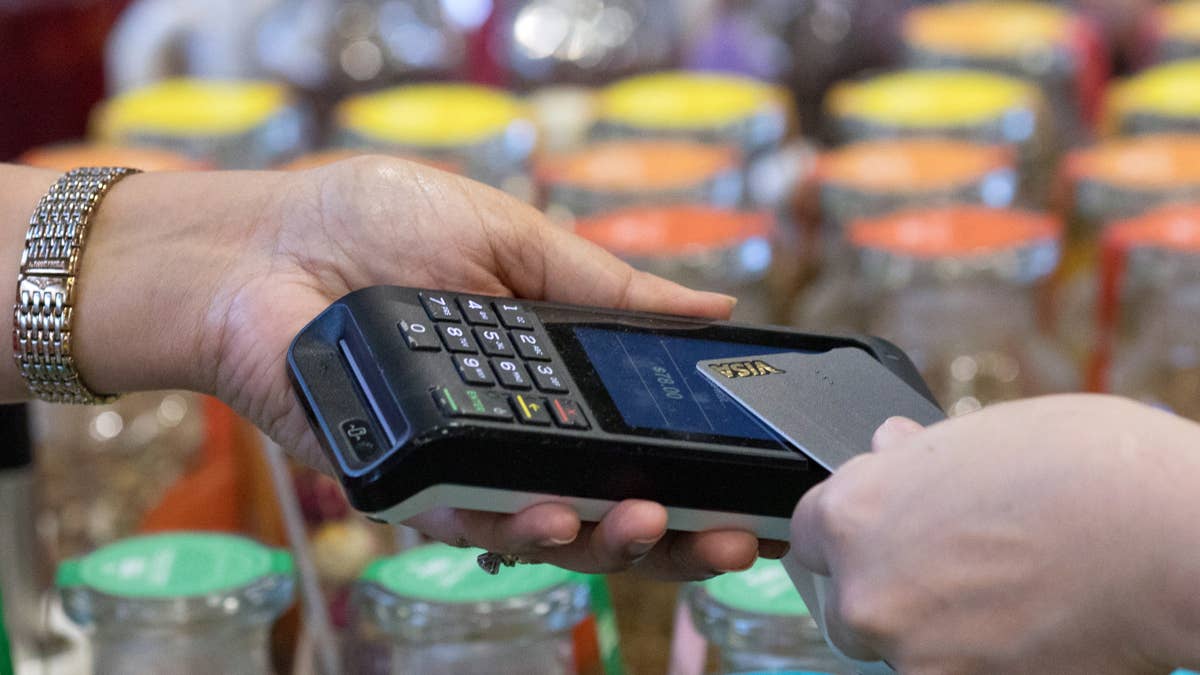
After nearly 60 years of service, the magnetic stripe — that dark magnetic band on the back of your credit card — is heading into retirement. Invented by IBM in the early 1960s, company lore holds that engineer Forrest Parry successfully secured magnetic tape to a plastic card only after his wife suggested using a hot clothing iron to fuse them together.
Before the stripe, clerks copied card numbers by hand or ran cards through carbon-paper imprinters (“zip-zap machines”), cross-referencing account numbers against physical printed ledger books. The stripe introduced real-time digital verification, revolutionizing daily commerce. But with secure EMV chip technology now common worldwide, the magnetic stripe has transitioned from a necessity to an outdated legacy backup.
Read: Should you cancel your credit cards when you retire?
When your cards change
Mastercard is the first payment network to phase out the stripe. The schedule:
2024: New Mastercard credit and debit cards no longer required to carry a stripe in most markets, starting with chip-heavy regions like Europe.
2027: U.S. banks no longer required to include a stripe on new Mastercard chip cards.
2029: No new Mastercard credit or debit cards issued with a stripe. Prepaid cards in the U.S. and Canada are exempt for now.
2033: No Mastercard credit or debit cards include a stripe at all.
For most readers, the change will arrive quietly in the mail with a replacement card. Any cards issued with a stripe before the 2029 cutoff will keep working until they expire.
Why now
The stripe’s greatest weakness is that it never changes. It holds your card number and expiration date as fixed data, identical on every swipe, so a skimmer hidden in a gas pump or ATM can copy and write it onto a counterfeit card. A chip, by contrast, generates a unique code for each transaction, which the issuing bank checks to confirm the real card is present. Copying the data from one chip purchase is pointless because the verification code changes for the next transaction.
Shoppers have already moved on. Chips handle almost 98% of face-to-face card transactions worldwide, and contactless tapping has become standard.
Ann Johnson, Mastercard’s executive vice president of Security Solutions, credits the stripe with bringing payments into the electronic age, noting that “today’s threat landscape demands stronger, smarter defenses.”
How your next card will look
It may stand up straight
Some banks print cards in portrait orientation because that’s how people naturally hold them. Cowyk Fox, former managing executive at South Africa’s Absa bank, explained the logic when Absa introduced vertical cards in 2019: whether you’re tapping, dipping, or handing the card to a cashier, you’re likely holding it vertically, on the short end. Absa has since switched all its cards to vertical designs, while the Hudson Bay Company was an early North American issuer of the vertical card.
It may know your fingerprint
Similar to smartphone authentication, a biometric credit card features an integrated fingerprint sensor built into the plastic. You register your print once — at home or at a bank branch — storing it locally in the card’s chip. At checkout, you hold your thumb on the sensor while tapping the card. Instead of needing a battery, the card draws power inductively from the payment terminal to check your print before authorizing the transaction.
Replacing PINs or signatures with biometric verification allows banks to lift spending caps on tap payments. Card manufacturers Thales and Giesecke+Devrient have supplied biometric cards to pilot programs at banks including Bank of Cyprus, NatWest in the U.K., and Crédit Agricole in France, targeting primarily premium and high-net-worth customers.
U.S. customers will have to wait a while longer for this new technology. High production costs ($20-$25 per card) and strong competition from established mobile wallets like Apple Pay and Google Pay have contributed to the slower domestic deployment.
Are shoppers ready?
Most Americans know biometric payments exist, but far fewer have used them in person. Industry surveys place general awareness above 90% and actual use closer to one-third of consumers. Meanwhile, nearly 81% of consumers consider biometrics more secure than traditional payment methods.
Earlier survey data shows similar preferences. A 2024 payments survey found that a majority of North American consumers said they’d used biometrics for some purpose, and nearly half said they were open to using biometric authentication at retail checkout terminals. Financial institutions surfaced as the most trusted keepers of biometric data, ranking ahead of tech companies and government agencies.
Analysts expect growth but not a stampede. Christopher Miller, lead emerging payments analyst at Javelin, noted that tapping a card is already fast and low-fraud, so shoppers lack an obvious reason to switch. “The immediate trigger that would drive substantial uptake right away just isn’t there,” he said.
What’s not changing
The magnetic stripe is slowly moving toward retirement, but a full phase-out will take time.
Your current cards are safe: Cards already in your wallet will keep working until they expire.
Prepaid cards remain exempt: Prepaid cards in the U.S. and Canada are not subject to Mastercard’s 2029 stripe removal deadline.
U.S. card readers will retain swiping: While Mastercard will let terminals and ATMs drop stripe readers beginning in April 2029 in most of the world, U.S. terminals must keep the stripe as an option, since swiping remains common.
Network variance: Other major card networks, including Visa, have no plans to phase out the magnetic stripe, keeping options available for global merchants.
The stripe hasn’t died yet, but it’s on hospice, with a projected end date of 2033 — and a long list of terminals, door readers, and prepaid cards still depending on it.
This article written for TheStreet by Nifty 50+