


Every large home project comes down to a question you answer before you ever call a contractor. Not what it costs.
When you already know the arithmetic of waiting. Prices drift up, your kitchen gets another year older, and the quote you were quietly hoping would improve never does.
So you wait anyway, because waiting feels free and deciding does not.
Most of the time, that instinct is defensible. Home improvement spending is discretionary by design, and a project you postpone is money that stays in your account doing something else.
The dishwasher still runs. The cabinet doors still close, mostly. There is always a better quarter coming, and no particular reason this one has to be it.
Deferral works right up until a date gets attached to the decision. Then the free option stops being free, because somebody else has started the clock for you.
That is where kitchen and bath projects sit this fall.
Imported kitchen cabinets and bathroom vanities entering the United States currently carry a 25% tariff under Section 232 of the Trade Expansion Act of 1962. On Jan. 1, 2027, that rate is scheduled to double to 50%.
Upholstered wooden furniture rises from 25% to 30% on the same day, according to Barnes Richardson.
Almost everything you read between now and January will treat this as a price story. Cabinets cost more; you adjust your budget and move on.
That framing skips the part that decides what you actually pay. The stated purpose of the tariff is to move cabinet production back into American factories.
Whether that works depends on something almost nobody outside the industry looks at: whether domestic manufacturers can absorb the volume in the time remaining.
I went looking for that answer, and the numbers are not reassuring.
What the January cabinet tariff actually changes
The duty applies worldwide rather than country by country, and there is no exemption for Canadian or Mexican goods.
It also stacks on top of existing antidumping and countervailing duties, which is why cabinets of Chinese origin can land at effective rates well above the headline number, according to Barnes Richardson.
One detail matters more than the rate itself. This increase has already been postponed once.
It was scheduled for Jan. 1, 2026, and President Donald Trump signed a New Year’s Eve proclamation delaying it a full year while trade talks continued, the Associated Press reported.
So treat January as scheduled, not settled. That distinction should shape how much you are willing to spend to get ahead of it.
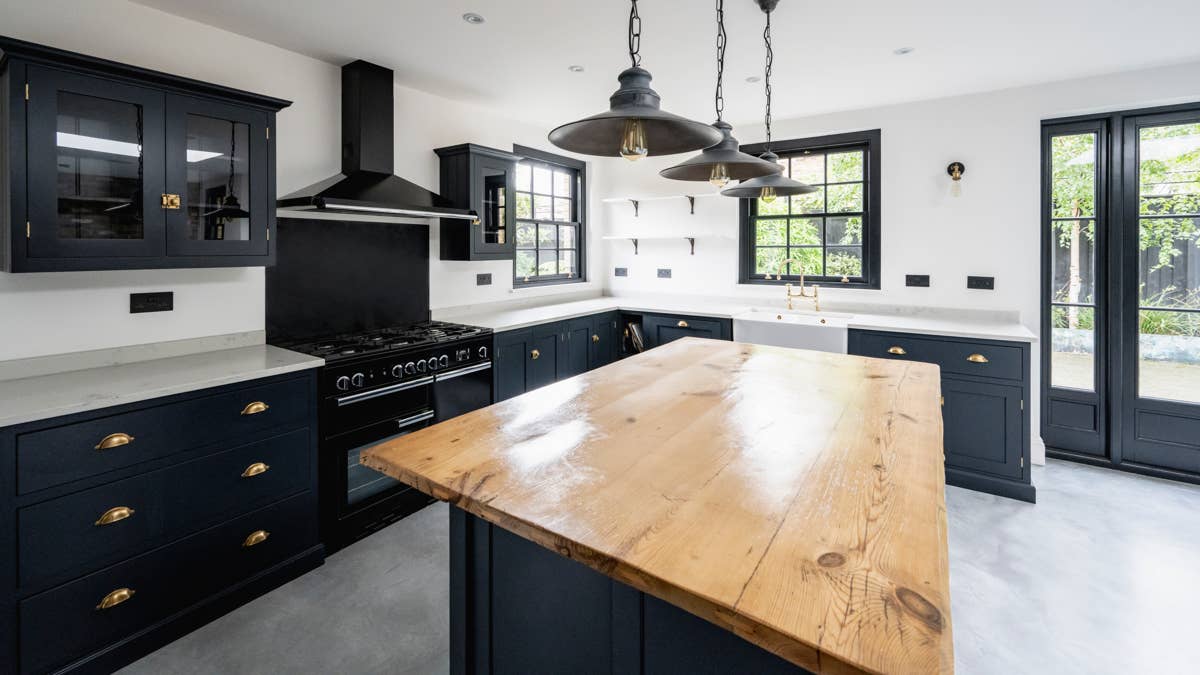
U.S. cabinet tariffs are set to double from 25% to 50% on Jan. 1, 2027, raising project costs.lisegagne / Getty Images
Why domestic cabinet capacity is shrinking instead of growing
Here is the part that changed my read on this story.
MasterBrand (MBC) closed a $3.6 billion all-stock merger with American Woodmark on May 28, 2026, creating the largest cabinet maker in North America, the company said.
On its Aug. 11 second-quarter call, management laid out a second-half outlook built on the assumption that the Section 232 rate stays at 25%. A move to 50% in January would stretch the company’s debt reduction timeline, executives said on the call.
More Household Products:
How Americans buy furniture is starting to change
Amazon finds itself in hot water over Ring camera feature
Home Depot is making a big bet on cautious consumers
Read that again. The biggest player in the industry is not planning around the tariff. It is planning around the tariff not happening.
The operating picture underneath the guidance is worse. Management described a repair-and-remodel market down mid- to high-single digits as homeowners defer discretionary work.
It also described a trade-down pattern in which buyers strip features out of made-to-order cabinets to reach a price. American Woodmark came in below expectations on excess fixed capacity, and two plant closures are already underway.
The wider supply chain tells the same story. Consider what the reshoring math is actually working with:
U.S. sawmill production fell for a second consecutive quarter in the first quarter of 2026, according to the National Association of Home Builders.
Full production capacity at U.S. sawmills dropped 6% over the year, based on NAHB analysis of Federal Reserve and Census Bureau data.
Utilization rose to 71.8% from 71.2%, a gain NAHB attributes to shrinking capacity rather than rising output.
Sawmill and wood preservation employment fell to roughly 82,800 workers, a 12th straight quarterly decline and the lowest level since 2010, according to Eye on Housing.
Capacity is not being built ahead of January. It is being retired.
The bottleneck sits between your cabinet order and the factory floor
Physical capacity is only half of it. The other half is what happens between a customer order and a production-ready cut list, and that is where a custom cabinet order quietly eats a shop’s throughput.
Lernik Mirzakhanyan, chief product officer at BeeGraphy, a cloud-based computational design platform that works with furniture manufacturers, frames it as two separate ceilings.
A manufacturer has physical capacity, meaning people, materials, equipment, and floor space. But it also has information capacity, meaning the ability to turn a custom order into a verified production assignment.
“Actual output is limited by the weaker link,” Mirzakhanyan explained.
Related: Zillow predicts big mortgage rate, housing market change
The weaker link is often the order-preparation process itself. Design software, resource planning systems, and the machines themselves often “operate as separate islands,” he said, leaving manual data transfer, repeated checks, and version control in between.
Change one dimension, and the cascade runs longer than you would guess. Move a cabinet width from 24 inches to 26, and the carcass, shelves, doors, connections, clearances, hardware, and drilling can all shift, along with the cost, cut layouts, and machine data.
The cost of materials, production cost, and selling price may then need to be recalculated, along with the parts specification, edge-banding data, drawings, cut layouts, production files, and the order version.
According to Mirzakhanyan, such a change requires repeated calculations, approvals, and replanning, regardless of whether production has started.
The work can take several person-hours. If materials have already been ordered or parts have already been manufactured, there can also be additional purchases, delays, and material write-offs.
There is a detail here that should interest anyone shopping down a tier. Buyers trading down replace hardware and finishes with cheaper ones to lower the final price. The material cost does indeed decrease, but the manufacturer has to discuss the order again, recalculate it, and redo the production documentation.
It does not lower the engineering work. “A simpler product does not always mean a simpler order,” Mirzakhanyan said, describing orders where price and margin fall while processing cost can increase.
The costs of this additional work can be higher than the savings on the hardware. As a result, the buyer pays less, while the manufacturer’s actual cost of processing the order increases and its margin decreases.
What 4 months of preparation can realistically fix
Ask what a U.S. cabinet manufacturer could accomplish between now and January, and the honest answer is narrow. Over this period, a manufacturer can analyze the entire order journey and begin gradually changing how it works with the product lines that require the most repetitive manual preparation, Mirzakhanyan said.
That gap is the whole story for your budget. The tariff arrives on a fixed date, while the final price and order fulfillment time will depend on how quickly the manufacturer can adapt.
Mirzakhanyan’s comments align with what I would tell a friend. I would not make a decision based solely on price forecasts.
If your project is ready and your manufacturer has locked in the price, deadlines, and tariff risk in writing, order this fall. If it is not ready, rushing into mistakes could cost you more than a possible price increase in the coming months.
How to decide on your kitchen renovation timing this fall
Run your own version of this, because the answer is not the same for everyone.
The case for moving now is a scheduled cost increase against a contracting supply base, plus a housing stock that keeps generating deferred projects. The median age of American homes has reached 44 years, the oldest on record, according to the Harvard Joint Center for Housing Studies.
That is the same pressure already showing up in rising homeownership costs.
The case for waiting is that January has slipped once and could slip again, and that a rushed project carries costs of its own.
Mirzakhanyan’s advice tracks with what I would tell a friend. If your project is ready and your manufacturer has locked price, deadlines, and tariff risk in writing, order this fall.
If it is not ready, rushing into mistakes will cost you more than the tariff will.
The word doing the work there is “locked.” A quote is not a lock.
Ask your dealer, in writing, which side of Jan. 1 your duty rate gets assessed on, and who absorbs the difference if the date holds. That single question is worth more to your budget than any forecast, including mine.
Related: Fannie Mae predicts where home prices are headed next