


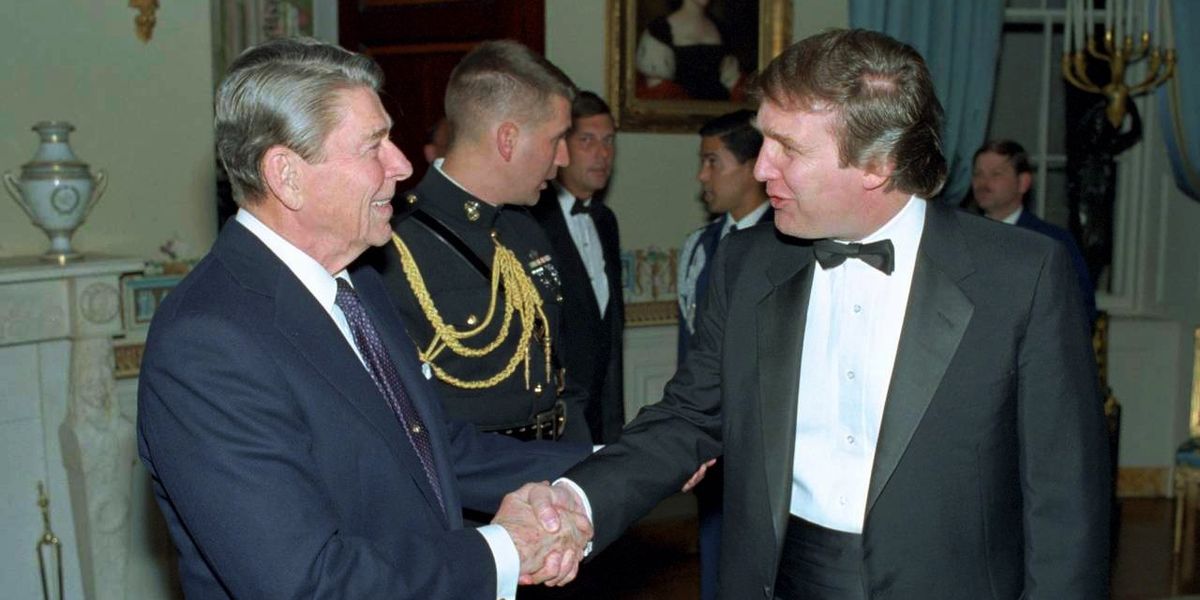
President Donald Trump won the Republican nomination in 2016, 2020 and 2024, prevailing in the 2020 election — yet according to a recent report, he first developed a thirst for the presidency in 1987. The catalyst, it appears, was a desire to promote his then-new book “The Art of the Deal,” which was ghostwritten by journalist Tony Schwartz.
“Astonishingly, Trump’s thirst for recognition, and Random House’s desperation, came together to create a publicity stunt which now haunts us all: A campaign for people to think Trump was running for president,” reported The Daily Beast’s Michael Daly on Tuesday about Trump’s life in the summer of 1987. “It began when the publicity team was meeting in Trump Tower, where fakery was never far away (Trump always said it had 68 stories; it actually only has 58). A secretary reported that his office had been contacted by a New England furniture maker with a big idea.”
Daly continued that Trump was recruited by a New Hampshire Republican activist, Mike Dunbar, to run for president. While initially the goal was merely to help raise Trump’s national profile, Dunbar convinced him that he actually could be a great president, and Trump began to spend money to pack auditoriums and otherwise give the media the impression that he was a serious candidate.
This culminated in a series of Sept. 2, 1987 full-page ads that Trump published in The New York Times, The Boston Globe and The Washington Post advocating for an isolationist foreign policy quite different from the neoconservatism being implemented by President Ronald Reagan.
“For decades, Japan and other nations have been taking advantage of the United States,” Trump wrote. “Why are these nations not paying the United States for the human lives and billions of dollars we are losing to protect their interests?”
In a harsh language with which Americans would soon become intimately familiar, Trump claimed that “the world is laughing at America’s politicians as we protect ships we don’t own, carrying oil we don’t need, destined for allies who won’t help” and would face a “catastrophe” without better foreign policy leadership. He also described Iran as “a horrible, horrible country,” suggesting that America “go in and take over some of their oil.”
Ultimately, Daly found that Trump became addicted to the attention he received, and speculated that his need for it never stopped.
“While seeking ever more power as a ruler, he has himself been ruled by an addict’s insatiable need for more, more, more,” Daly wrote. “He who once stood outside Trump Tower hoping to be recognized has been affixing his name and face everywhere possible. Our history is being governed by someone who exists only in the instant.”
He continued, “And, as we celebrated America’s 250th birthday, Trump sought to supplant the nation as the center of attention.”
Regardless of Trump’s ultimate goals, “The Art of the Deal” singlehandedly transformed him from a local celebrity in the New York City area into a national one. It also gave him the image of the ultimate dealmaker, as exemplified by a key passage from his book.
“My style of deal-making is quite simple and straightforward,” Trump wrote in “The Art of the Deal.” “I aim very high, and then I just keep pushing and pushing and pushing to get what I’m after. Sometimes I settle for less than I sought, but in most cases I still end up with what I want.”