

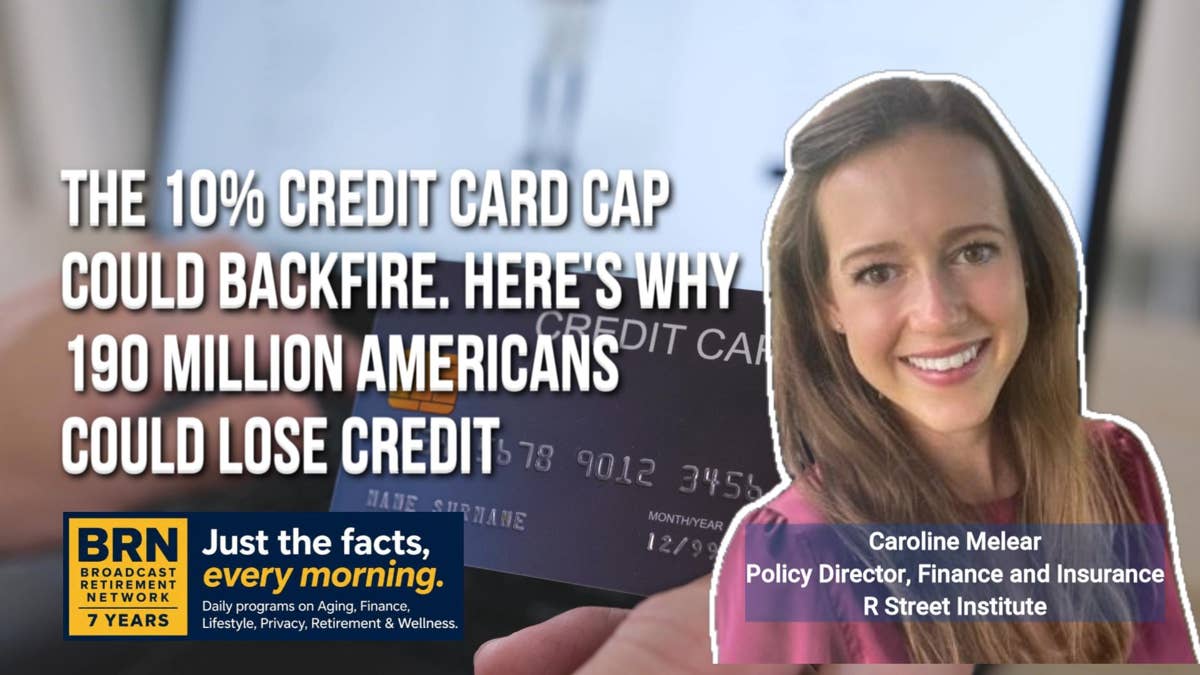
Caroline Melear, Policy Director for Finance and Insurance at the R Street Institute, explains why Senator Elizabeth Warren’s push for a 10% cap on credit card interest rates could backfire and cut off credit for up to 190 million Americans.
Jeffrey Snyder, Broadcast Retirement Network
Well, Caroline, it’s great to see you. Thanks for joining us on the program this morning.
Caroline Melear, Policy Director for Finance and Insurance at the R Street Institute
Thank you so much for having me, Jeff.
Jeffrey Snyder, Broadcast Retirement Network
And thank you so much for coming on the program given it’s a Thanksgiving holiday weekend and you could be out shopping and doing a lot of things with your family. So thank you for that. To that end, you know, Black Friday has come and gone.
People are out shopping, probably using their credit cards. And I know you wrote a piece around this cap on the credit card interest rates. Before we kind of delve into that, can you level set for us what’s going on in Washington, DC and what our lawmakers and regulators are talking about, please?
Caroline Melear, Policy Director for Finance and Insurance at the R Street Institute
Yeah, absolutely. So obviously the Democrats had a pretty resounding victory earlier this month in the midterm elections. And one of the first things out of the gate from Senator Elizabeth Warren, she is the Democrat out of Massachusetts.
She has long sat on the banking committee and has worked on a whole host of consumer finance related issues. So one of the first topics that she came out with was wanting to cap credit card interest rates at 10%. This is not a new idea.
This is something that we have seen. The president has actually supported it in the past. He talked about it on the campaign trail in his most recent election and has signaled his support for it a handful of times as well.
And there are a couple of Republicans in Congress who have also signaled support for the legislation.
Jeffrey Snyder, Broadcast Retirement Network
So very excellent. I mean, as a lay person, that’s an excellent summary. And we have covered the topic this year with different folks.
But thank you for being very clear and concise on that. So all that being said, and we don’t know, the new Congress comes into place, is seated and sworn in in January. So we don’t know yet what will happen.
But my understanding is right now, we’re looking at interest rates in the 20s. And there’s a lot of reasons for that. Well, perhaps we’ll get into that in our discussion.
But America has faced affordability challenges. Now, this is kind of where you focus your research on, what would this do potentially? Because we don’t know really what outcomes will be.
But if it capped at a 10%, what would that mean for affordability for most Americans using their credit cards?
Caroline Melear, Policy Director for Finance and Insurance at the R Street Institute
Right, so I think the intention is fairly clear. The intention is that for people who are carrying a credit card balance, who have debts on their credit cards, reducing the interest rate means that you’re reducing the payment that they have to pay. Our concern is more so what does that actually mean in practice for financial institutions and credit card companies?
So if you are cutting off that stream of revenue that they rely on, then does that mean that we will reduce access to credit? Yes, it very, very likely does mean that. And to your point, we do not know until these things actually play out.
But we do have some historic examples of these sorts of things happening. States have done it, for example. And people, particularly lower income individuals were forced to turn to payday lenders and all sorts of more scrupulous forms of lending and credit.
And so that is the major concern, is how many people with that reduction in the interest rate are going to lose access to their credit cards? I think that the regular consumer who says, hey, that would be great. I would love to have a lower interest rate.
They’re not necessarily making that connection. And so we’re here to say, hey, upwards of 190 million Americans, according to some research, could lose access to credit overnight. And that would be a huge issue for affordability for Americans who do rely on credit.
And there are millions and millions of Americans who use their credit responsibly. And we do not want to punish those individuals with burdensome government regulations.
Jeffrey Snyder, Broadcast Retirement Network
Yeah, well, I guess economists would refer to that as the law. I’m not an economist, by the way, but I’ve read enough economic textbooks, the law of unintended consequences. If we may, and think again, very concise, let me ask you about why, let’s talk about the type of debt, because this is, I think, something that, and I’m not the financial expert.
I mean, I’ve been in the retirement industry for 30 years, so I have that level of acumen. And of course I’ve used credit cards, but my understanding is, unlike most debt, this is unsecured debt, meaning there’s no collateral that Jeffrey Snyder puts down in order to, other than my credit score, to get that line of credit on the credit card, right? So it’s a very different type of debt than a mortgage or some other type of, or an auto loan.
Caroline Melear, Policy Director for Finance and Insurance at the R Street Institute
Yeah, that’s exactly right. So it’s unsecured debt, as you said, which means you are not putting forth any type of collateral in a car, a home. That’s exactly right.
And so that necessarily requires a higher interest rate because that alone, regardless of your credit worthiness as an individual, that necessitates a higher interest rate because it is a higher risk, because there is no collateral to fall back on. And so I think that that is certainly a discrepancy as well, as people say, well, mortgage rates are 7% to 9%. Why are credit card interest rates 23%?
So that is a major reason. There are other reasons as well that I can get into that go back to some other policy decisions that lawmakers have made. But I would say the other thing as well is that credit cards are very unique in that if you pay off your balance every single month, you are never paying interest.
So there are millions and millions of Americans who get this free 30-day float every single month, and they enjoy that. There’s a lot of great security protections for consumers. If you have fraud on your credit card, you are very, very well protected.
That is not the case if you have fraud on a debit card. You have a lot more hurdles to jump through to recoup your funds. There’s also obviously the rewards programs that people rely on, cashback rewards at grocery stores, and that’s huge for affordability.
And then you have kind of this whole other piece as well, which is small businesses. Small businesses, that is the first line of credit for most small businesses in the United States, and they rely very, very heavily on credit cards. And so what could that do to the small business environment in the United States?
That is a huge concern for us as well.
Jeffrey Snyder, Broadcast Retirement Network
Yeah, and count me in as one of those small businesses. Let me ask you, you brought up payday loans, I think was the term you used, and some of these other methods. I’ll use that term loosely, because I don’t want to be negative on anybody.
I guess everything kind of serves its purpose. But what type of interest rates are we talking about with those types of products? So if we force people, if the Congress voted to cap 10%, the credit card companies react in a certain way, the banks react in a certain way, these other opportunities, what does that mean in terms of the interest rate that people seeking these methods would have, would get, I guess?
Caroline Melear, Policy Director for Finance and Insurance at the R Street Institute
Right, and so that’s people who are going to be fairly desperate, unfortunately, and really kind of need access to money in a quick way, and they don’t have anywhere else to turn. And so think, for example, of someone who needs to get to work and they need a car repair that costs $1,500, $500. And so they don’t have access to a credit card any longer, and where do they turn then?
And so payday loans are, they do not provide the benefits that credit cards do. I have not, I am a credit card user, so I have never used a payday loan, thankfully, but the rates are higher and you are paying interest from day one. You do not get that sort of float.
So it is a far inferior product, absolutely.
Jeffrey Snyder, Broadcast Retirement Network
So there seems to be, and again, I don’t want to put you in a position where you’re prognosticating, but this seems to be bipartisan in getting at least interest. And I would assume come January when the gavel is switching parties, this could get a hearing or a hearing in a subcommittee. We’ve been talking about this for over 12 months, almost 12 months now.
What’s the ultimate likelihood that something like this gains traction? Because I could see it from the affordability perspective, but I could, the banks have big, let’s cut to the chase. Banks have big lobbyists and they can spend money to interject their perspective into the committee, right?
And other organizations, not just banks, it could be not-for-profits. So what’s the likelihood that this really gains traction? Sorry for long-winded question.
Caroline Melear, Policy Director for Finance and Insurance at the R Street Institute
Yeah, no, it’s an important question and you’re absolutely correct. I mean, the goal here is affordability. It was a major concern in the midterm election.
It clearly has not been properly addressed. People are still very much feeling the sting. We see this solution, obviously, as a misguided attempt to address affordability.
And in fact, in the op-ed I wrote, I argue that it will make affordability worse because you will be reducing access to credit for all types of people who rely on it. In terms of the actual likelihood of it passing, it’s hard to say. I mean, there is Republican support, but it’s fairly narrow.
You have kind of what would be considered the populist economic wing of the Republican Party. So in the Senate, Senator Josh Hawley, he was a co-sponsor on a bill in the last Congress.
Jeffrey Snyder, Broadcast Retirement Network
That’s right.
Caroline Melear, Policy Director for Finance and Insurance at the R Street Institute
Yeah, and Congresswoman Anna Paulina Luna was the sponsor in the House. And on the Democrat side, at the time it was Bernie Sanders and Alexandria Ocasio-Cortez. And so I wrote a piece at the time when the bill first came out saying, this is horseshoe theory, if you’re familiar with that term.
So on the far extremes of the left and the right, you get sort of this horseshoe effect where you ultimately end up with the same sort of ideas on either ends that come together. So you have all of those people, right, upstream of the ends of the horseshoe who I think do not agree with this. I think it is still an uphill battle, but it’s certainly not impossible by any stretch of the imagination, and especially with the president signaling his support for the idea.
And very clearly signaling it, by the way. I mean, he went on national television and said that he would sign the bill.
Jeffrey Snyder, Broadcast Retirement Network
Yeah, but they gotta get it through and delivered to them right. And all that kind of good stuff. All that other schoolhouse rock stuff.
Let me ask you, where does this fall in the priorities of social security, Medicare? And again, I recognize you’re a research fellow, so maybe this is not your specific area of expertise, but I have to think, if I’m the speaker and the Senate, was it Senate, majority leader, forget it, they have to prioritize what’s gonna come to the floor, what’s gonna come to the committee. So social security is a big deal.
Medicare is a big deal. Health care is a big deal. How does this fit in?
Because that’s current day affordability. I mean, that’s a big deal for all these Americans that are watching our show, hopefully, and spending money this Christmas season or holiday season.
Caroline Melear, Policy Director for Finance and Insurance at the R Street Institute
Yeah, absolutely. I mean, there’s a whole host of priorities and the way that Congress addresses priorities does not always necessarily make a whole lot of sense to anyone, frankly, to kind of your regular Americans watching news on the TV, all the way to people who kind of work in policy. So it’s hard to say.
I think with social security in particular, the general consensus is that there’s still a few years until things really hit a very serious boiling point there. Unfortunately, I would imagine it continues to get pushed off until that point. I did see over the weekend, Senator Bill Cassidy did release a plan on social security.
I can’t speak to it at all, but there are members of Congress who are working on these issues. Incoming Senator Abdul Al-Sayed released some healthcare proposals. That’s not a full-fledged piece of legislation or anything.
But so these things are being put out as well, but the interest rate cap is an easier kind of policy to advance because it is fairly narrow as opposed to addressing these broad government programs. And so that’s another, I think, side of the affordability equation too is the actual solutions to affordability are much harder than taking a single policy that sometimes maybe gets people into financial harm. So people who carry large balances unnecessarily and maybe don’t necessarily use their access to credit responsibly.
So it’s targeting something very small and saying, well, we can fix affordability this way. Well, you can’t. Affordability will remain an issue and reducing people’s purchasing power will make it worse.
Jeffrey Snyder, Broadcast Retirement Network
Yeah, well said. I like the concise end. Caroline, I could talk to you for hours.
Unfortunately, we don’t have the time. Thank you so much for writing the op-ed, for giving your opinion, coming on the program. And look, we look forward to having you back on the program again very soon.
Caroline Melear, Policy Director for Finance and Insurance at the R Street Institute Thank you so much, Jeff. I appreciate it.