

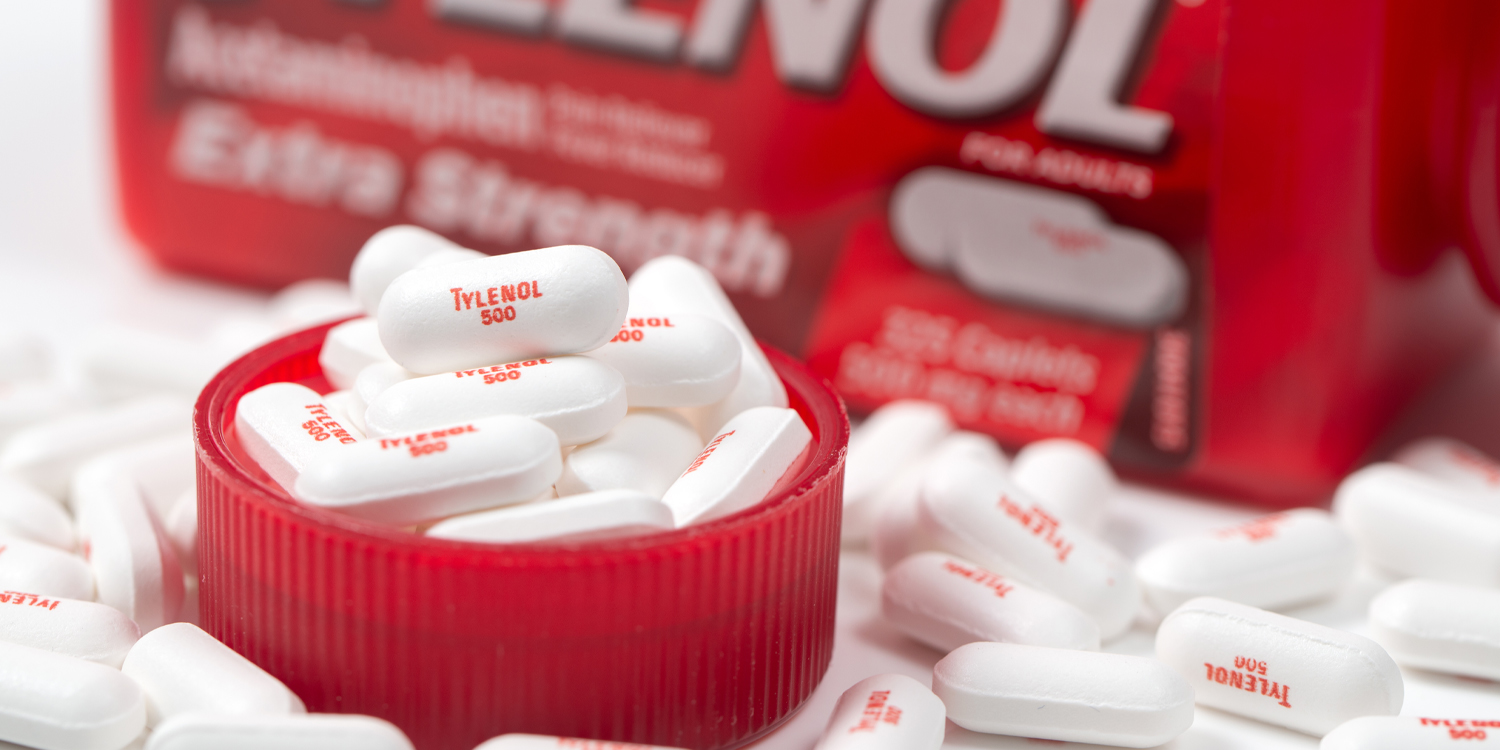
Public opinion polls often make headlines when they suggest that large numbers of people believe an unproven health claim, yet the exact wording of a survey question may not capture what respondents actually think. A new experiment published in Scientific Reports indicates that most people respond similarly whether a poll asks if taking Tylenol during pregnancy “causes” autism, “increases the risk” of autism, or simply has a “link” to the condition. Respondents with a four-year college degree were somewhat less likely to agree when the claim was framed as a direct cause, while political party affiliation proved to be a much stronger predictor of belief than how the question was phrased.
In medical research, scientists distinguish between correlation, where two things occur together in statistical data, and causation, where one factor directly produces another. This distinction frequently blurs when scientific findings are translated for the general public. For example, a 2014 observational study of university press releases found that roughly one-third of press announcements exaggerated correlational health findings by using causal language, and the vast majority of resulting news stories repeated those overstated claims.
When health claims reach the public, subtle differences in wording can shape how people understand the underlying science. In a 2017 study of how readers interpret news headlines, participants recognized that direct verbs like “makes” imply a stronger cause-and-effect relationship than tentative phrases like “might make” or ambiguous terms like “linked to,” which readers treated much like simple statistical associations. Less is known, however, about how everyday readers interpret claims that a behavior or medication “increases the risk” of a health outcome.
This linguistic question became a matter of national debate following a White House press conference on September 22, 2025, featuring President Donald Trump and Health and Human Services Secretary Robert F. Kennedy Jr. During the event, Trump stated that taking acetaminophen, the active pain-relieving and fever-reducing ingredient in Tylenol, during pregnancy “can be associated with a very increased risk of autism.” Autism is a developmental condition that affects how a person communicates, interacts socially, and experiences the world.
While some observational studies have noted a statistical association between prenatal acetaminophen use and autism, the broader scientific evidence on autism risk factors does not support a cause-and-effect relationship. In a 2024 study of nearly 2.5 million children in Sweden, for example, researchers found that once shared family and genetic factors were accounted for by comparing siblings born to the same parents, prenatal acetaminophen exposure was not associated with a higher risk of autism.
Shortly after the September 2025 press conference, the Kaiser Family Foundation (KFF) conducted a national poll asking Americans whether it was definitely or probably true that using Tylenol during pregnancy “increases the risk” of autism. Many respondents, particularly Republicans, agreed with the statement, and subsequent news reports, and even KFF’s own press release, summarized the poll as showing that many Americans believe Tylenol “causes” autism. To test whether the public actually views “increases risk” as equivalent to “causes” or to a general “link,” Julie S. Downs of Carnegie Mellon University and her colleagues designed an experiment comparing all three phrasings.
The researchers conducted a preregistered experiment, meaning they publicly recorded their study design, hypotheses, and planned statistical analyses before collecting data to prevent analytical bias. On October 24, 2025, the team recruited 2,000 participants across the United States using CloudResearch’s Connect online platform, paying each person $0.25 with a $0.10 bonus for paying close attention. Survey software automatically blocked suspected automated bots before the questionnaire began, and the authors excluded 43 participants (2.2 percent) who failed an attention check asking them to identify the two topics covered in the survey from a list of four options: opioids, Tylenol, vaccines, and autism.
The final primary sample included 1,957 adults who were randomly assigned in roughly equal numbers to one of three wording conditions. Depending on their assigned group, participants read a prompt stating that Tylenol use in pregnancy “causes” autism, that taking Tylenol during pregnancy “increases the risk” of the child developing autism, or that there is a “link” between Tylenol use in pregnancy and autism. The researchers predicted that participants would be most likely to agree with the “link” phrasing, followed by “increases the risk,” and least likely to agree that Tylenol “causes” autism. Mirroring the structure of the original poll, participants first answered a yes-or-no question about whether they had heard or read the claim anywhere.
Next, participants rated whether they thought the statement was definitely true, probably true, probably false, or definitely false. For their main analysis, the researchers followed the original poll’s method by combining “definitely true” and “probably true” into a single category representing endorsement, and “probably false” and “definitely false” into a single category representing rejection. They also conducted an exploratory analysis of the full four-point scale to see if wording changes affected the strength of a person’s conviction, and they examined how responses varied by political party affiliation and educational attainment, using data from the 1,950 participants who reported their education level.
Overall awareness of the controversy was widespread, with 89.9 percent of participants reporting they had heard or read the claim, compared to 77 percent in the national poll conducted a month earlier. Familiarity with the topic was nearly identical across all three phrasing conditions. This consistent recognition across groups allowed the researchers to rule out differences in familiarity as an explanation for how participants rated the truth of the claim.
When the researchers looked at whether participants judged the statement to be true or false overall, the specific phrasing had minimal impact and only partly matched their predictions. In the two-category comparison of true versus false, the difference between the “causes” phrasing and the original poll’s “increases risk” phrasing fell just short of statistical significance, with about 23 percent lower odds of agreement when the claim was framed as “causes” (an odds ratio of 0.77). An odds ratio compares the likelihood of an outcome occurring in one group versus another, where a value of 1.0 means both groups have identical odds of agreeing and values below 1.0 indicate lower odds of agreement. Agreement with the “link” phrasing sat between the other two options and was not statistically significant when compared against either “increases risk” or “causes.”
A small effect emerged in the exploratory analysis that examined all four response categories separately rather than grouping them into simple agreement or disagreement. Across the four-point scale, participants assigned to the “causes” condition had about 22 percent lower odds of expressing stronger endorsement compared to those in the “increases risk” condition, and participants endorsed the “link” phrasing more strongly than “causes.” Even on this more detailed scale, the difference between “link” and “increases risk” was not statistically significant. These results suggest that changing the wording from an association to a direct cause mainly shifts people between saying the claim is “probably” versus “definitely” true or false, rather than changing their overall position from agreement to disagreement.
In contrast to the modest influence of wording, political party affiliation was strongly tied to how participants answered. For the “increases risk” wording that matched the poll, agreement was about 6 to 10 percentage points lower within each party than in the September survey, yet the partisan divide remained wide.
Compared to Democrats, Republicans had nearly ten times the odds of endorsing the relationship between Tylenol and autism (an odds ratio of 9.84), while Independents had more than three times the odds of agreeing (an odds ratio of 3.25). Odds ratios magnify differences when a response is common, so this does not mean Republicans were ten times as likely to agree, only that the partisan gap was very large.
The researchers had initially predicted that political Independents might be more sensitive to wording differences than Democrats or Republicans, who often hold firmer prior beliefs on politically polarized topics. However, statistical tests for an interaction between political party and phrasing were not statistically significant. Across the sample, the effect of wording did not differ detectably by party.
In an exploratory analysis, meaning the researchers had not made a specific prediction, educational attainment was the only factor that altered how participants reacted to the three phrasings. Overall, respondents with a four-year college degree were less likely to endorse the Tylenol-autism claim than those without a four-year degree, showing 34 percent lower odds of agreement (an odds ratio of 0.66).
This overall gap was driven by how college graduates responded to the “causes” wording: among participants with a four-year degree, endorsement dropped noticeably when the statement claimed Tylenol “causes” autism compared to when it said Tylenol “increases the risk.” Meanwhile, college-educated participants endorsed the “increases risk” and “link” phrasings at similar rates, and participants without a four-year college degree showed almost no difference across any of the three wordings.
Taken together, the authors conclude that agreement with an “increases the risk” question cannot tell apart a belief that Tylenol causes autism from recognition that some studies have reported a link. Among college graduates, the pattern is consistent with reading “increases risk” as something short of direct cause, though the study did not ask participants what the phrases meant to them. Among those without a degree, “causes” was endorsed about as often as the other wordings, which the authors suggest reflects a distinction many people do not naturally make.
As with all research, there are some caveats to consider. Overall, the influence of wording was modest: the main two-category comparison fell just short of statistical significance, and the interaction with education was an exploratory finding that sat close to the statistical threshold, particularly when tested across finer education categories. In addition, the experiment examined a single, politically polarized health claim, so wording differences might work differently for less charged health topics.
The participants were also recruited from an online crowdsourcing platform a month after the original national poll, following extensive media coverage and statements from medical organizations affirming the safety of acetaminophen during pregnancy, which may help explain why awareness was higher and agreement lower than in the national poll, and means the sample was not nationally representative.
It is also worth noting that while a four-year college degree was associated with greater sensitivity to causal wording, this observational comparison cannot prove that formal education directly causes people to distinguish between correlation and causation. Other factors associated with attending college, such as familiarity with scientific news or general analytical habits, could account for the difference.
The authors suggest that future studies should design and test new survey formats that explicitly separate a person’s awareness of a statistical association from their belief in a direct cause, helping policymakers and health communicators better understand what the public actually believes.
The study, “Endorsement of increased-risk claims about Tylenol and autism may not reflect causal beliefs,” was authored by Julie S. Downs, Caitlin Drummond Otten, and Stephanie M. Anglin.