

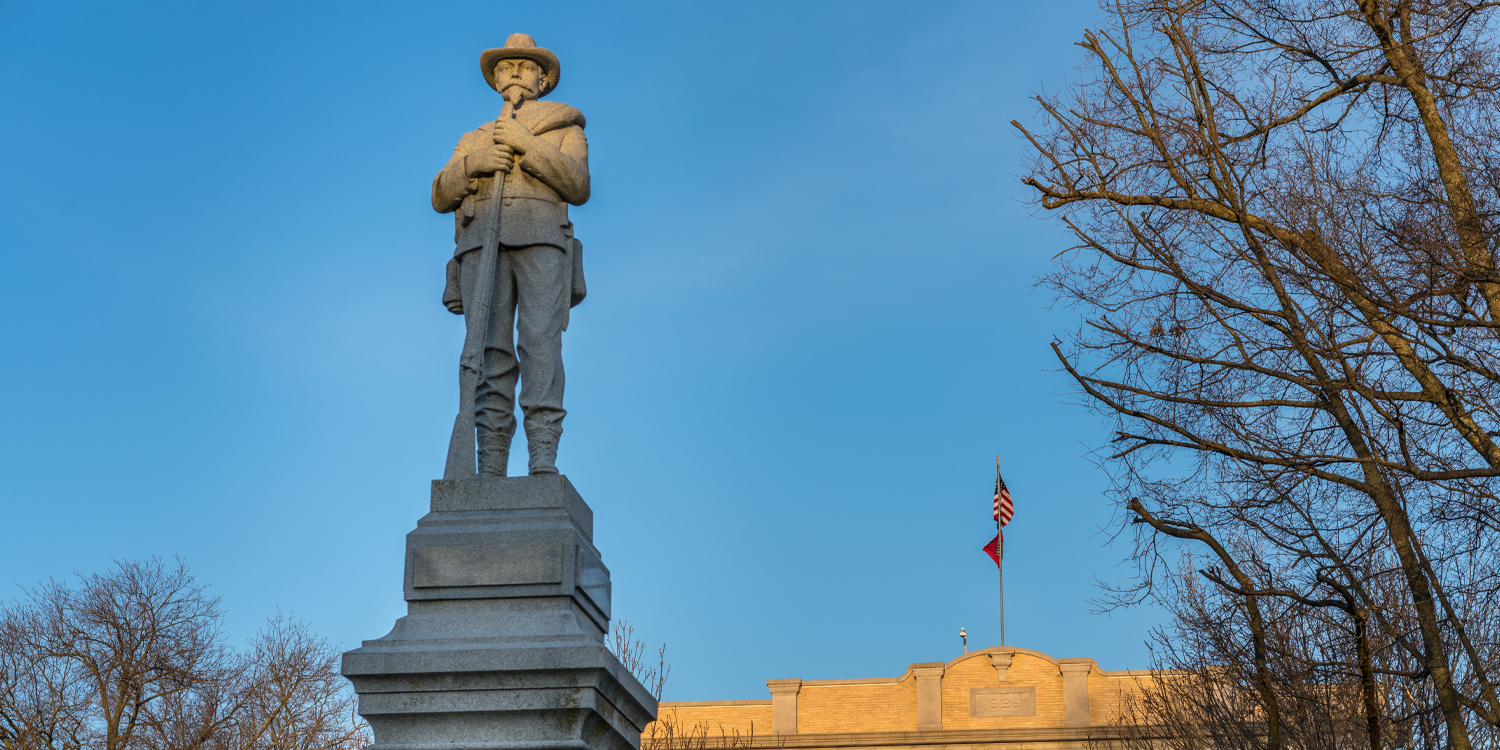
A recent investigation into whether the presence or removal of Confederate monuments affects racial prejudice found no evidence that these statues cause changes in people’s biases. The findings suggest that while these monuments are deeply tied to historical inequalities, simply being exposed to them does not directly alter subconscious or conscious racial attitudes, and there is no evidence that removing them from public squares does either. The research was published in Personality and Social Psychology Bulletin.
Confederate monuments are statues and memorials erected to honor the pro-slavery Southern states that seceded during the American Civil War. In recent years, many communities have debated whether to remove these statues, viewing them as symbols of white supremacy that continue to harm marginalized groups. Psychologists often distinguish between two types of prejudice that such environments might influence. Explicit bias involves conscious beliefs and feelings about a racial group, while implicit bias involves subconscious, automatic associations that people might not even realize they hold.
Previous research suggested that implicit bias is driven by local environments and historical oppression. For instance, a 2019 study found that white residents in Southern counties with historically higher rates of slavery still display stronger implicit racial bias today. The idea that changes in community environments can shift people’s biases is supported by other research. For example, a separate 2019 study found that antigay bias declined roughly twice as fast after states legalized same-sex marriage, suggesting that changes in public institutions can shift community attitudes.
The new research, led by Maximilian A. Primbs of Radboud University, was designed to test whether this idea applies to Confederate symbols to see if their physical presence or removal actually changes residents’ racial biases. Primbs told PsyPost that his motivation stemmed from the cultural climate a few years ago. “I had previously done research on the 2020 Black Lives Matter movement and discussions about Confederate monuments and what to do with them were widespread in 2020/2021,” he explained.
“These discussions eventually reached Europe, which had its own subsequent reckoning with colonial monuments,” Primbs continued. “Monuments were being graffitied, removed, or in one case even thrown in a river. I want to contribute to these debates by investigating some of the effects of these monuments.”
His 2024 study, covered by PsyPost, indicated that the 2020 Black Lives Matter protests led to a rapid, immediate decrease in implicit racial bias among white Americans, though this reduction was temporary. These patterns are consistent with the Bias of Crowds model, proposed in 2017, which holds that physical and social cues in an area constantly activate stereotypes, shaping the prejudices of the people living there.
To investigate the impact of Confederate monuments, the researchers conducted four distinct studies. The first study analyzed a massive dataset from the Project Implicit database, comparing it with records of Confederate monuments from the Southern Poverty Law Center. The sample included up to 1.75 million white participants across the United States. The scientists looked at geographic areas such as counties and commuting zones, tracking whether areas with monuments had higher aggregate levels of bias, adjusting for variables like population density and the proportion of Black residents.
The authors tracked changes in bias around the time specific monuments were taken down, looking for immediate or delayed drops in prejudice. The results did not show any reliable shifts in implicit or explicit racial bias following a monument’s removal. While there were some minor correlations between the number of monuments and bias levels, the results were inconsistent and sometimes even pointed in the opposite direction of what the theory predicted. The data provided no evidence that taking a statue down caused a change in the local community’s racial attitudes.
Notably, these results conflict with a 2019 study by two of the current paper’s co-authors, Heidi A. Vuletich and B. Keith Payne, which found that college campuses displaying Confederate monuments had higher average implicit bias among students. The researchers suggest three possible explanations for the discrepancy: the earlier result might have been a false positive, the correlation might have reflected an unmeasured third factor, or college campuses might simply operate differently than wider communities.
“We very strongly expected to find effects of Confederate monuments,” Primbs noted. “Many prior studies have found that historical inequalities like slavery, sundown towns, or the Ku Klux Klan shaped social and cultural norms and structures within geographical regions in ways that caused biased attitudes to persist over generations.”
“Confederate monuments are a physical manifestation of these White Supremacist beliefs, and therefore should have shown a similar link,” he added. “To me, this suggests that perhaps social and cultural environments are more important in determining racial biases than physical environments.”
Because observational data can be influenced by many outside factors, the scientists designed a second study to test the effect in a controlled laboratory setting. They recruited 1,161 white participants and 416 Black participants for an online experiment. Half of the participants were randomly assigned to read an educational text explaining the racist history and symbolism of the Confederacy.
After reading the text, this group took an Implicit Association Test with images of Confederate monuments displayed in the background. This test measures the speed at which a person associates positive or negative words with Black or White faces, serving as a standard metric for subconscious prejudice. The control group simply took a standard version of the test.
The researchers found no statistically significant differences in implicit or explicit bias between the group exposed to the monuments and the control group, for both white and Black participants. Further statistical analyses, known as equivalence tests, confirmed that any potential effect of the monuments was smaller than a conventionally small effect size, indicating that exposure does not meaningfully alter bias.
A third study utilized a different measure of subconscious prejudice called the Affect Misattribution Procedure. In this task, participants briefly see a photo of a Black or White face, followed immediately by an abstract painting that they must rate as pleasant or unpleasant. The idea is that feelings about the face subtly influence judgments about the painting. In a sample of 537 participants, those who viewed a slideshow of Confederate monuments and described their associations with them showed no statistically significant differences in bias compared to a control group.
To see if these laboratory findings held up in the real world, the researchers conducted a final field experiment in Tilburg, a city in the Netherlands. Instead of Confederate monuments, they used a local colonial monument, a 1926 statue showing the Catholic missionary Peerke Donders standing over a kneeling Black man from colonial Suriname, which critics say reflects colonial racial hierarchies. The scientists approached 174 white Dutch pedestrians passing by either the colonial monument or a visually similar control monument and asked them to fill out a survey measuring their conscious racial biases and policy preferences.
Half of the participants were given an informational text explaining the colonial monument’s historical meaning before answering the questions. Similar to the previous experiments, neither the physical presence of the monument nor the provided historical context altered the participants’ explicit racial attitudes. Whether people were standing in front of the colonial statue or a statue of the Virgin Mary, their self-reported feelings about minority groups remained similar.
There are a few things to keep in mind regarding these findings. The lack of an effect on psychological bias does not mean that monuments are harmless or lack historical importance. “I’d like to make clear that Confederate monuments not affecting racial bias does not mean that Confederate monuments do not have negative effects,” Primbs said, noting that prior research indicates these statues are often perceived as markers of inequality by Black Americans and have been linked to anti-Black hate crimes.
The authors suggest that the transmission of bias might rely more on interpersonal interactions, community norms, and social behaviors than on isolated physical structures. People might absorb prejudice by observing how others act and speak rather than by walking past a monument.
“Confederate monuments are a physical reminder of historical inequality, a built structure commemorating past evil committed,” Primbs said. “Yet, simply removing the monuments had no effects on racial bias. The key takeaway for a lay person might be that undoing past wrongs is not as simple as removing a monument.”
“Discrimination has become deeply entrenched in societal systems, and to tackle it successfully we need to make changes to the system,” he continued.
Future research might explore other environmental cues that are more socially active or frequently discussed to see what actually sustains regional biases. “This research is part of a research line that highlights the historical origins of present-day racial attitudes,” Primbs noted.
“We’re currently pursuing further research that examines how these historical inequalities shape present-day behaviors, for example by affecting how Black and White people interact and share space,” he concluded.
The study, “On Confederate Monuments, Their Removal and Racial Bias,” was authored by Maximilian A. Primbs, Nicolas Sommet, Gijsbert Bijlstra, B. Keith Payne, Ruddy Faure, Tessa A. M. Lansu, Rob W. Holland, Amanda B. Diekman, and Heidi A. Vuletich.