


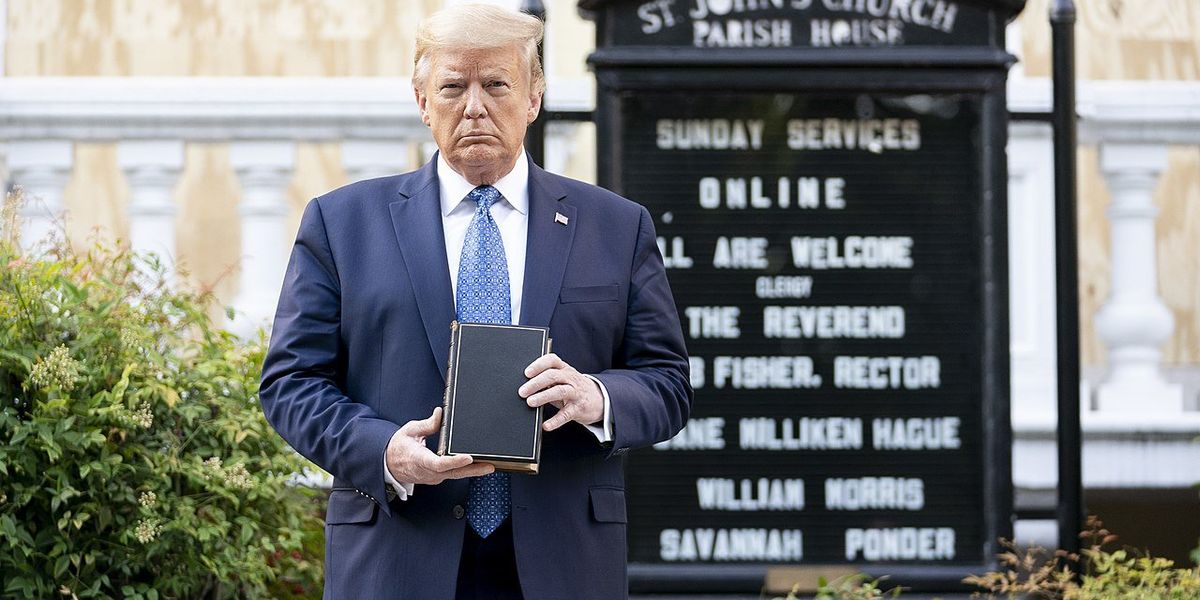
President Donald Trump’s supporters have long been accused of acting like they are in a cult and viciously turning on anyone who criticizes their leader. Now Corey Nathan,
“There is such a thing as Trump Derangement Syndrome, but it’s not what you think,” wrote Corey Nathan, who was born Jewish and subsequently converted to Christianity, in an editorial for a conservative publication called The Dispatch. Instead of using it to describe people who criticize Trump, Nathan argued that it refers to people “who look upon the words and actions of Donald Trump and cannot see them for what they are. On any given day, his conduct exhibits the very antithesis of what Scripture—or anyone with the most basic sense of decency—calls virtue.”
He mentioned that, whenever he cites Trump’s numerous actions that would be described as sins according to the tenets of Christianity, he receives “now entirely predictable, seemingly reflexive comebacks. ‘Oh, well what about Biden? What about Ka-MAH-la? What about Obama? Nobody was more arrogant than Barack Hussein Obama.’ Or something like, ‘Doesn’t the Bible tell you not to judge?’ Or maybe simply, and this was said to me just last week, ‘The TDS is strong in you, man.’”
Nathan continued that these arguments tend to be self-serving and one-way, made by people who are putting out whatever they hope might help them defend Trump rather than because there is any internal consistency or moral logic to what they are propounding. In this expedient and irrational mindset, Nathan compared Trump supporters to individuals struggling with addiction issues.
“The dynamic feels familiar: the denial, the defensiveness, the way confrontation closes doors that patience might eventually open,” Nathan wrote. “The problem I keep wrestling with isn’t political. It’s human. What do we do when people we love become morally and epistemically unavailable to us?”
He added, “By that I mean, why do people I care about seem not even to know about example after example (and the volume is part of the MAGA strategy) of what should be disqualifying statements and actions Trump has made through the years? By the time you’ve cataloged everything, you’ve already forgotten Helsinki. You’ve forgotten his sanitization and deflections for people chanting ‘the Jews will not replace us.’ You’ve forgotten ‘I like people who weren’t captured.’ Those moments now seem almost quaint.”
Describing this phenomenon as “a moral and epistemic disorder, a specific kind of blindness with a specific structure,” Nathan compared the attitudes of Trump supporters to those that facilitated the rise of fascists in the 20th century and were chronicled by writers of the time like George Orwell and Theodor Adorno.
“There are moments in history when one thing is happening that dwarfs everything else,” Nathan argued. “The people who miss it aren’t always wrong about their concerns; they’re just catastrophically misallocating their moral attention. My friend the pastor isn’t pro-Trump, exactly. He’s distracted. And distraction, at this historical moment, is its own form of complicity. But Trump promises to win the culture war this faith leader is losing. In exchange, he doesn’t have to look too hard at the man doing the winning.”
He continued, “There’s also the matter of incentives. Calling out Trump would cost him—empty pews, less tithing, the church across town gaining ground. Russell Moore was pressured out of his position with the Ethics and Religious Liberty Commission within the Southern Baptist Convention for less. I’ve seen how that goes firsthand. I’ve been asked to leave Bible studies for insisting on what Scripture actually says when it cuts against the room’s political preferences. The people who showed me the door didn’t say they disagreed with my politics. They said I was ‘getting political.’ The politics were always there, of course. Just not the right kind.”
Overall, Nathan ended by saying that people who oppose Trump but are close to people who support him must continue showing up and conversing with them, in an understanding and non-confrontational tone, even though he does not know beyond that how to deprogram them.
“These are not stupid men,” Nathan said. “My good friend is sharp and informed. My old pastor is educated and theologically serious. That’s the syndrome. The real one. Not the inability to tolerate Trump. The inability to see him clearly.”
He concluded, “I don’t know what cures it. But I’m not ready to stop trying to find out.”
Nathan is far from alone in comparing Trumpers’ behavior to that of a cult. Speaking with the conservative website The Bulwark in March, former MAGA influencer Ashley St. Clair bluntly said that the Trump movement “is a cult. And what you have to understand is that in any abusive relationship, your access to other people is cut off. You’re isolated. Your access to information is cut off. Your access to people who might have rational perspectives on what you’re involved in — that’s cut off too.”
She added, “These people are told it’s all fake news. The only things you can trust are Twitter and Truth Social. And for better or worse, they actually believe that. They believe that established outlets are lying to them, that nothing those outlets publish can be true.”