

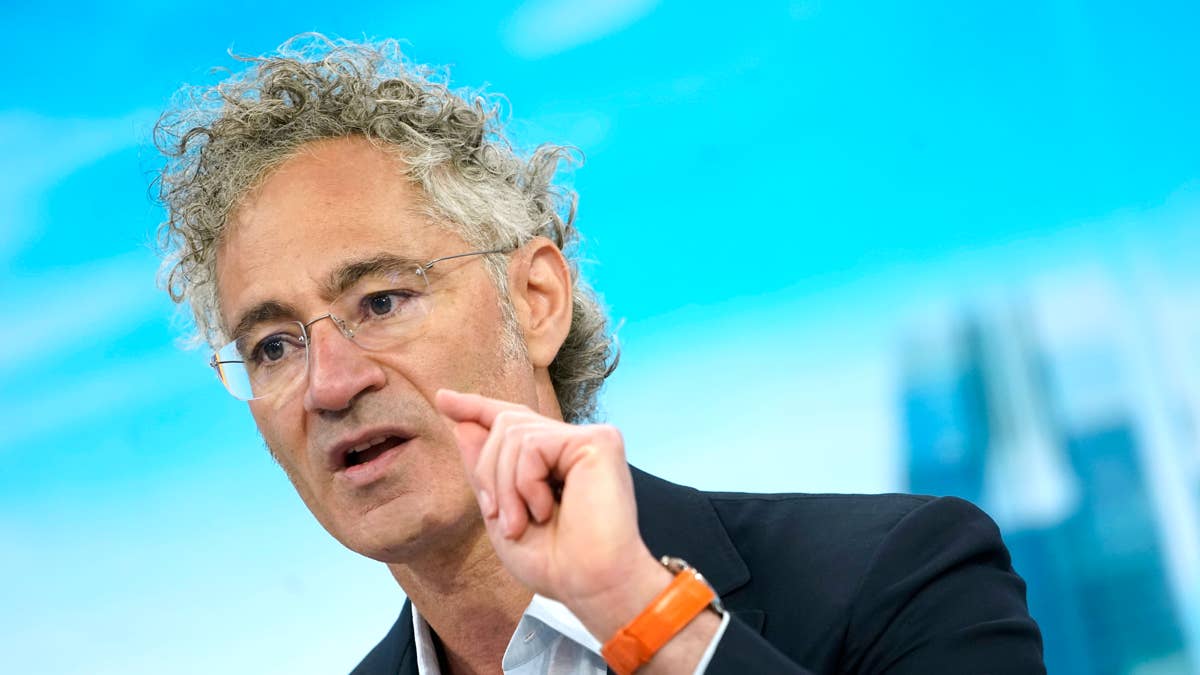
Palantir (PLTR) CEO Alex Karp is reinforcing an argument with clear stakes for shareholders.
Speaking to CNBC, he said that AI needs to deliver practical results for businesses and the military while remaining safe.
Before entering the White House for the all-important AI superintelligence meeting hosted by President Trump, Karp stressed that AI needs to work for “the warfighter” and “enterprises.” Those priorities offer investors another window into the business Palantir wants to build.
His comments fit a campaign that has been building for months.
In July, Karp criticized companies’ AI spending, saying customers were “paying for tokens that create no value.” He also warned that businesses risk handing over the knowledge that gives them an edge, which I covered in “Palantir CEO escalates Microsoft’s AI warning.”
That concern sits behind his push for sovereign AI, where customers retain control over their technology and sensitive information.
Whether Palantir can turn that concern into a lasting advantage is the bigger question behind Karp’s increasingly forceful public pitch to customers.
Palantir CEO Alex Karp emphasizes practical AI results for businesses and defenseJohn Lamparski / Getty Images
Karp puts useful, trusted AI at the center of Palantir’s pitch
Alex Karp’s insistence that AI serve “the warfighter” and “enterprises” points to the competitive ground he wants Palantir to occupy.
More Wall Street:
Wall Street’s AI trade faces its biggest valuation test
The next Wall Street shift is already underway
Wall Street sends strong 4-word verdict on the stock market
Karp’s been arguing over the past several months that Palantir’s technology serves customers in a way they can trust for consequential decisions.
For investors, the implication is that building a powerful model addresses only part of the problem. Businesses and governments also need ways to apply it to sensitive information, control access, and turn its output into useful action.
That explains how Karp’s latest remarks connect with his earlier criticism of AI economics.
In July, he complained that customers were “paying for tokens that create no value.” He also alleged that businesses risked surrendering valuable info to their AI providers. Those allegations form part of his commercial argument rather than established facts about every provider.
The pitch is that adopting AI needs to strengthen a customer’s competitive advantage without handing control of that advantage to someone else.
For Palantir shareholders, that suggests an opportunity in helping customers deploy AI under conditions they can accept. If security, control, and practical results become decisive purchasing criteria, Karp’s positioning could support demand.
Karp is describing why Palantir could matter more as AI spreads. Execution must establish how much shareholders ultimately benefit.
Palantir’s Q2 results lend financial weight to Karp’s argument.
Revenue surged 93% to $1.94 billion, with U.S. commercial sales surging 149% to $764 million and U.S. government revenue rising 90% to $809 million. A 47% GAAP operating margin shows that demand is translating into substantial operating profit.
That said, it’s important to note that these figures support his emphasis on serving business and government customers, although they don’t isolate sovereign AI’s contribution.
Palantir’s rebound leaves investors facing an unresolved AI risk
Veteran technology analyst Gene Munster sees Washington’s support for AI as bullish, but he feels AI stocks like Palantir are not out of the woods yet.
“The safety topic has still not been solved,” the Deepwater Asset Management analyst told CNBC.
Munster argued that government encouragement to accelerate development doesn’t settle concerns about employment, mental health, or how increasingly autonomous systems behave. He also questioned corporate incentives: “It is in their best interest to downplay safety.”
That creates a tension for Palantir shareholders.
Stronger demand for safeguards could strengthen Karp’s pitch around controlled, practical AI deployment. Yet industry failures could also prompt customers to delay projects or demand more testing before committing money.
Overall, though, Munster remains optimistic, describing AI as in its “third inning” and suggesting that next year’s hyperscaler capital spending growth could reach 60% or more, versus roughly 40% expected by Wall Street.
Palantir’s returns show both enthusiasm and hesitation. Shares gained 30.69% over six months, beating the S&P 500’s 20.45%. But their 5.19% year-to-date advance trails the index’s 12.06%, while the latest month delivered just 0.37% as reported by Seeking Alpha.
Palantir investors should demand proof behind the AI pitch
Palantir’s growth gives investors plenty of reason to take Karp’s argument seriously.
The next step is to check whether that momentum can support the price shareholders are paying.
Start with commercial demand. Investors need to monitor whether U.S. businesses continue expanding deployments and whether signed contracts are recognized as revenue. A growing pipeline matters less if customers take longer to commit or projects stall.
Then follow profitability. Palantir’s 47% GAAP operating margin sets a demanding benchmark. Investors should examine whether margins remain strong as the company spends to win customers and deliver increasingly complex deployments.
Treat sovereign AI as a potential advantage, but still require measurable evidence. Customer wins, renewals and broader adoption would strengthen Karp’s case more than another forceful interview.
For prospective buyers, compare the stock’s earnings multiple with realistic growth assumptions before chasing its rebound. Existing shareholders should also review their position size after the six-month rally.
Related: Michael Burry sends fresh warning on Nvidia stock