


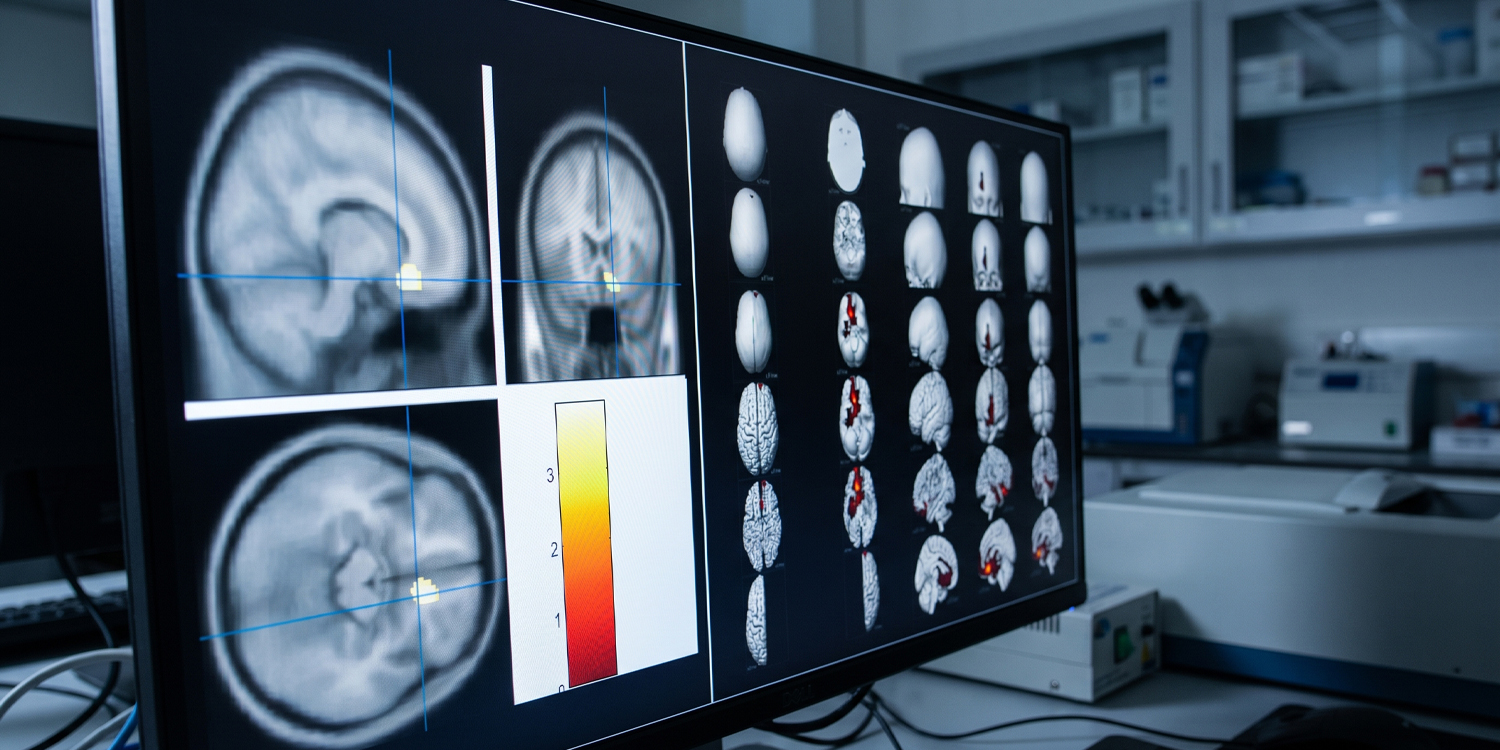
The collective emotional stress of the COVID-19 pandemic may be reflected in how the human brain regulates fear and anxiety. A recent study published in Frontiers in Nuclear Medicine indicates that on days when public social media posts expressed higher levels of negative emotions, brain scans of patients taken on those same days showed reduced activity in areas responsible for emotional regulation. This provides evidence that societal stress can have measurable, wide-reaching neurological effects on vulnerable populations.
The COVID-19 pandemic brought about widespread isolation, uncertainty, and fear. Public health lockdowns, intended to limit the spread of the virus, placed intense psychological burdens on communities worldwide. These environmental and societal factors can interact with human biology, a dynamic that population neuroscience aims to understand. By studying this interaction, scientists hope to learn how collective experiences shape large-scale brain function.
An earlier study by the same research group explored the physical impacts of the lockdown. The scientists found that social isolation and reduced physical activity were associated with lower brain metabolism in the sensorimotor network, the areas that process movement and sensory information. In separate work, they also observed that long COVID was associated with metabolic changes in olfactory regions, the temporal lobe, and the brainstem.
“The idea grew directly out of our previous study,” said study author Eric Guedj, a professor at Aix-Marseille University in France. “In that work, we investigated the more physical side of lockdown — reduced activity and deconditioning — and found measurable effects on brain metabolism.”
“We then wanted to explore another question: how does our individual brain absorb the emotional shocks experienced collectively by society?” Guedj explained. “The first COVID-19 lockdown provided a unique natural setting to examine this.”
To capture the psychological climate, the researchers used a sentiment analysis of public social media posts. “We used social media as a real-time window into the collective emotional climate and compared daily negative-emotion levels, derived from approximately 2.6 million French tweets, with FDG-PET brain scans performed on the same days in 95 patients with neurological conditions,” Guedj said.
These posts were created on X, the platform formerly known as Twitter, during the 55-day national lockdown in France from March to May 2020. The authors calculated a daily negative-emotion score by evaluating the intensity of words related to fear, anger, disgust, sadness, and surprise. They then compared this daily national mood score to brain imaging data collected in clinical settings during the same period.
The sample included 95 adult patients, with an average age of 54, who underwent brain positron emission tomography scans. A positron emission tomography scan, commonly known as a PET scan, uses a small amount of radioactive material to measure cellular metabolism, showing how different parts of the brain utilize energy. The patients in the study were already receiving these scans for pre-existing neurological conditions, such as cognitive impairment, brain tumors, or focal epilepsy.
When running their statistical models, the authors controlled for several potential confounding variables. They adjusted for the patients’ age, sex, and the presence of specific focal brain lesions. They also accounted for the duration of the lockdown, noting how many days had passed since the lockdown began at the time of each scan.
The data suggests an inverse relationship between collective negative emotions and the metabolism of specific brain regions. On days when the national negative-emotion score was higher, the patients’ PET scans tended to show lower metabolic activity in the right ventromedial prefrontal cortex and the anterior cingulate cortex.
These two regions are core components of the brain’s fear network. The ventromedial prefrontal cortex helps regulate emotional responses and decision-making, while the anterior cingulate cortex is involved in processing emotions and assessing threats.
“The broader message is that our brains do not function in isolation from the social world,” Guedj told PsyPost. “On days when negative emotions expressed collectively on social media were more intense, we observed lower brain metabolism in the ventromedial prefrontal cortex and anterior cingulate cortex, two regions that play important roles in regulating fear, stress and emotions.”
The correlation between the daily negative-emotion score and brain metabolism was moderate, with a correlation coefficient of -0.40. A correlation coefficient measures the strength of a relationship on a scale from -1 to 1, meaning this represents a moderate negative relationship at the group level. When the authors looked at specific emotions, they found that sadness, fear, and surprise drove this effect. In contrast, emotions like anger and disgust were not statistically significant in their primary brain imaging analysis.
Social media served as an indicator of the environment rather than the direct cause of the brain changes. “This does not mean that social media itself was changing the brain,” Guedj clarified. “Rather, social media provided us with a kind of real-time mirror of the emotional climate experienced by society, and that collective emotional climate was associated with measurable differences in brain function.”
The authors also analyzed how these specific brain regions interacted with others. They found that the prefrontal and cingulate cortices were connected to a broader network located primarily in the right hemisphere of the brain. This network included the amygdala, which detects threats, as well as the hippocampus, which is involved in memory processing.
“What struck us most was the anatomical coherence of the finding,” Guedj said. “The association was not scattered randomly across the brain: it involved regions at the core of emotional regulation, connected to a broader limbic network including the amygdala, hippocampus, thalamus and basal ganglia.”
The reduced metabolism in these regulatory areas points to a potential impairment in how the brain processes collective stress. Notably, this pattern of reduced metabolism in the fear network was entirely separate from the sensorimotor changes the researchers previously linked to physical deconditioning. It also only had a ten percent overlap with the pattern seen in long COVID patients, suggesting that collective emotional stress affects the brain through its own distinct pathways.
“It was also interesting that this pattern was distinct from the brain changes we had previously associated with physical deconditioning during lockdown, and also distinct from the brain changes associated with long COVID,” Guedj added. “This suggests that the physical and emotional dimensions of a collective crisis may affect the brain through partly different mechanisms.”
The study relies on observational data, meaning it indicates a correlation but cannot establish that the national mood directly caused the brain changes. Additionally, the proxy measure for societal stress is limited to users of a single social media platform. Social media users do not perfectly represent the demographics, socioeconomic status, or emotional state of an entire country.
“The most important point is that this is an observational study showing an association, not proof of causality,” Guedj warned. “We cannot say that collective negative emotions directly caused the metabolic changes we observed. The Twitter-derived score was also a measure of the broader emotional environment, not of what each individual patient personally felt or saw online.”
The sample consisted exclusively of individuals with neurological conditions, who may possess a heightened vulnerability to societal stressors. Conditions like brain tumors or cognitive impairments can disrupt neural connectivity, potentially making these patients more susceptible to the effects of collective negative emotions.
“Finally, our participants had neurological conditions and may represent a particularly vulnerable population, so the findings cannot yet be directly generalized to healthy people,” Guedj said.
The findings suggest a new way to conceptualize emotional well-being during wide-scale events. “One concept I find particularly important is that mental health is not exclusively an individual matter,” Guedj explained. “We are relational beings, continuously influenced by our social and emotional environment.”
“Social media is often viewed mainly as a potential source of psychological harm, but from a research perspective it can also provide an extraordinary real-time measure of collective emotional states,” he continued. “Combining these large-scale societal data with objective biological markers such as brain imaging may help us better understand how events experienced by society become associated with what happens in individual brains.”
Future research could track individuals over longer periods to see if these metabolic patterns persist after a crisis resolves. Expanding data collection beyond social media to include personal diaries or longitudinal surveys could provide a more accurate picture of collective stress.
The researchers hope to expand this framework to other contexts. “We would like to develop this approach within what could be called population or societal neuroscience: studying how large-scale social and environmental events interact with individual brain function and vulnerability,” Guedj noted. “The COVID-19 pandemic offered an exceptional natural experiment, but the broader questions go far beyond COVID. How does the brain respond to periods of collective fear, major social crises, terrorist attacks, wars or climate-related disasters?”
Investigating the potential benefits of shared positive experiences is another goal for the team. “And conversely, could positive collective experiences — major celebrations, sporting events or periods of social cohesion — produce measurable protective effects? These are questions we would now like to explore,” Guedj said.
Understanding how vulnerable populations react to environmental shifts may eventually guide public health interventions. “In that sense, the most vulnerable individuals may also act as particularly sensitive indicators of the effects of collective stress,” Guedj said. “Understanding this interaction between society and the brain could become increasingly important for public health.”
“Ultimately, this type of research could help identify both individual vulnerability and population-level warning signals, and perhaps contribute to better mental-health strategies during future collective crises,” he concluded.
The study, “Emotional stress during the COVID-19 lockdown: how negative X/Twitter posts correlated with changes in the brain’s fear network,” was authored by Eric Guedj, Jacques-Yves Campion, Tatiana Horowitz, Fanny Barthélémy, Stéphanie Khalfa, and Wissam El-Hage.