

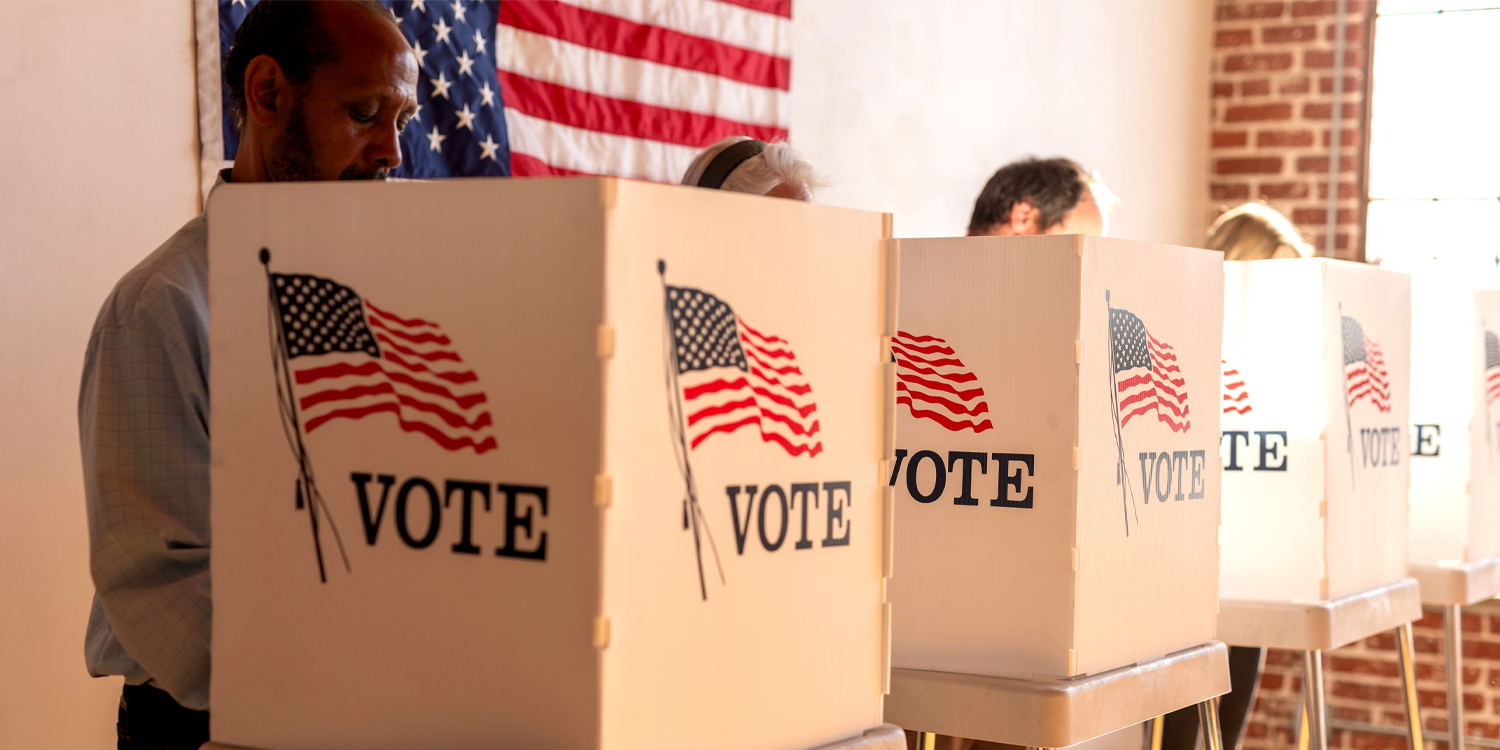
Nearly 90 percent of American voters who name a preferred presidential candidate now expect that candidate to win, up from roughly 70 percent a few decades ago. New research published in Political Behavior suggests this surge in optimism is linked to growing hostility toward the opposing party. When those high hopes are dashed, losing voters who expected to win tend to stay more hostile toward the other side than losers who saw defeat coming.
In almost every democratic election, far more people predict that their favored candidate will win than the final vote tally can support. Political scientists call this pattern wishful electoral thinking, a phenomenon in which a person’s desire for an outcome directly shapes what they expect to happen. Optimistic predictions may help voters avoid mental discomfort and cope with an uncertain future.
Social scientists have documented how stubbornly these biases resist correction. For instance, a 1997 study of voters in a Jerusalem mayoral election found that citizens overwhelmingly predicted their favored candidate would win, even when they knew the latest polls or were offered cash for accurate forecasts. Media coverage can also shape expectations: two 2018 experiments on news consumption found that when partisan outlets covered viewers’ own party as winning the race, viewers became more likely to predict a win, and when coverage showed their side losing, they lowered their predictions.
Over the past few decades, the United States has also experienced a steep rise in partisan animosity, often called affective polarization, which refers to Democrats and Republicans viewing the opposing party with deep dislike and distrust. Some research suggests that many voters today are driven more by dislike of the other party than by affection for their own, though others dispute how common this is. Preliminary evidence from a 2022 working paper based on an online survey, which has not been peer reviewed, suggested that disliking the opposing party predicts expecting an election victory more strongly than feeling warmly toward one’s own party.
Hostility toward political opponents shapes how citizens process election results as well. For example, a survey of voters surrounding the 2020 presidential election found that while most Americans overestimated their emotional reactions to the outcome, people with deeply negative views of the opposing candidate experienced more intense emotions than anticipated. Building on this line of research, study author Seth Warner of the University of Connecticut examined whether partisan animosity has driven the surge in electoral optimism, and whether those high hopes leave losing voters more resentful when their candidate falls short.
“I think, initially, this started when I noticed how news outlets whose audiences lean left or right run stories that suggest that the ‘other side’ is about to fall apart,” Warner told PsyPost. “Reading the New York Times, for example, it sometimes seems like Donald Trump is always in trouble, Republicans are about to turn on him, or his supporters are beginning to question things. You see much the same thing in reverse in right-leaning media.”
“I know from personal experience — and it’s backed up by a lot of psychology — that people react badly when things don’t turn out the way they expect,” Warner added. “So my original thought was that when people expect their party to win and then lose, they might come away from the election feeling even more hostile toward the other side. That’s part of what I found, but the bigger discovery was just how stratospherically high Americans’ expectations of victory have become.”
In the first of two studies, Warner tracked how election predictions have changed using the American National Election Study, a long-running national survey of American adults conducted around each presidential election, drawing on its cumulative file from 1952 to 2020 plus survey data from 2024. Before each presidential election, participants answered who they thought would win in November, allowing Warner to measure whether voters predicted a victory for their preferred candidate (among the 71 percent expressing a vote intention) or for their party’s nominee. To account for objective race conditions, he matched each interview date to a seven-day rolling average of national polls from Gallup (before 2004) and RealClearPolitics (2004 to 2024).
Warner then analyzed survey waves from 1980 to 2020 to test which individual traits explained the rise in poll-adjusted optimism. He examined party loyalty in voting, party attachment strength, policy alignment, campaign news interest, living in a state and congressional district dominated by one’s party, and political knowledge (knowing which party controlled the U.S. House of Representatives). He also measured attitudes on a 0-to-100 “feeling thermometer” scale, where 0 represents very cold feelings and 100 represents very warm feelings, defining ratings above 75 for one’s own candidate as warm feelings and ratings below 25 for the opposing party as high partisan animosity.
The historical data showed that the share of voters expecting their preferred candidate to win hovered around 70 percent for decades, rose into the high 70s in the 2000s, and reached the high 80s from 2012 onward. Polls mattered: each additional percentage point of polling lead was associated with about a 7 percent increase in the odds of expecting victory. But polling could not explain the recent surge. Even after accounting for polling margins and how close each race was, the odds of expecting one’s side to win stayed within a fairly narrow band for decades and then climbed sharply from 2012 onward.
“The big takeaway is that elections these days are close, and nobody really knows in advance who’s going to win,” Warner explained. “Polling the public has gotten quite hard, and although we can usually get results within 5 percentage points, most pivotal elections these days are decided by less! You wouldn’t know that to talk to most Americans, though. In the last election, about 90% of people now expect their preferred candidate to win, so we’re seeing a big disconnect between expectations and reality.”
When Warner calculated how much each trait contributed to the 17.6-percentage-point linear rise in expectations of an in-party win between 1980 and 2020 (a statistical accounting rather than proof of cause), two factors stood out. Party loyalty in voting rose by 8 percentage points and accounted for 24.9 percent of the rise in optimistic predictions, while the share of voters with high partisan animosity jumped by 47 percentage points over those four decades and accounted for 22.0 percent of the increase.
Disliking the opposing party had almost no link to electoral optimism in 1980 but became a reliable predictor by 2020, whereas strong party identity (3.0 percent), candidate ratings (2.8 percent), and news interest (2.2 percent) explained very little of the shift. Taken together, the measured traits accounted for roughly half of the overall increase in optimism, leaving about half unexplained.
In a second study, Warner examined whether changes in an individual’s partisan hostility over time correspond with changes in their election predictions. He analyzed data from the American National Election Study’s 2016, 2020, and 2024 multi-wave panel survey, which tracked the exact same partisans and independent leaners across three presidential elections (providing over 5,100 observations). Partisan animosity was measured continuously from 0 to 100 by reversing each respondent’s feeling thermometer rating of the opposing party, and statistical models isolated changes within the same person from one election cycle to the next.
Across these within-person models, rising hostility toward the opposing party reliably predicted higher expectations of victory, though the link was stronger among Democrats; among Republicans it pointed the same way but was not statistically significant. Controlling only for polling margins, a one-standard-deviation increase in animosity (roughly the typical spread of scores on the scale) corresponded with an 8.0- to 8.9-percentage-point increase in the probability of expecting one’s party to win.
After controlling for candidate ratings, party attachment strength, ideology, news interest, and geographic sorting, a one-standard-deviation rise in animosity still corresponded with a 3.3- to 3.7-percentage-point increase in the probability of predicting a win. Warm feelings toward the in-party candidate had the largest direct relationship (a 17.4- to 18.0-percentage-point increase per standard deviation), while news interest and geographic sorting were not statistically significant.
Using a statistical technique that maps how different attitudes feed into one another over time, Warner also traced how attitudes among 1,912 panel participants in 2016 related to their views in 2020 and subsequently predicted expectations in 2024. This analysis indicated that 2016 partisan animosity was linked to 2024 victory predictions indirectly, through its connections with other attitudes measured in 2020, even though its direct link to 2024 expectations was small and not statistically significant. The model also suggested a two-way relationship: expecting a win in 2016 predicted higher animosity in 2020, though this reverse effect was weaker than the path from animosity to expectations.
Next, Warner tested what happens after Election Day when hopeful voters see their party lose. He analyzed pre- and post-election interviews with 22,313 respondents from American National Election Study surveys across presidential elections from 1996 to 2024 (excluding 2000, when post-election party ratings were omitted). Comparing pre-election feeling thermometer ratings of the opposing party with post-election like-or-dislike ratings, both rescaled from 0 to 1, he tested how pre-election predictions interacted with election loss while controlling for pre-election animosity, candidate ratings, party identity strength, ideology, demographics, and election year.
The results suggest that losing usually takes some of the edge off partisan hostility, but not for voters who expected to win. After accounting for their pre-election views, losing voters who had anticipated defeat ended up about 2 points less hostile toward the other party than winners, on a 100-point scale. Losing voters who had expected to win showed no such drop, scoring about 3.1 points higher than losers who had braced for defeat. The effect pointed the same way in every election studied and reached statistical significance in 2004, 2016, 2020, and 2024, with the largest estimates in the three elections Donald Trump contested.
Among Republicans who expected to win in 2020, the added hostility was still detectable in 2024, while Democrats’ disappointment from 2016 had faded by 2020. Warner cautions that the 2020 aftermath, which included Trump’s unfounded claims of mass voter fraud, was an unusual case, and that the 2016 result calls for caution about how long such effects typically last.
Warner sees this effect as small next to the rise in optimism itself. “The ‘dashed hopes’ effect that I found on post-election animosity is more modest, about three points on a 100-point scale,” he noted. “But it occurs at a particularly sensitive moment for democracy, when one side has to accept defeat and the other prepares to take power. Even relatively small changes in political hostility could matter at that moment.”
These findings stand in tension with an earlier study of American partisans across the 2022 midterm election cycle, which found that hostility toward the opposing party and support for democratic norm violations stayed persistently high after the election, leaving winners and losers equally polarized.
Both studies evaluated post-election partisan animosity among winners and losers, though Warner’s analysis spanned multiple presidential cycles and separated voters by their pre-election expectations, whereas the earlier study tracked overall shifts across a single midterm election without distinguishing between hopeful and realistic voters. Warner suggests his findings may help reconcile the two: if nearly everyone on the losing side expected to win, the usual post-election cooling may not show up.
As with all research, there are some caveats to consider. Because the study relies on observational survey data rather than an experiment that randomly alters political preferences, it cannot establish strict cause and effect. Unmeasured factors could simultaneously boost both a voter’s dislike of the opposing party and their optimism, and high expectations can also feed back into greater animosity over time. In addition, pre-election animosity was measured on a 0-to-100 feeling thermometer and post-election animosity on an 11-point like-or-dislike scale, making the before-and-after comparison approximate.
National surveys are also limited in how well they can separate internal psychological desires from partisan information bubbles. Although Warner accounted for campaign news interest and geographic sorting, these measures do not capture a person’s exact media diet or social networks. Future research using experimental designs could help isolate how much of electoral optimism stems from an emotional desire to see the opposing party lose versus exposure to partisan commentators who repeatedly predict victory. Warner suggests that tempering these unrealistic expectations could help support democratic stability during post-election transitions, when unprepared voters may be especially vulnerable to anger and false claims of election fraud.
“To speak a little more normatively, it’s important for people to remember that democracy involves winning and losing,” Warner said. “In a competitive two-party system, your side is going to lose about half the time, and some degree of intellectual humility is important for democracy to work properly. That means being willing to consider what a good-faith person might find lacking in the way your side has made its case, so that parties can be self-improving, as opposed to just negatively defined by who their opponents are.”
“Of course, there are big moral issues in American politics that are genuinely difficult to find agreement on, and we shouldn’t pretend otherwise,” he added. “But there are also plenty of pragmatic issues where everybody holds a similar goal — like good jobs and schools, low crime, and national security — and it’s just the approaches that differ. For better or worse, those are often the most important ones to the swing voters who decide elections.”
The study, “Partisan Wishful Thinking in Polarized Times,” was authored by Seth Warner.