


Microsoft spends billions building its own AI models every year. Internally, though, the company just told its own developers to reach for someone else’s technology first.The instruction came from deep inside Microsoft’s engineering organization, and it says as much about the economics of AI spending as it does about which chatbot writes better code.Why Microsoft defaulted GitHub Copilot to GPT-5.6 SolJay Parikh, executive vice president of Microsoft’s CoreAI engineering group, told employees in a memo on August 4 to default to OpenAI’s flagship GPT-5.6 Sol model when working inside the GitHub Copilot coding tool. “Internally, shifting more workloads to OpenAI models helps us get greater value from our token investment,” Parikh wrote, according to CNBC.Parikh’s group oversees GitHub, Visual Studio, and Visual Studio Code. Before the Sol switch, Microsoft’s internal GitHub Copilot setup ran on an auto-router that defaulted primarily to Anthropic’s Claude models. Microsoft engineers were, in effect, mostly coding with expensive Claude tokens on the company’s own infrastructure.More Microsoft:Morgan Stanley resets Microsoft stock forecast ahead of earningsBank of America doubles down on Microsoft stock ahead of earningsCiti revamps Microsoft stock price target for the rest of 2026The memo told staff to lean on OpenAI specifically to capture value from Microsoft’s early investment in the company. That is a notable instruction given that Microsoft has built its own AI programming model and gives cloud customers access to more than 11,000 models, including Anthropic’s. As of July 2026, Microsoft divisions began operating under formal AI token budget targets for the first time.Parikh framed the shift as a break from what he called “tokenmaxxing,” a period when developers were encouraged to run up large AI processing bills without much scrutiny of the output. “Tokenmaxxing is not what we are optimizing for,” he wrote. “I want all of us focused on maximizing outcomes that move the needle for our customers and our business.”404 Media reported on the internal memo, which Parikh sent as employees were already logging monthly AI spending ranging from hundreds of dollars to several thousand per engineer.What the Microsoft OpenAI deal means for GitHub CopilotThe guidance arrives nine months after OpenAI completed a corporate restructuring that extended Microsoft’s intellectual property rights through 2032. Microsoft said separately in April it had stopped revenue-sharing payments to OpenAI, changing the financial shape of the partnership that once ran on shared profits rather than fixed licensing terms.Microsoft’s fiscal year 2026 results illustrate why OpenAI stays at the top of the pecking order. The company reported full-year revenue of $331.8 billion, up 18%, with AI services accounting for a growing share. OpenAI-related investment gains contributed $4.963 billion to net income for the full year, reflecting the financial value Microsoft extracts from the partnership beyond direct revenue.The diversification play is real but different in character. Microsoft put up to $5 billion into Anthropic, and Anthropic agreed to spend on Azure in return. There are no public IP commitments in that relationship the way there are with OpenAI. Anthropic’s Claude Code only runs on Anthropic’s models. GitHub Copilot runs on everyone’s, including Anthropic’s, Google’s, Moonshot AI’s, xAI’s, and Microsoft’s own. That gives Microsoft the flexibility to point traffic wherever it wants. Right now, it’s pointing at OpenAI.
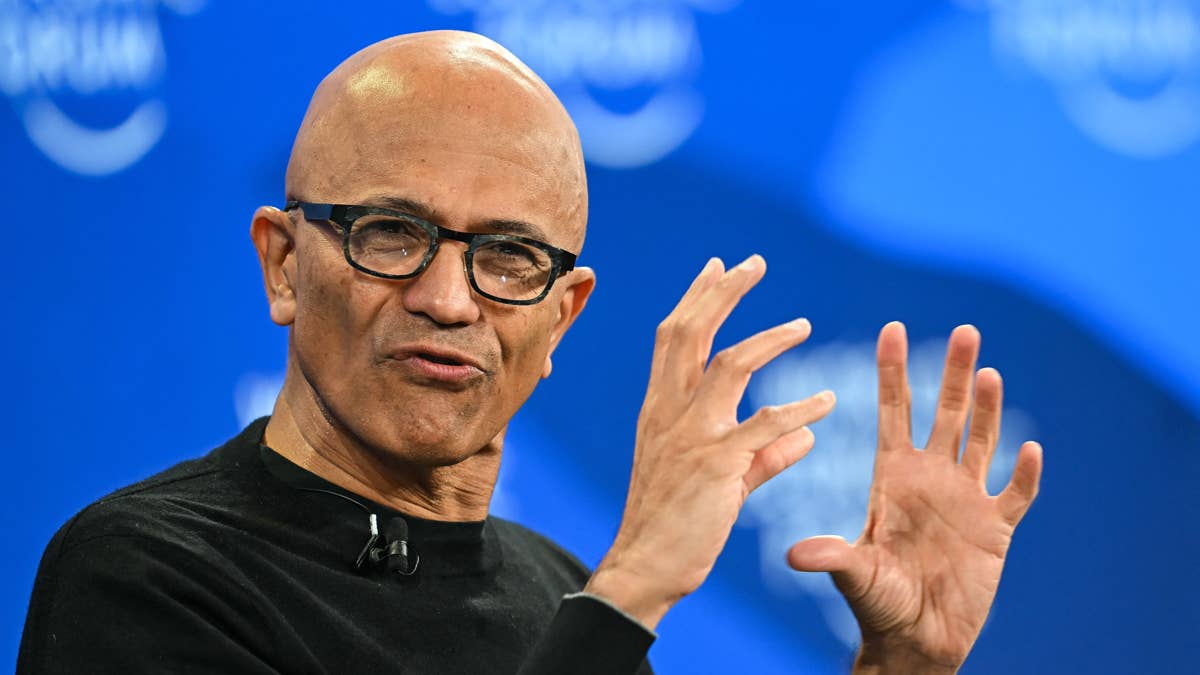
The memo told staff to lean on OpenAI specifically to capture value from Microsoft’s early investment in the companyHarun/Getty Images
Microsoft stock and Azure $100 billion in contextThe memo drops during Microsoft’s best stretch on Wall Street in years. July 29 earnings came in at $4.74 per share on $90.01 billion in revenue. Both beat the consensus of $4.24 and $87.62 billion, respectively. The stock jumped roughly 8% on the day, as TheStreet reported.Azure crossed $100 billion in annualized revenue and grew 43% in constant currency. Intelligent Cloud came in at $39.3 billion, up 32%. Worth noting though: a $3.2 billion gain from Microsoft’s Anthropic investment added 27 cents to earnings per share. Part of the beat was investment accounting, not operations.That strength has stood out against rising skepticism toward hyperscaler AI spending generally. Alphabet raised its 2026 capex guidance to between $195 billion and $205 billion, pushing quarterly free cash flow negative for the first time, as TheStreet reported. Combined capital expenditures from Microsoft, Amazon, Alphabet, and Meta are expected to top $700 billion this year.What Microsoft’s tokenmaxxing crackdown means for AI spendingMicrosoft isn’t alone in doing this. Cheaper open-weight models, a lot of them from Chinese labs, have been quietly eating into the dominance of frontier models from OpenAI and Anthropic. They cost less to run. That gives budget-conscious teams a real alternative in a market that used to have only one direction: spend more.Parikh acknowledged CoreAI has not yet set formal token budgets for individual teams or employees, and encouraged staff to document both successful and unsuccessful uses of AI spending. GitHub Copilot itself has scaled to 50 million users, Microsoft said, even as newer entrants like Cursor have taken market share in the same space.Whether Microsoft’s internal preference for OpenAI signals where enterprise customers should be looking remains an open question, but the memo makes one thing explicit: even Microsoft’s own engineers are being told that more AI spending is not automatically better spending.Related: Mark Zuckerberg, Microsoft CEO just made major AI decision