

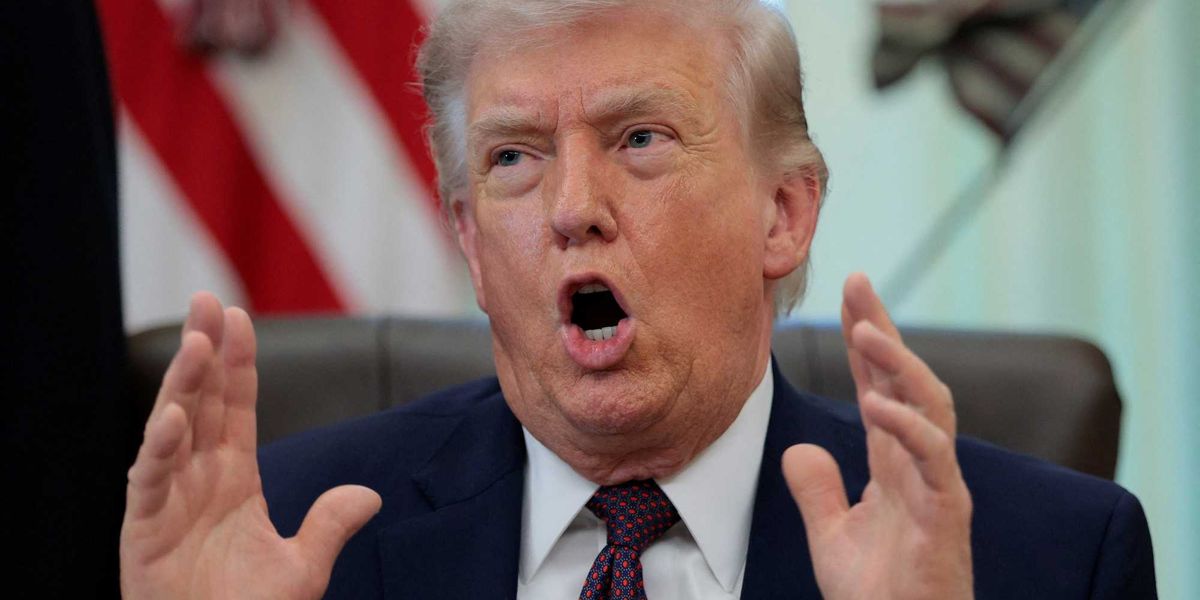
Prior to Election Day 2026, President Donald Trump repeatedly threatened to meddle in the midterms unless they allowed Republicans to retain control of Congress. Upon losing in a pro-Democrat landslide, however, Trump almost immediately conceded the results, surprising those who feared a repeat of his coup attempt after losing in the 2020 presidential election.
According to a pro-voting rights attorney, the media is missing a big part of the story regarding why Trump did not contest the results.
“Donald Trump spent countless hours and taxpayer dollars trying to rig the rules to hold on to power,” wrote attorney Marc Elias for the Democracy Docket Newsletter. “The Department of Justice systematically attacked our elections through lawsuits, intimidation and lies. In the end, they failed, because lawyers litigated, election workers did their jobs and the American people voted.”
He added, “Sadly, the legacy media largely ignored the real stakes of these long, hard-fought legal battles to protect voters and voting rights in the midterm elections. Their coverage focused on the horse race and on who stood to benefit from each challenge. It ignored the question of right and wrong: Trump was trying to undo democracy, while those of us fighting back were working to protect it.”
Not everyone believed Trump had the power to interfere with the midterm elections. Speaking with AlterNet in September, Loyola Law School professor Justin Levitt dismissed the idea that Trump could purge people from the rolls, seize ballot boxes, intimidate voters with law enforcement, file frivolous lawsuits and/or have Congress reject the results.
“None of them will work,” Levitt said. “Those five things, and 18 others, all sort of fall down at the point of possibility. You’re absolutely right that he will try something: one, maybe several of those, or other things. But none of those things will succeed.”
He added, “The short version is he is trying to project power that he does not have. He would love the American public to believe that he actually has operational control of forces able to execute on any of those five things or others, but he doesn’t. He’s not in charge of the systems that govern the election process. As much as he thinks he is, he’s not. And so I have firmly believed for a while that the single biggest risk to the ’26 elections is that the American public falls for the marketing stunt and bestows magical wizard powers on a tired old man. That we do it to ourselves. That we get so spun up and freaked out thinking that he’s got a magic ring that lets him do whatever he wishes that we decide to stay home, or we decide to trim our own sails, because we imbue him with an aura of invincibility that he has not earned and does not have.”
After the election, which vindicated his analysis, Levitt reiterated this fundamental point.
“There are margins that are simply too large to even try the magic wand,” Levitt explained. “If the races were closer, a lot closer, he might try and fail, as if there was ever a realistic possibility that he would actually succeed. But at this point, even he can see that there is no magic button to vanish the vote. And so he’s not going to try.”
Levitt then reiterated that people should not let their guard down just because Trump suffered a setback.
“He’s delusional,” Levitt told AlterNet. “He’s still dangerous. The fact that a major network felt the need to ask him, “Are you going to declare martial law?” which isn’t a thing. He’s deeply disturbed. We’ve got a lot of work to do. So this is a victory lap in the sense that the system held exactly as I thought it would, but that is not to say we are out of danger at all.”