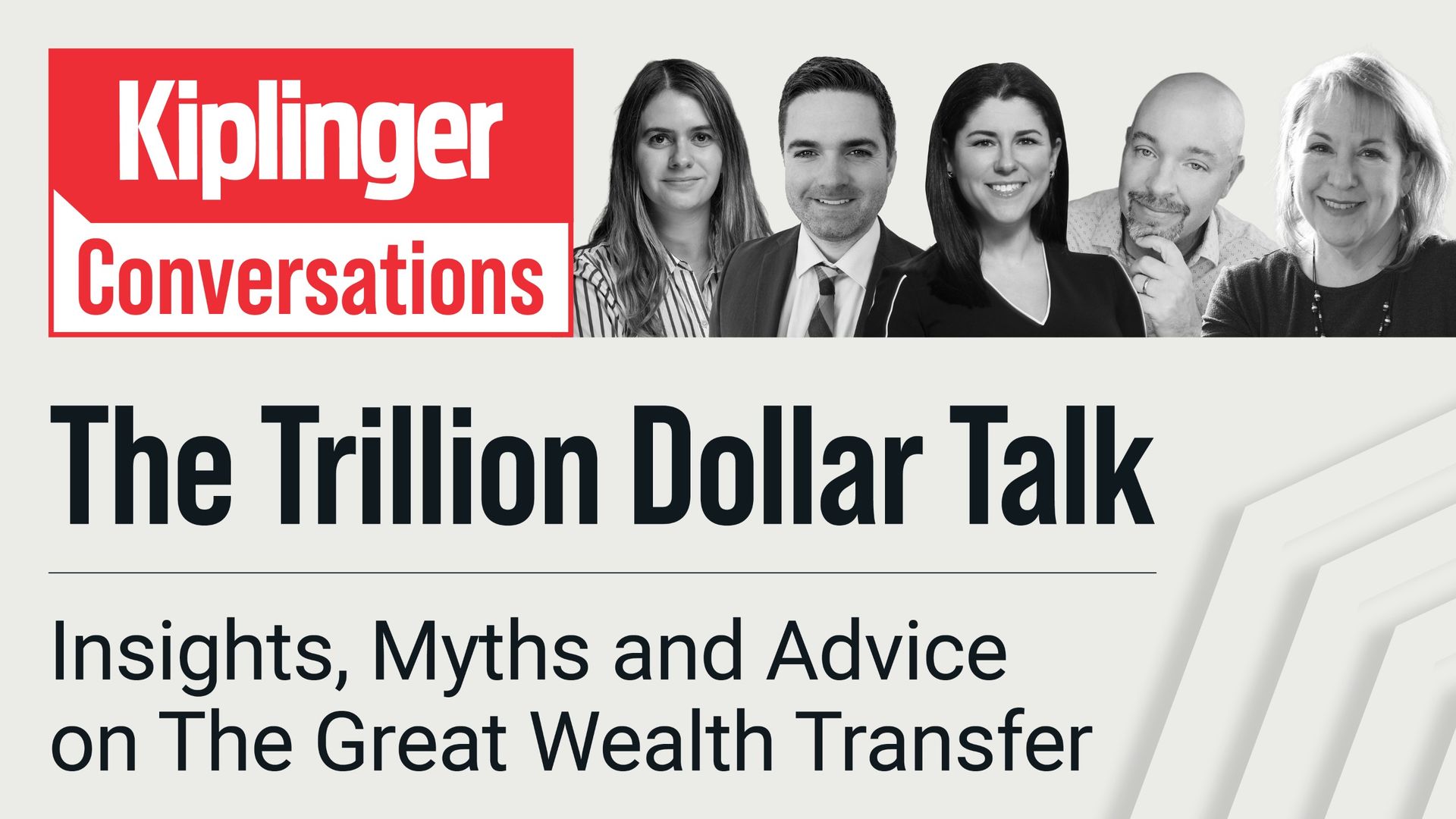

As part of our Trillion Dollar Talk campaign, Kiplinger editors — Alexandra Svokos, Kiplinger digital managing editor and Diane Harris, Kiplinger Personal Finance Magazine deputy editor — brought together three of our favorite experts to discuss inheritance. We had an invigorating conversation about how families can approach these conversations and the types of problems that often come up, as well as highlighting possible solutions for those scenarios.Joining us for our panel conversation were Valerie Galinskaya, managing director and head of the Merrill Center for Family Wealth®, Brad Klontz, associate professor of practice in financial psychology at Creighton University Heider College of Business and Ryan Coon, attorney at Anderson Advisors and J.D. from Willamette University.Watch the full conversation here:During this episode of Kiplinger Conversations, we asked viewers to send us their questions. Here’s a round-up of those questions, along with our responses. If you have questions on this topic, please reach out to us at KipInheritanceTalk@futurenet.com. We will do our best to answer as many questions as we can, and your questions may inspire future articles for Kiplinger. The answers provided by our editors are for general informational purposes only. Not all questions submitted will be published and some will be edited for clarity. 1. Addressing specific numbers.Question: The overarching question is, how do you have an informed conversation with your adult children without having to discuss specific dollars and cents?Diane Harris: Great question! It’s a very common concern among parents, not wanting to disclose exact numbers. And you don’t need to, honestly. Your general intentions, and why you’ve made the decisions you’ve made, and what plans you have in place are what the kids need to know, not numbers. After all, those numbers can change, depending on how long you live and what your expenses will be, particularly when it comes to health or long-term care. The critical details are not the amounts you intend to leave but whether you have a will and other estate planning documents and, if so, where to find them; the kind of assets you have (for example, do you have accounts that will pass outside of a will, property in addition to your primary residence, investment accounts, and so on); and how you plan to divide them and why. In particular, it’s important to explain your thinking if you intend an unequal distribution of assets among your children, so they understand your reasoning. And if you have money you intend to give for specific purposes during your lifetime — say, if you plan to help pay for a wedding or assist with the down payment on a home or your grandchildren’s college education — it would be good for the children to know that too, so they can plan accordingly.(Image credit: Kiplinger / Future)Alexandra Svokos: It’s not unheard of to be concerned about this. In our Trillion Dollar Talk survey, conducted by Morning Consult, we asked adult children to write in the one question they would want to ask their parents about a possible inheritance. The most common response we heard was a version of, “How much will I receive?”On the flip side, the most common reason parents said they haven’t talked to their kids about inheritance yet is that “there are too many unknowns.” Don’t let this uncertainty stop the conversation from happening in the first place. As Diane said, you don’t have to lay out everything in your estate – but I would recommend you aim to give your children a ballpark idea of what’s in your estate so you can both plan appropriately. Again, exact numbers aren’t what matter here; you just don’t want to leave them surprised and unprepared when you’re gone. Additional reading:We Know You’d Rather Talk to Your Kids About Politics Than Inheritance. Here’s the Right Way to Have That Conversation Anyway.Why So Many Families Are Unprepared for the Great Wealth Transfer — and What to Do About ItCounting on the Great Wealth Transfer? Why It May Not Pan Out the Way You Hope 2. One-on-one vs group conversationsQuestion: Do you feel it is better to have a family group inheritance discussion or one-on-one with each family member?(Image credit: Getty Images)Alexandra Svokos: The answer to this largely depends on your own family dynamics. If your family regularly has open (and healthy) conversations about finance and future planning, a group setting would make sense. If, however, group settings tend to bring up arguments, you may want to start the conversations one-on-one. Starting with a one-on-one conversation is also helpful if you’re splitting an estate anything besides explicitly equally – that way, you can explain your reasoning without having to balance group dynamics, and you’ll be in a space where the heir can openly ask questions to understand your decisions. But what I would keep in mind, as Ryan said, is that it’s not a one-and-done conversation. You can have both group discussions and one-on-one conversations to make sure everyone feels comfortable and confident. Additional reading:The Conversation You’re Avoiding: How to Bring Up Estate Planning with Your Family 3. Handling older parents’ financesQuestion: My husband is an only child, and his parents own two homes. They are 88 and 87. They have made it clear that everything is coming to us and have started to gift us the max each year $76K. We don’t know how much they have, and we don’t need the money. We worry that they might need extensive care as they get older (her mother lived to 106 years old). We are keeping the money in an interest-bearing account so we can use it for them if they need it later. Are there any recommendations as to how/where we keep these funds they are gifting to us? We want to do what is best for them.(Image credit: Kiplinger / Future)Alexandra Svokos: Thanks for your question. Long-term care costs are something many families are worrying about. In fact, our survey found that 24% of older parents fear that ongoing care costs will deplete their estate. First and foremost, we recommend speaking to professionals for advice on your own particular case. Our answers here are for general information purposes only. As a general principle, it’s worth having a conversation to ask parents if they have their own plans for managing long-term care. They may feel comfortable making gifts because they have a plan in place, for example, and if not, you can discuss how to set up a plan and what makes sense for you both. Again, this is generally speaking: If you have funds you may need to use within a short time span, an interest-bearing account where you can immediately access funds (like a high-yield savings account) is a decent idea. If you feel sure you won’t have to use funds for a longer time period, you can consider CDs (which typically have higher rates, but lock your money in for a set time period) or investing in the market, although that comes with higher capital gains tax rates if sold within a year, and of course, more risk than, say, a locked-in CD.Additional reading:No One Wants to Ask Their Aging Parents About Their Finances, But Here’s How Where to Put Inherited Money Gift Tax Exclusion 2026: How Much You Can Give Tax‑Free This YearI Have $150,000 That I Don’t Need Anytime Soon, but I Don’t Want To Put It in the Market. What Should I Do?4. Estate planning for blended familiesQuestion: Given the realities of today’s blended and often fractured family dynamics, is there a provision that allows us to safeguard the inheritance so it stays within the family?(Image credit: Getty Images)Diane Harris: Yes, in blended families, as our panelists mentioned during the discussion, a will is often not sufficient to ensure your assets pass as you want them to and protect the people you love and want to provide for. One key estate-planning tool that helps with this is a trust, which allows you to make stipulations – for example, you might set up a trust in a way that provides for a surviving spouse during his or her lifetime but then ensures that the remaining assets will pass to your children from a previous union. Whatever the specifics you want to put in place, a trust is often a good tool. Laying out your intention for personal property in a letter of intent, while not legally binding, is also often helpful. Often the most contentious items in an estate — in all families, not just blended ones — are items with emotional resonance, not the investment portfolio. Who gets Mom’s engagement ring or Dad’s prized watch or the ornament that sat on top of the Christmas tree or Grandma’s yellow pie plate… those are the items that can cause the greatest friction in families, experts tell us.An estate planning attorney can help with all of these decisions. You can find them either via personal recommendations from people you trust or by checking a professional directory such as those from the National Association of Estate Planners and Councils or the American College of Trust and Estate Counsel (ACTEC) Directory.Additional reading:The 5 Essential Trusts You Need for 2026 Estate Planning This Is How the ‘Brady Bunch’ Safety Net (aka a QTIP Trust) Protects Your Kids’ InheritanceThe Six Estate Planning Steps Every Blended Family Must TakeThe Little-Known Tool to Protect Your Retirement Savings in a Divorce5. Children with particular circumstancesQuestion: How do I or you address issues of a child with dementia and estrangement, re any or partial benefits of an inheritance?Alexandra Svokos: This is where you definitely want to make sure to get professionals involved. If you are planning to leave something to a child or other heir with whom you’re estranged, a letter of intent can help explain the inheritance to them without breaking an estrangement. I would just caution you to remember that a letter of intent is about explaining an inheritance, not about reopening conversations when you’re not around to have them. For a child with dementia or special needs, the answer here is again to make use of trusts. You can, for example, set up a special needs trust. This is also why I say you’ll need professionals involved – be careful about setting these systems and guardrails up so that your legacy gets used in the way in which you want it to be used. Additional reading:The Benefits of a Special Needs TrustA 5-Step Plan for Parents of Children With Special Needs, From a Financial PlannerManaging the Financial Dominoes of Special Needs Planning: A Practical Guide for Long-Term SecurityHow to Plan for Retirement When Your Child Has Special NeedsIs a Living Trust the Right Move for Your Estate Plan?
Kiplinger Conversations: How to Talk Inheritance With Your Kids