

A 1% annual advisory fee doesn’t look too alarming on a quarterly brokerage statement.
For millions of everyday retirees, handing a firm a single percentage point each year might feel like a modest price for peace of mind, steady financial guidance, and protection against a choppy stock market.
That said, the comfort has now vanished, revealed in an exchange broadcast on the November 25, 2026 episode of CNBC’s Mad Money.
A caller named Dave from Colorado dialed in on behalf of his retired girlfriend, in her early 60s, with a state pension and $600,000 invested in tax-deferred stocks and ETFs. Her management firm charges roughly 1% per year, or $6,000 annually right off the top, yet has been unable to keep pace with the S&P 500 while avoiding Magnificent Seven and growth stocks almost completely.
Jim Cramer’s blunt prescription exposes a quiet fee trap draining retirement funds across America, along with a straightforward fix.
Jim Cramer’s two-part blueprint to ditch the 1% fee
Dave wondered how his girlfriend could effectively manage her $600,000 nest egg on her own without stumbling. Cramer didn’t hesitate to cut out the middleman and anchor her retirement savings directly in the broader market.
More Jim Cramer:
Jim Cramer sends clear signal on Apple and Palantir stock
Jim Cramer explains the ‘AI cheat code’ driving Apple stock higher
Cramer thinks Boeing’s problems aren’t going away soon, says buy GE
“Okay, so I would put two-thirds of it in an S&P index fund,” Cramer advised. “Obviously, if they can’t beat it, just go for it and join it. Then one-third I would structure around what you’ve been saying, a portfolio of, say, 6 to 10 stocks, of which 2 or 3 can be over-weighted and large, mostly MAG-7, I should add. Stocks that we think are really great.”
That shift allocates $400,000 to a low-cost S&P 500 tracker and $200,000 to a focused basket of individual stock names. Even better, Cramer celebrated, eliminating the recurring drag: “No more 1%. You’re now free to move.”
Ditching leading growth stock names helps explain why wealth managers lag.
Later in the same broadcast, as I covered in a recent article, Cramer gave an unusual explanation for Nvidia stock’s price. He pointed to how fast-growing leaders consistently confounded cautious skeptics.
Calling the chipmaker “a really great example,” Cramer notes that Nvidia often looks pricey on forward estimates until robust earnings make its earlier price look remarkably cheap in hindsight.
Nvidia stock is currently trading at 15.56 times non-GAAP forward earnings, 62% below its 5-year average and 18% below the sector median, according to Seeking Alpha.
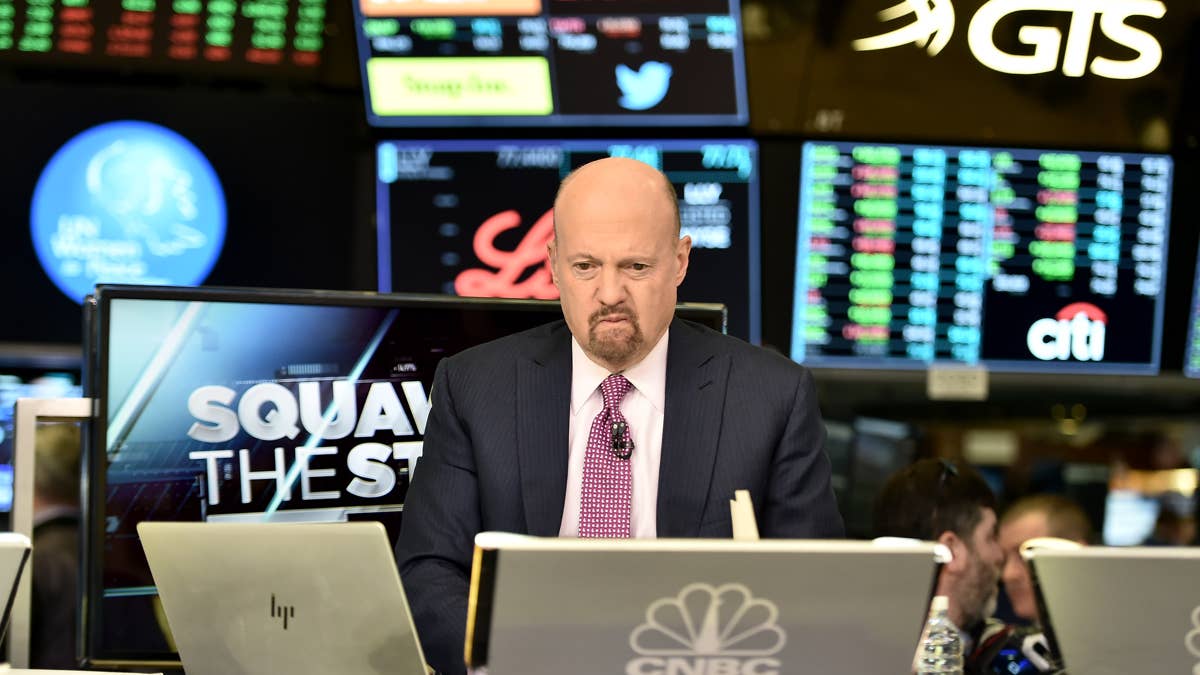
Jim Cramer suggests low-cost index funds for a retiree paying advisory fees.Steven Ferdman / Getty Images
Why paying 1% to lag the S&P 500 costs hundreds of thousands
Cramer’s pushback against underperforming active stock market managers is backed up by hard data.
As per the S&P Dow Jones Indices’ SPIVA U.S. Mid-Year 2026 Scorecard, 67% of active U.S. large-cap funds lagged the S&P 500 in the first half of 2026, while 83.33% underperformed over 10 years and 90.49% trailed over 15 years through June 30, 2026.
At the same time, the compounding math of a 1% advisory fee is brutal.
On $600,000, a 1% charge starts at $6,000 per year, compared to $180 annually in a 0.03% S&P 500 ETF. Under the Securities and Exchange Commission’s 4% annual return illustration over the course of 20 years, a 1% fee drains $231,007 from a $600,000 balance.
At a 7% gross annual return over two decades, paying 1% instead of 0.03% costs $384,545 in lost retirement wealth.
Market giants like Warren Buffett hammered the issue in his 2016 Berkshire Hathaway shareholder letter, according to Reuters,
“When trillions of dollars are managed by Wall Streeters charging high fees, it will usually be the managers who reap outsized profits, not the clients.”
Cramer’s broader stock market rules for DIY retirement investors
Ditching a 1% manager typically works if you stay disciplined once you take control. Throughout the November 25 broadcast, Cramer paired his index-fund endorsement with clear stock market rules for everyday savers.
First, treat index funds as your retirement bedrock.
“Putting money in a 401k or an IRA? Oh, that’s index fund territory,” Cramer told viewers, adding that even active stock pickers might keep a major share of savings in a cheap S&P 500 fund.
Second, it’s imperative to avoid herd panic.
Calling his framework the “kind-of-sorta-efficient-markets corollary,” Cramer warned,
“The most useless thing you can do as an investor is to worry about what everyone else is worrying about.” Because widely shared fears are typically priced into stocks, reacting to headlines generally means arriving late.
Finally, it’s important to protect gains with strict rules instead of emotion. As Cramer reminded another caller, “Discipline must always trump conviction,” advising investors to trim 5% to 10% after a 20% gain.
Comprehensive tax, Social Security, or estate planning may justify professional advice, including lower-cost hybrid options such as Vanguard Personal Advisor at 0.30%. Yet if you are paying $6,000 a year simply to trail the S&P 500, Cramer’s verdict is clear: it’s important for investors to demand real value or take the wheel themselves.
Related: Suze Orman warns retirees against one costly stock market mistake