

[[{“value”:”When it comes to finding a productive workout routine, there’s no need to reinvent the wheel. Looking to someone who’s in great physical shape and has already been there and done that is all the inspiration you need to get started. That’s why we looked to Peter Feysa, a pro trainer of 20+ years and the founder of STATE360 Fitness & Performance. We learned how he stays strong, along with the five exercises he does every week.
Feysa also trains clients in their 40s, 50s, 60s, and beyond who want to remain strong and active as they grow older. He shares some solid advice he regularly tells his clients.
“I’m 48 years old, and after more than 20 years as a personal trainer, I’ve learned that staying strong as you age isn’t about doing more exercises. It’s about picking the right ones, and working out with intensity and consistency week after week,” explains Feysa. “Staying strong in your 40s and 50s is a delicate balance because you need to push for intensity with your training, but you also have to train smart so you avoid injury.”
Feysa has experienced his fair share of injuries throughout the years, so he prioritizes these exercises to protect his joints and stay strong.
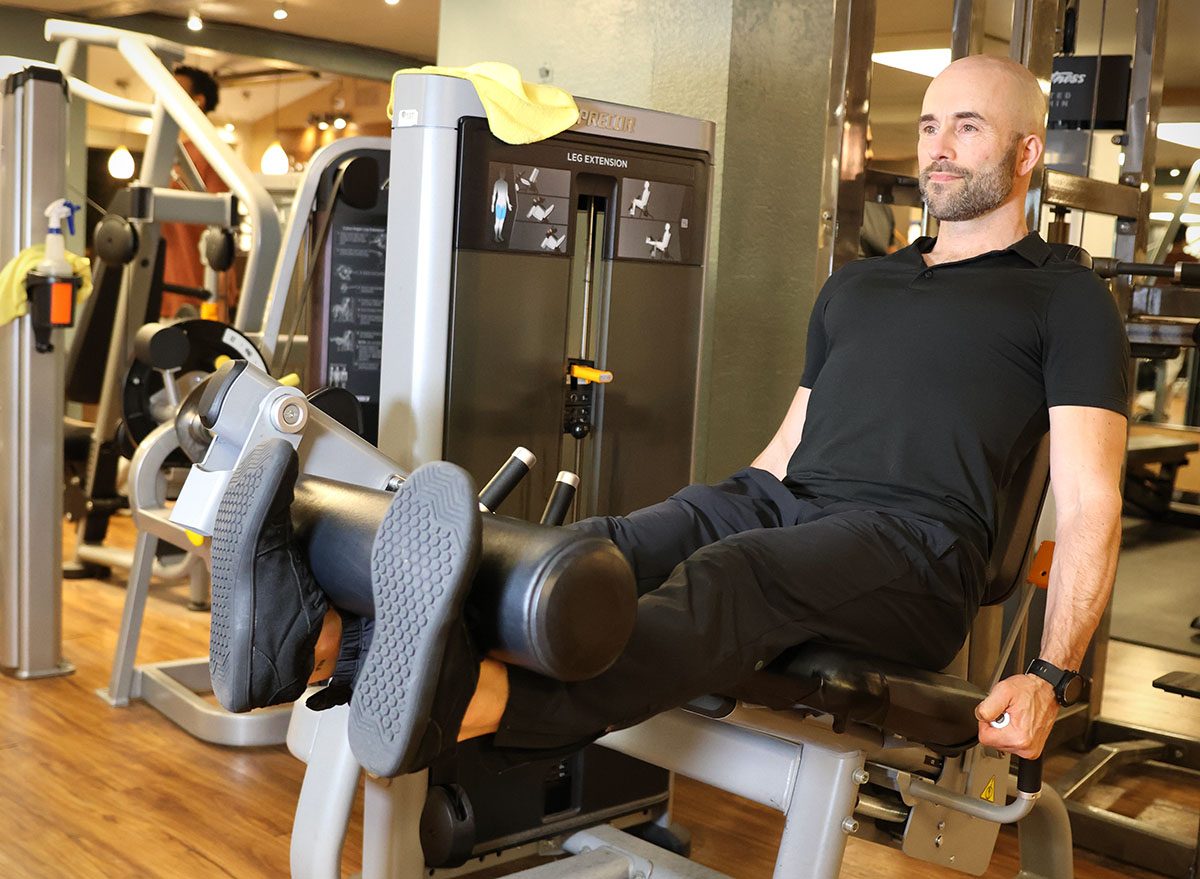
Leg Extensions
“Leg extensions are one of my favorite exercises for keeping my knees strong and healthy. I’ve dealt with knee injuries over the years, and strengthening my quadriceps has been a huge part of keeping me in the game,” Feysa says. “Squats and lunges are great exercises, but if you don’t have strong quadriceps, which are the exercises targeted with leg extensions, you can aggravate your existing knee problems.”
You can perform this exercise on a leg extension machine, but you can also use a sturdy chair at home.
Begin sitting tall with your back supported against the back of a sturdy chair.
Place your feet flat on the floor.
Hold the sides of the chair for added stability.
Straighten your left leg out in front of you until your knee is completely extended. For max quad engagement, keep your toes flexed toward your shin the entire time.
Hold for 2 seconds at the top before lowering.
Repeat on the other side.
RELATED: 6 Standing Exercises That Build More Strength Than Traditional Dumbbell Exercises After 40
Lat Pulldowns
“Your lats (latissimus dorsi muscles) are the largest muscles in your back, and keeping them strong is vital as you age,” Feysa tells us. “Lat pulldowns strengthen your back and biceps, and a lot of the accessory muscles in your back at the same time, which I love. This one exercise is non-negotiable for functional strength.”
Begin with a gentle load.
Sit at the cable machine.
Grab the handle using a pronated, supinated, or neutral grip.
From fully extended arms overhead, pull the bar toward your chin.
Use control to release.
RELATED: This Simple Japanese Walking Trick Could Help You Live Longer
Chest Presses
“Whether I’m using a chest press machine, dumbbells, or just doing pushups, this is an exercise I incorporate weekly,” Feysa explains. “Chest presses are a great multi-joint exercise that helps maintain upper-body strength as you get older. It strengthens your chest, shoulders, and triceps all in one movement.”
Lie flat on your back on a workout bench or the ground.
Hold a dumbbell in each hand just outside your chest.
Keep your feet flat on the ground and maintain an engaged core.
Press the dumbbells over your chest until your arms are extended but not locked out.
Use control to lower the weights.
RELATED: 5 Standing Strength Exercises That Reverse Muscle Loss Faster Than the Gym After 45
Planks
“If there’s one core exercise I think almost everyone should incorporate into their routine, it’s the plank,” Feysa says. “Unlike crunches and sit-ups, which can aggravate your spine and cause back pain, planks challenge your core to resist movement without punishing the vertebrae of your spine. This is called anti-extension training, and it’s vital for building core stability.”
Place your hands under your shoulders.
Press into the pads of your fingers and hug your inner arm toward your armpit.
Walk your feet out to hip-width. Your body should form a straight line.
Engage your abs, squeeze your buttocks, and pull upward through your quads.
Hold the position for the prescribed time.
RELATED: 4 Daily Exercises That Build More Strength Than Weight Training After 50
Back Extensions
“If there is one exercise that I could recommend that will dramatically improve your strength and health throughout your entire body, this is it,” Feysa says. “Back extensions strengthen your spine, glutes, and hamstrings—the entire posterior chain. It will help you decrease back pain, fortify your posture, and strengthen your hips while supporting your knees.”
Begin by adjusting the pad so it rests across your upper thighs or hips with your feet secured below the foot pad.
Make sure your body is positioned so your hips are able to hinge freely.
Hinge forward at the hips, lowering your torso toward the ground while maintaining a flat back—descending until your torso reaches right below parallel.
Activate your lower back and glutes before you rise back up.
RELATED: If You Can Do This Many Squats After 50, You Are in Great Shape
4 Tips He Gives Women 50+ Who Want To Stay Strong as They Age
Feysa has spent over 20 years training women in their 40s, 50s, 60s, and beyond, with his oldest client being 95 years old. He has also developed online training programs and spearheaded workshops focused on helping women remain healthy, active, and strong as they age.
Below is some sage advice he shares for women who want to maintain muscle and confidence with age.
Strength-Building Basics Don’t Change Very Much as You Age
One thing Feysa has learned over the years is that, when it comes to building strength, the basics don’t change very much as you age.
“Right now I’m training a 55-year-old woman who’s the strongest she’s ever been in her entire life. The formula is really simple. We focus on challenging strength training on Mondays and Fridays, with a lighter muscular endurance workout on Wednesdays,” Feysa says.
Don’t Fear Lifting Heavy Weights
One of Feysa’s biggest tips? Don’t fear lifting heavy weights. And by “heavy,” he doesn’t mean lifting weights that place you at risk of injury.
“Strength is relative to each person. I mean choosing weights that really challenge your muscles while allowing you to maintain good form,” Feysa tells us.
Prioritize Resistance Training
Resistance training is one of the most essential things you can do as you age.
According to Feysa, “It helps preserve and build your muscle, increase bone density, and keeps you independent and active.”
Focus on strength training a minimum of two to three times a week, activating all of your major muscle groups, including your hips, legs, chest, back, arms, shoulders, and core.
Don’t Think That Your Best Years Are Behind You
Your best years may very well be ahead of you!
“You can absolutely build muscle, improve your shape, increase your strength, and feel more confident in your 50s, 60s, and beyond,” Feysa stresses. “I’ve watched women do it for more than two decades as a trainer. That’s why I love being a coach.”
The post I’ve Trained Women Into Their 90s for 20 Years. These 5 Exercises Keep Them Strong appeared first on Eat This Not That.”}]]