

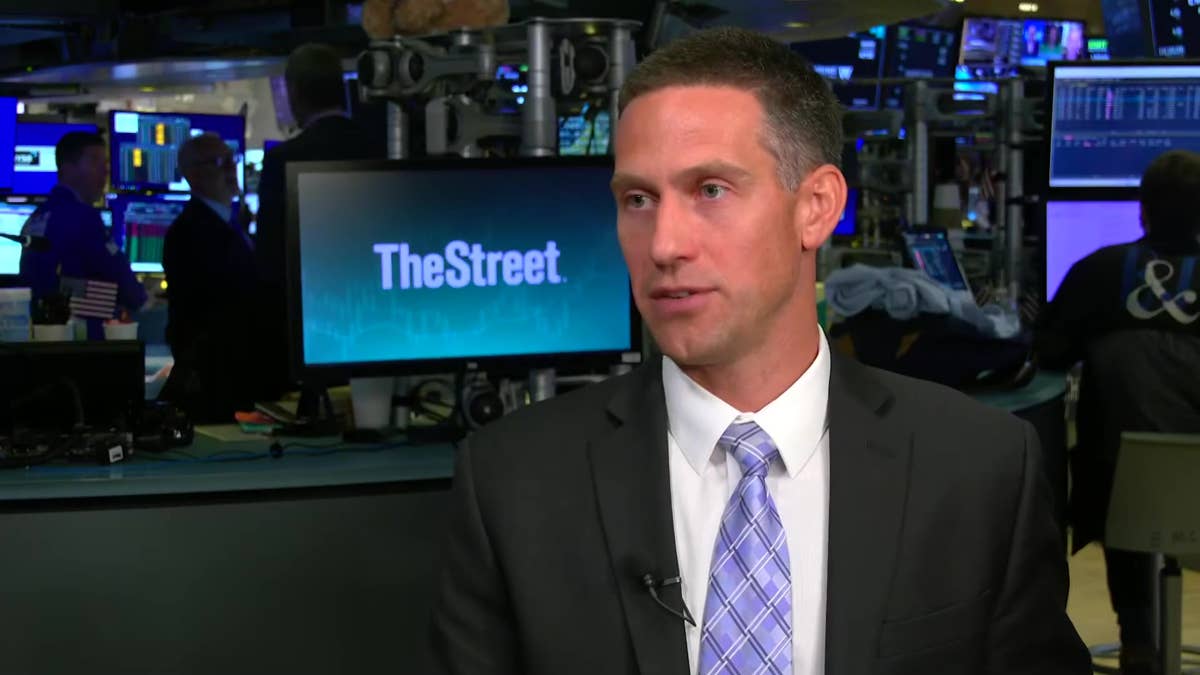
Record-high stocks can make a portfolio feel safer than it is. Investors who have benefited from an S&P 500 index fund, technology stocks, or the artificial-intelligence trade may be sitting on meaningful gains, but Nick Lumpp, president of RCN Wealth Advisors, argues that those gains can mask a market increasingly prone to abrupt reversals.
Lumpp, a fiduciary and ETF manager with 13 years of market experience, sat down with TheStreet’s Caroline Woods to explain how his systematic, trend-following investment approach attempts to ride upward momentum while minimizing the effects of market downturns.
His concern is not that a selloff is certain or that stocks have already reached a peak. Instead, he worries that the combination of late-cycle economic risks and changing market structure could make a future downturn sharper than investors expect.
For individual investors, the practical question is less about predicting the precise date or depth of the next decline and more about deciding how much downside they can live with before it arrives.
Lumpp’s process centers on rebalancing concentrated winners, holding assets that may behave differently from stocks, and using a rules-based approach to determine exposure to market trends without relying entirely on judgment. His strategy doesn’t fit every portfolio, but it offers a useful framework for thinking about risk after a long run in stocks.
Here is how Lumpp sees the current market’s risks, the role of gold and bonds in a defensive portfolio, and the trade-offs investors should weigh before changing their portfolio composition.
Why passive index investing can magnify stock-market swings
Lumpp’s starting point is a structural argument about passive index investing. When money flows into an index fund, he said, the fund must generally buy the securities represented in its benchmark.
In his telling, persistent inflows can reduce the supply of shares available to other buyers and sellers, helping reinforce an advance. The same dynamic can become uncomfortable when money starts flowing out, and investors rush to sell.
This viewpoint helps explain why an investor should look beyond economic data and corporate earnings when assessing portfolio risk. A market can be affected by how money moves through funds, derivatives, and trading strategies, as well as by the underlying businesses.
Because by mandate, an index fund can’t sell unless they have redemptions or outflows. So every week, every month that we have constant inflows in, they just keep pulling more shares from the market.
Nick Lumpp, when asked why he believes investors should become more cautious near record highs
Lumpp also pointed to stock options, CTA strategies, and leveraged ETF products. A CTA, short for commodity trading advisor, is a manager who often uses systematic rules to follow market trends. Leveraged ETF products seek to amplify the daily move of an underlying market or stock. Lumpp said these tools can add to volatility when trends accelerate in either direction.
His concern is not limited to a normal correction, which typically means a 10% decline from a recent peak. He said that if selling begins to build across these market mechanisms, a decline could be deeper than a standard correction. Lumpp explicitly declined to make a hard forecast about the size of any decline, citing uncertainty around economic conditions, the midterm elections, and other variables.
How investors can prepare for a possible market downturn in 2027
Lumpp sees signs of a late-cycle environment, including tighter financial conditions and the possibility that economic data could slow into 2027. He also said the pace of growth in the AI story appears to have slowed during the summer.
Those observations led him to say that RCN Wealth Advisors is preparing for a potential move lower in the first half of 2027, while stressing that he was not calling the market’s top in October 2026.
That distinction matters. Investors who need money soon have a different problem from long-term, buy-and-hold investors who can tolerate a drawdown. Someone saving for a near-term goal may need to reduce the amount of stock-market risk in their portfolio.
A long-term, buy-and-hold investor may decide that staying invested remains appropriate, but they should still understand whether recent gains have left their portfolio more concentrated than intended.
Lumpp listed several ways investors can reduce risk: Rebalance by trimming positions that have grown too large, lock in a portion of gains, hold more cash, add assets that are less correlated with stocks, and use hedges. Rebalancing does not require a prediction about tomorrow’s market direction. It means restoring a portfolio to the mix of stocks, bonds, cash, and other investments an investor originally intended to own.
A hedge is a position intended to offset some losses elsewhere in a portfolio. Non-correlation means two investments do not reliably move in the same direction. Neither is a promise of protection. Assets can become more correlated during periods of stress, and any hedge can carry its own costs or risks. The goal is to avoid depending on a single market outcome.
How systematic trend following tries to limit left-tail risk
Lumpp’s preferred approach is systematic trend following, a rules-based method that seeks to remain invested while a market trend is rising and reduce exposure after that trend reverses. Rather than asking a manager to decide each day whether stocks are attractive, the strategy follows predetermined signals. In simple terms, the rules are meant to tell the investor when to remain in a position and when to exit it.
The appeal is clearest for investors worried about left-tail risk, the possibility of an unusually severe loss that sits at the far negative end of potential outcomes. Lumpp said a systematic approach can help investors participate in an uptrend while creating a defined process for responding when the trend weakens.
It cannot eliminate losses, and it can be late to recognize a reversal. A quick decline followed by a quick rebound can also produce a costly exit and reentry cycle.
When things are working and they’re building to the upside, you want to jump on that trend and you want to ride it as long as it goes. But if and when that starts to reverse, you want to exit and hopefully avoid as much of the downturn and the unwind as you can.
Nick Lumpp, when asked how systematic trend following can help manage downside risk
Lumpp said the PRTO Strategic Allocation ETF that he manages applies this approach across several asset classes, including large-cap stocks, small-cap stocks, Treasury bonds, and gold. He described the ETF as a tactical asset allocation fund, meaning it can serve as a portion of a broader portfolio that adjusts exposure as conditions change. He also said some more conservative investors could use it as an equity replacement because the fund generally has roughly 70% equity exposure when stock-market trends are favorable.
The fund’s flexibility is part of its case and part of its trade-off. Lumpp said the PRTO Strategic Allocation ETF can reduce stock exposure to 0% when its trend signals turn off. That may help during a sustained decline, but it also means investors can miss gains if the market turns higher after the fund has moved defensively.
Investors considering an ETF should examine its strategy, holdings, fees, and fit with their existing portfolio rather than assume that a systematic label makes it appropriate.
Why the PRTO Strategic Allocation ETF holds small caps
One counterintuitive feature of Lumpp’s approach is its substantial small-cap exposure. Investors often think of small caps as economically sensitive companies that may struggle when growth slows. Standard portfolio construction also often gives large-cap stocks a larger weight because large caps tend to be less volatile.
Lumpp’s argument is that a systematic trend-following strategy changes that conventional calculation. Small caps have historically been more volatile than large caps, he said, with larger gains during bull markets and bigger losses during bear markets.
In Lumpp’s view, the greater movement can make trends easier for a rules-based system to identify and follow. That does not mean small caps are automatically defensive or that they will outperform during an economic slowdown.
When you apply a systematic trend-following approach, it kind of distorts the return and volatility profile of the asset class. And so the more volatile an asset is, the better it works to use a trend following approach.
Nick Lumpp, when asked why PRTO Strategic Allocation ETF had more small-cap exposure than large-cap exposure
Lumpp said the fund remained invested in small caps at the time of the interview because their recent trend had stayed positive. He also said deteriorating market breadth, meaning fewer securities are participating in an advance, could be one factor that leads the strategy to reduce or exit the exposure. That condition-based approach is central to the fund’s thesis: Own an asset while its trend remains intact, then change the position if the evidence changes.
When gold may diversify a stock portfolio better than bonds
Gold is another major part of Lumpp’s portfolio view. He said PRTO Strategic Allocation ETF had nearly 19% of its portfolio in gold across two gold ETFs at the time of the interview. This figure describes his fund’s holdings, and it’s certainly not a recommended allocation for every investor. A portfolio’s appropriate gold exposure depends on its time horizon, income needs, other holdings, and tolerance for volatility.
Lumpp framed gold in three ways. Over many decades, he said, gold tends to keep pace with purchasing power. Over intermediate periods, he said gold can move in longer waves influenced by inflationary and disinflationary conditions. In the short term, he described gold as a measure of financial conditions, which can be affected by changes in interest-rate policy.
The more distinctive part of his argument is gold’s relationship with bonds. Bonds are widely used to diversify stock exposure because they can (but don’t always) rise when stocks fall. Lumpp said that this relationship can change during periods of higher inflation, when bond investors demand higher yields and stock and bond prices can decline together, as occurred during 2022.
Lumpp said core CPI above roughly 3% to 3.5% has tended to coincide with a less useful stock-and-bond diversification relationship. He argued that gold can be a more effective portfolio hedge during a structurally higher-inflation environment. He also said gold had performed significantly better than long-term Treasury bonds over the prior six years, though he did not provide specifics.
Investors should be careful not to turn that view into a permanent rule. Gold does not produce income, can experience long stretches of disappointing performance, and may respond differently depending on interest rates, the dollar, inflation expectations, and investor demand. Bonds also remain important to many investors because of their income potential and their role in meeting planned spending needs.
How long-term, buy-and-hold investors can review concentrated gains
For long-term, buy-and-hold investors, Lumpp’s warning does not necessarily point to selling all stocks or abandoning passive index investing. It points to a more basic review: Has a strong run in VOO, technology stocks, or AI-related investments changed the portfolio’s risk level? A position that began as a modest allocation can become a dominant one after a large rally.
Lumpp’s rapid-fire responses reflected his preference at the time of the interview. Asked whether investors should buy stocks immediately or wait at record highs, he said to wait. He favored holding cash, chose bonds over stocks for the next 12 months, said to buy gold, and called the traditional 60/40 portfolio outdated. Those are personal allocation views, not universally applicable instructions, and the rapid-fire format did not include the reasoning needed to make them stand-alone recommendations.
His broader point was more durable: Risk management should be tied to an investor’s timeframe. A person who expects to use money soon may reasonably prioritize stability over maximizing stock exposure. A long-term, buy-and-hold investor can focus on diversification and periodic rebalancing rather than trying to trade every warning sign. Investors who own concentrated positions may also want to consider whether a decline larger than a routine correction would force an unwanted sale.
The takeaway for investors near record-high stocks
Lumpp’s case is not a prediction that a 2027 selloff will happen, nor is it evidence that every investor should move into cash, gold, or a tactical ETF. His case is that recent stock-market gains have arrived alongside market forces that could amplify a reversal, and that investors should consider their downside plan before they need it.
A useful decision procedure starts with three questions. When will you need the money? How much of your portfolio now depends on continued gains in the same stocks or sectors? And what change, if any, would you make if markets fell sharply? If the answers reveal a portfolio that is more aggressive or more concentrated than intended, rebalancing may be more useful than a dramatic market call.
For investors who want a tactical strategy, the next step is to understand the rules, the asset exposures, and the possibility of missing a rebound. For long-term, buy-and-hold investors, the next step may be simpler: Maintain a diversified allocation that matches their time horizon and revisit it after large gains.
The right response to market risk is rarely a single asset or a single forecast. It is a portfolio plan that an investor can follow when conditions change.
Some or all of this content may have been generated by AI. While we strive for accuracy, AI can occasionally produce incorrect information. If you buy something via one of our links, we may earn a commission.