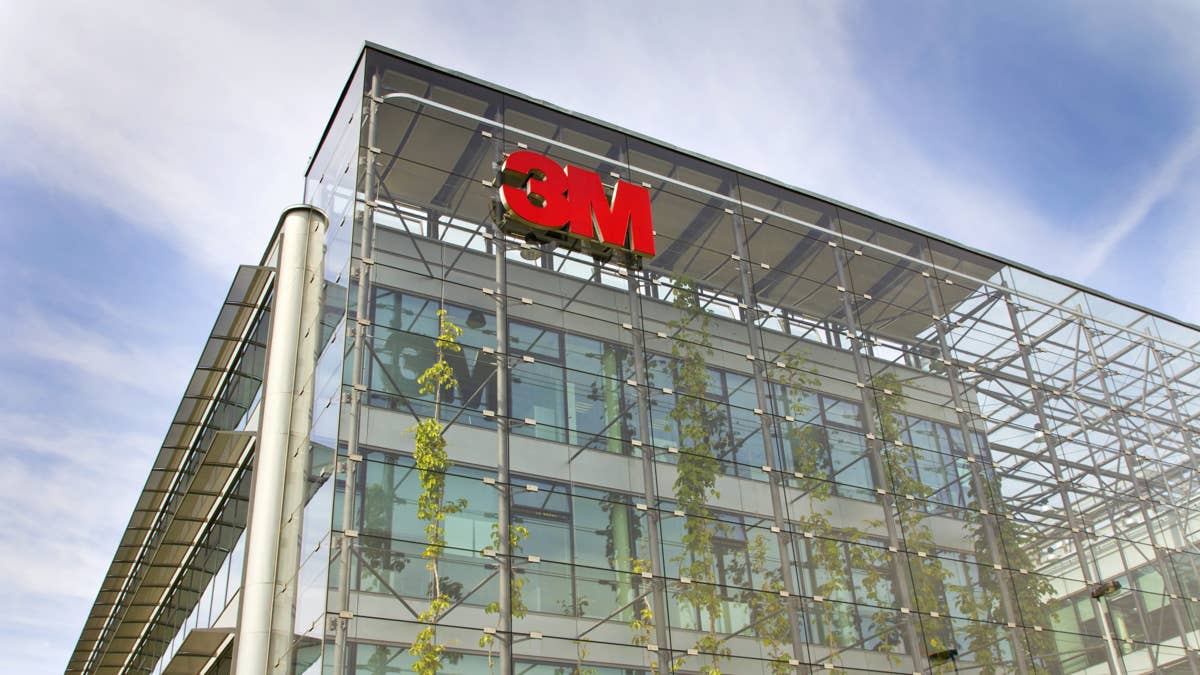


It was the misfire that launched the Boise Blitz.Back in 1968, Spencer Silver, a scientist for 3M (MMM), was working on a super-strong aerospace adhesive. Instead, however, he ended up with a substance that stuck to surfaces lightly, could be peeled off easily, and could be reused multiple times without leaving residue.”It was part of my job as a researcher to develop new adhesives, and at that time we wanted to develop bigger, stronger, tougher adhesives,” Silver said. “This was none of those.”A few years later, another 3M scientist, Art Fry, became frustrated while singing in his church choir when the scraps of paper he used as bookmarks kept slipping out of his hymnal. Remembering a seminar that Silver had given, Fry realized that the weak adhesive would make the perfect bookmark because it would stay in place without tearing the pages. The two men soon started singing from the same hymnal and developed a product codenamed “Press ‘n Peel” that unfortunately did not stick with consumers. Market surveys suggested that people didn’t want to pay for paper squares they could just cut themselves. So, it was off to Idaho’s capital city. Boise was chosen as the testing ground because 3M needed a self-contained market with a high concentration of office workers to prove their new sampling strategy.Bypassing traditional advertising, the company directly distributed free samples to offices — aka the Boise Blitz — and changed the name to “Post-it Notes.”Over 90% of businesses that received samples placed reorders, prompting 3M to retain the name and launch Post-it Notes nationwide on April 6, 1980. The sticky note went on to become one of the most popular office products, and 3M makes between 50 billion and 90 billion individual Post-it Notes globally each year. Analysts and financial publications estimate that 3M generates $1 billion in annual revenue from Post-it Notes, which accounts for a substantial portion of the company’s Consumer Business Group revenue.But there’s more to 3M than sticky notes—a lot more.3M wasn’t always the massive, material science and safety behemoth it is today. Here’s a closer look at the company’s founding, history, growth, and current significance, along with a timeline of key events and milestones. 3M’s founding and early Years3M, which also owns such brands as Scotch Tape and Nexcare adhesive bandages, got started in the early 20th century when five businessmen founded the Minnesota Mining and Manufacturing Company as a mining venture in Two Harbors, Minnesota.In 1947, 3M began producing perfluorooctanoic acid (PFOA), an industrial surfactant and chemical feedstock, by electrochemical fluorination.A few years later, DuPont purchased PFOA from the company for use in the manufacturing of Teflon. Related: Goldman Sachs: The History Behind Wall Street’s Most Influential Investment BankThe original formula for Scotchgard, a water repellent applied to fabrics, was discovered accidentally in 1952 by 3M chemists Patsy Sherman and Samuel Smith.However, the original formula relied on PFOS, a highly persistent chemical.The environmental impact of the original Scotchgard chemicals led to major financial burdens. 3M entered the pharmaceutical industry in 1969 with the acquisition of Riker Laboratories, which had previously invented the first asthma inhaler in 1956.Relocating Riker’s operations from Northridge, California, to St. Paul, Minnesota, 3M eventually rebranded the division as 3M Pharmaceuticals.Contending with forever chemicalsIn 2018, 3M agreed to pay the state of Minnesota $850 million to settle a $5 billion lawsuit over drinking water contaminated by PFOA and other fluorosurfactants known as “forever chemicals.”These chemicals are well known for their water-resistant and nonstick properties and have been commonly used in items such as food packaging, cellphones, nonstick pans, firefighting foams, and clothing.However, they are also dangerous pollutants that are linked to serious health problems, including ulcerative colitis and cancer.Related: History of Honeywell: Company timeline, milestones & factsAmid growing environmental and health concerns, 3M phased out PFOS-based Scotchgard chemicals in 2000 and later reformulated the product using alternative chemistries.In December 2022, the company announced plans to stop producing PFAS, often referred to as “forever chemicals,” by 2025.“This action is another example of how we are positioning 3M for continued sustainable growth by optimizing our portfolio, innovating for our customers, and delivering long-term value for our shareholders,” then- chairman and CEO Mike Roman said in a statement.As of Dec. 31, 2025, 3M employed roughly 60,500 people worldwide.3M’s Solventum spinoffIn 2022, 3M announced that it would spin off its healthcare division as a separate company to streamline operations. The new company would assume 3M’s business in wound and oral care, health informatics, and biopharmaceutical filtration.3M called the company Solventum, a mash-up of “solving” and “momentum,” and the spin-off was completed on April 1, 2024, with 3M owning a 20% stake of the business.3M’s stock & addition to the Dow3M went public and first traded on the New York Stock Exchange on Jan. 14, 1946, but the company had already offered its first employee stock purchase program in 1928 at $10 per share.The company entered the Dow Jones Industrial Average on Aug. 9, 1976, replacing Anaconda Copper. 3M has had five stock splits in its history, including four traditional stock splits and one distribution related to the Solventum spinoff.Related: History of American Express: Company timeline & facts3M’s CEO & financialsToday, 3M operates through Safety and Industrial, Transportation and Electronics, and Consumer segments, selling thousands of products used in manufacturing, healthcare, electronics, automotive, and consumer markets worldwide.3M reported full-year 2025 revenue of $24.95 billion, a 1.5% year-over-year increase from 2024. The company posted adjusted earnings per share of $8.06 in 2025, up 10% from the prior year.William “Bill” Brown took over as CEO on May 1, 2024, and succeeded former executive chairman Michael Roman as Chairman in March 2025.Before joining 3M, Brown served as CEO and president of Harris Corp. and later led defense contractor L3Harris Technologies.“Our performance reflects strong execution on productivity, cost discipline, and commercial rigor,” Brown said during the company’s first-quarter earnings call on April 21. “We are building a stronger foundation based on commercial, innovation, and operational excellence underpinned by a relentless focus on strengthening our performance culture.”Wall Street analysts generally view 3M favorably, citing improving operational efficiency and margin expansion, though ongoing litigation and uneven organic growth remain concerns.A timeline of key events and milestones in 3M’s historyJune 13, 1902: The Minnesota Mining and Manufacturing Co. makes its first sale.Jan. 14, 1946: 3M goes public and begins trading on the New York Stock Exchange.July 8, 1969: 3M acquires Riker Laboratories from Dart Industries.Aug. 9, 1976: 3M enters the Dow Jones Industrial Average, replacing Anaconda Copper.April 6, 1980: Post-it Notes are launched nationwide.Feb. 20, 2018: 3M reaches an agreement with the state of Minnesota to settle its lawsuit for $850 million. April 1, 2024: 3M completes the spin-off of its healthcare business, Solventum, into an independent, publicly traded company.May 1, 2024: William “Bill” Brown becomes CEO.Related: Home Depot over the years: A complete history of America’s biggest hardware store
History of 3M & its stock: Company timeline, facts & milestones