

Every Black Friday, my online shopping routine follows the same script.
I tell myself I’m grabbing just a few gifts, but by the time the cardboard boxes stack up by the front door, half my cart is filled with everyday basics, including coffee pods, paper towels, and laundry detergent, tossed in because one-click next-day shipping makes it all effortless.
If your own Amazon (AMZN) cart resembles mine, you are witnessing firsthand what has Goldman Sachs analysts leaning in hard.
Just days ahead of official Black Friday shopping and Amazon’s flagship cloud conference, in a note shared with me, Goldman Sachs just delivered a high-conviction signal on Amazon stock. As nervous traders continue to punish Big Tech over hefty spending bills, Goldman argues the market is misreading two powerful profit engines hiding in plain sight.
Inside Goldman Sachs’ $370 retail thesis for Amazon stock
Goldman Sachs analyst Eric Sheridan and his team reiterated a Buy rating on Amazon, keeping its stock on the firm’s Americas Conviction List, and reiterating its $370 12-month price target. That call implies around a 46.7% upside from Amazon stock’s November 24 finish at $252.29.
Sheridan didn’t mince words about the setup, stating that Amazon’s pricing setup “…leaves the stock as the most compelling risk/reward in our mega/large cap coverage from current levels.”
Read more: Amazon, Walmart, and Target’s holiday returns hide a catch
A core pillar of that call stems from changes in everyday shopping habits.
According to the bank, instead of losing shoppers to outside chatbots, Amazon’s first-party AI assistant, Alexa for Shopping, generated around $12 billion in incremental sales across over 300 million users in 2025. It is projected to climb 33% year over year to $16 billion or more across 400 million users in 2026.
Shoppers using it convert at 16%, a 60% lift over the 10% e-commerce baseline, while new “Shop Direct” and “Buy for Me” features allow Amazon to complete purchases even on external brand sites.
Meanwhile, fresh grocery and Everyday Essentials grew at about three times the rate of other categories and now account for 50% of all U.S. units sold.
That’s backed up by a brand new Uber Eats Prime perk across 10,000 cities and a high-frequency “halo effect” in which active grocery shoppers spend over twice as much across non-grocery categories.
Lower-priced staples ended up compressing Q3 stores contribution profit by around 220 basis points, but Goldman argues investors are overlooking automation. Amazon is now running more than 1 million fulfillment robots, potentially cutting per-unit cost-to-serve by around 13% by 2030, from $6.38 to $5.50.
Goldman Sachs reiterates its Buy rating and $370 price target on Amazon.Bloomberg / Getty Images
The $578 billion AWS catalyst heading into re:Invent
Black Friday checkout traffic is just one part of the story.
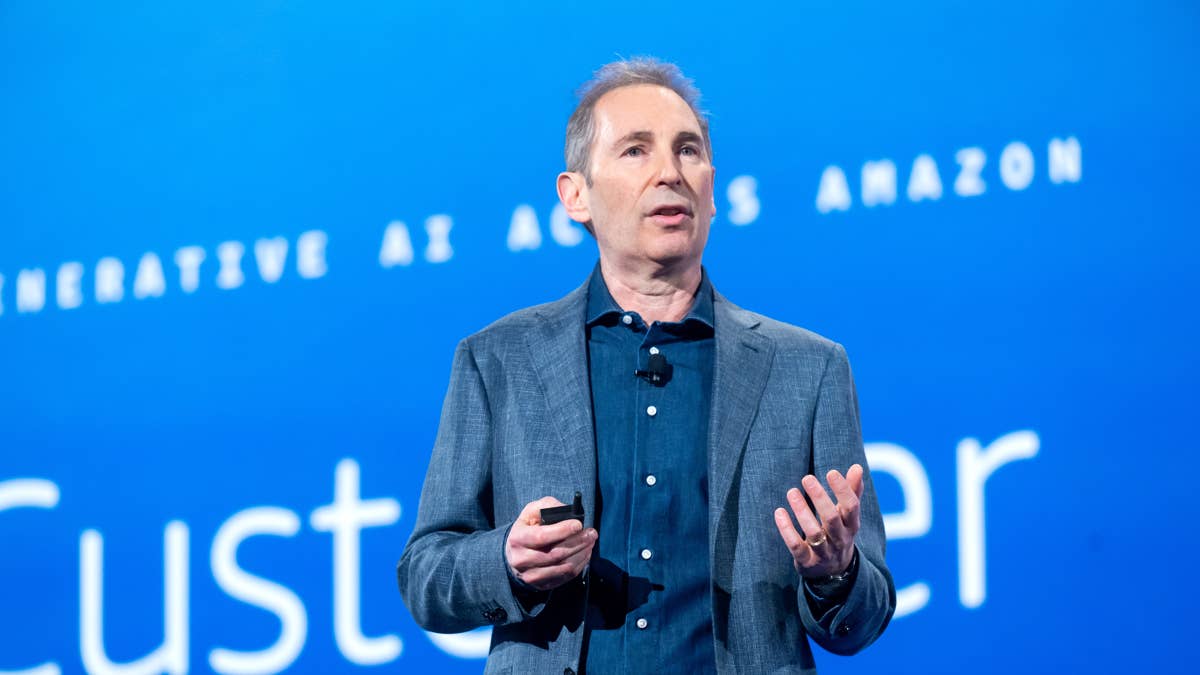
Amazon will host AWS re:Invent in Las Vegas, running from Nov. 30 through Dec. 4, putting its cloud division back in focus.
Sheridan’s team believes Wall Street remains behind the curve on cloud acceleration, writing that “we are in the early innings of an AWS estimate revision cycle that remains underappreciated by investors.”
After AWS grew 39% year over year in Q3, management forecast 40% or higher annualized growth in both 2027 and 2028, while outlining a path to a $1 trillion cloud business within five to 10 years.
More Amazon:
Amazon cuts more jobs as CEO touts record margins, retail gains
Amazon’s latest report left stock investors with one big question
Amazon’s $75 AI wearable hides a bigger $144-a-year bet
The underlying AI momentum is remarkable.
Amazon’s annualized AWS AI revenue run rate jumped from more than $15 billion in the first quarter to more than $25 billion in the second quarter.
Goldman forecasts AI services surging from $28.1 billion (15.9% of AWS revenue) in 2026 to $136.9 billion (40.7%) by 2028, while keeping consolidated AWS margins durable in the high-30s, backed by a year-end backlog that skyrockets 136.9% to $578 billion.
As AWS grows its Bedrock AI platform for businesses and prepares to sell its custom Trainium chips to outside customers by late 2027, Goldman Sachs points to substantial growth potential. In fact, in its most optimistic scenario, the bank estimates AWS cloud revenue could potentially rise by 54% to 55% over the next two years.
What Goldman’s signal means for Amazon stock investors
Despite near-unanimous Wall Street backing, with consensus targets ranging from $326 to $331, investor mood around Amazon has remained cautious.
Yet that skepticism has opened a rare valuation window.
Amazon trades near 23.5 times forward earnings, a 58% discount to its 10-year median of 56.5 times, roughly aligning with Microsoft’s mid-20s multiple and far below Apple’s 33-plus multiple, and just 17.4 times Goldman’s 2028 earnings estimate.
Goldman Sachs estimates that the stock could potentially drop to $190 in a worst-case scenario or climb to $500 if things go well, underscoring a wide range of possible outcomes for investors.
For long-term investors, the playbook is clear.
It’s important to monitor Black Friday order volumes and AWS CEO Matt Garman’s Dec. 1 re:Invent keynote for updates on Trainium adoption and Bedrock demand.
Instead of chasing post-event spikes, using pre-holiday pullbacks to build positions in stages allows for capturing both Amazon’s everyday shopping dominance and its accelerating cloud cycle.
Related: ‘Big Short’ investor snubs Tesla stock, echoes Buffett on $1,000 play