

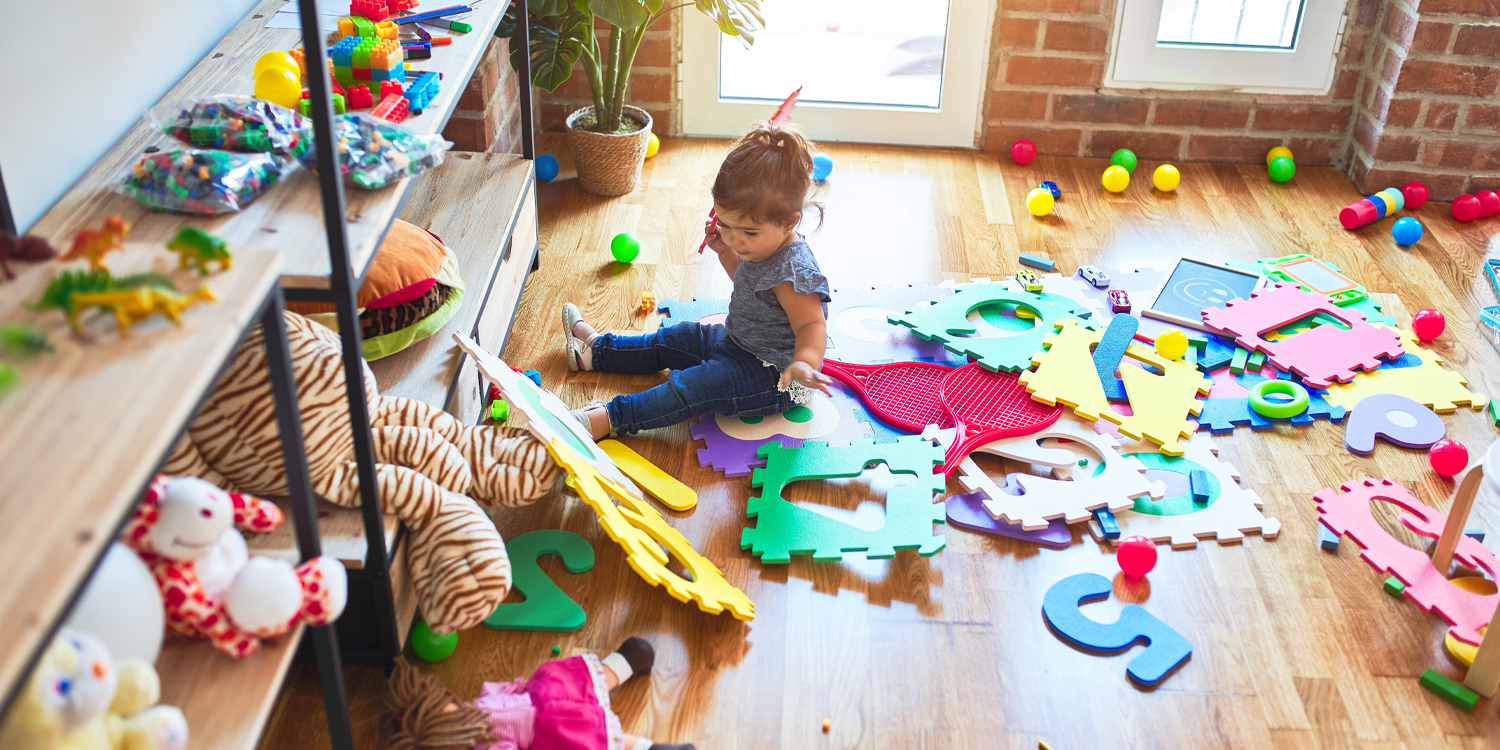
Even within the same home, mothers’ ratings of household noise, rushing, and disorganization vary somewhat from one child to the next, according to new research published in Journal of Child Psychology and Psychiatry. In a study of young sibling pairs, those modest child-specific differences tracked with outward behavioral difficulties like aggression and restlessness, even after accounting for overall household chaos and parenting. Inward emotional struggles like worrying and social withdrawal, by contrast, appeared tied to the household’s overall atmosphere rather than sibling differences.
Household chaos refers to a home environment marked by noise, commotion, disorganization, frequent rushing, and a lack of calm or predictable routines. Researchers often examine how this environment relates to two broad types of childhood adjustment problems linked to later mental health and schooling. Externalizing behaviors are outwardly directed difficulties such as aggression, rule-breaking, restlessness, and inattention, while internalizing behaviors are inwardly directed struggles such as frequent worrying, low mood, and social withdrawal.
Although brothers and sisters live under the same roof, most of the variation in childhood adjustment occurs between siblings in the same family rather than across different families. Developmental scientists have looked past shared household traits to examine child-specific experiences, such as differences in how warmly or harshly parents treat each child.
Household chaos blends purely physical features like street noise with social dynamics shaped by family members. As a result, siblings in the same home may face different levels of commotion, handle routines with different levels of ease, or contribute differently to daily clutter.
Earlier work using children’s own reports showed that siblings in the same home can experience different amounts of chaos in ways that track with behavior. In a 2012 longitudinal twin study of more than 6,200 British twin pairs at ages 9 and 12, children who reported more chaos than their twin tended to show more conduct problems and hyperactivity. Genetic modeling indicated that this link worked through environmental experience rather than purely inherited traits.
Parents and children, however, do not always view the home atmosphere the same way. In a 2024 nine-month study of 104 adolescents and their caregivers from low- and middle-income families, teenagers’ chaos ratings fluctuated more over time than their caregivers’ ratings did.
Because young children are usually too young to complete detailed questionnaires, research on early and middle childhood relies heavily on parents’ reports. In a 2023 longitudinal study by the same authors using a large British family cohort, parent-reported chaos showed a two-way relationship with maternal distress and child adjustment between ages 5 and 7. Children’s externalizing behaviors played a dominant role in that cycle.
Until now, parent-report studies have treated household chaos as a single score describing the entire family. The new research, led by Bonamy R. Oliver of the UCL Institute of Education at University College London, asked whether mothers perceive distinct levels of “child chaos” for and around each sibling. The team then tested how those child-specific ratings relate to siblings’ adjustment.
“Siblings can have very different experiences and exposures to aspects of the home environment and may even differ in the extent to which they contribute to or shape them,” Oliver, a professor of developmental and family psychology who leads the Nurture Lab, told PsyPost. “We need to understand these differences because they are increasingly recognized as important for sibling differences in cognitive and behavioral outcomes, yet we know surprisingly little about them. We were interested in questioning the assumption that a parent’s description of the home atmosphere (e.g., as calm, as chaotic) tells us what the home is like for and around every child in the family.”
To study parent-reported child chaos, the researchers recruited 301 mothers raising two children aged 3 to 11 in the United Kingdom and the Republic of Ireland through the online platform Prolific. Participants completed a survey averaging about 11 minutes for small compensation. After excluding mothers who failed data-integrity checks, had twins, or left all predictor items blank, the final sample included 261 families, or 522 children.
Older siblings averaged about 8.2 years old and younger siblings averaged about 5.4 years old, with just over half being same-sex pairs. Nearly 90% of mothers identified as White, and about 92% lived with a partner. About 72% held an undergraduate degree or higher, well above the United Kingdom’s national average of 42%, while their self-rated social standing matched a recent British parent cohort. Excluded mothers were slightly younger and more likely to identify as Black, though the groups did not differ in education or partnership status.
To measure chaos around each child, the authors adapted the widely used 15-item Confusion, Hubbub, and Order Scale. The questionnaire asks about daily home life using statements such as “We can usually find things when we need them” and “We almost always seem to be rushed.” Following common practice, one dated item about telephones was updated to “Screens take up a lot of time at home.”
Working with four parents of multiple children outside the research team, the authors revised the instructions and expanded the traditional yes-or-no format into a 5-point scale from “definitely untrue” to “definitely true.” Mothers rated how well each statement described the home “for and around” their older and younger child in side-by-side columns.
Mothers also completed the Strengths and Difficulties Questionnaire for each sibling. The researchers combined conduct and hyperactivity-inattention items to measure externalizing behaviors, and emotional and peer-problem items to measure internalizing behaviors.
Because perceived chaos could overlap with broader family stressors or parenting, the researchers controlled for maternal age, education, single parenthood, subjective socioeconomic status, and each child’s sex at birth. They also measured three parenting variables separately for each sibling: how negatively mothers felt about each child, over-reactive discipline, and parental hostility such as cursing when a child misbehaves.
The researchers used multilevel modeling, a statistical technique that separates differences between families from differences between siblings in the same home. For chaos and each parenting measure, they calculated a family average across both children and a child-specific score showing each sibling’s distance from that average. They then added demographic and parenting controls first, family-wide chaos second, and child-specific chaos last while modeling both behavior types together.
Consistent with earlier sibling studies, most of the variation in children’s adjustment lay within families rather than between them. Roughly 82% of the variation in externalizing behaviors and 71% of the variation in internalizing behaviors occurred between siblings in the same household.
Families with higher average externalizing difficulties also tended to report higher average internalizing difficulties. Inside the same family, however, the link between sibling differences in outward behavior problems and sibling differences in emotional or peer difficulties was not statistically significant. Mothers’ chaos ratings for older and younger siblings were closely aligned overall, showing only modest differences between children in the same home.
Demographic and parenting factors together accounted for roughly 26% of the overall variation in externalizing behaviors and about 11% in internalizing behaviors. Even after accounting for those variables, family-wide chaos remained tied to both outcomes, explaining roughly an additional 10% of the variation in externalizing behaviors and about 2% in internalizing behaviors. Children in more chaotic households tended to have more behavioral and emotional difficulties than children in calmer homes.
Adding child-specific chaos improved the model further and accounted for an additional 5% of the total variation in externalizing behaviors. That addition lifted the share of within-family externalizing variation explained from roughly 29% to about 39%. When mothers rated more chaos around one child than the family average, that child tended to show more conduct problems, restlessness, or inattention than their sibling.
For internalizing behaviors, however, the link with child-specific chaos was not statistically significant and added less than 1% of explained variation. A direct comparison confirmed that child-specific chaos related more strongly to externalizing problems than to internalizing problems.
“We tend to think of an atmosphere of calm and/or chaos in the home as something that is about the household as a whole,” Oliver noted. “However, parent perceptions of differences in the way the feeling of the home is experienced or altered by each of their children may tell us something important about how the home environment relates to differences in siblings’ behaviors.”
The contrasting patterns across behavioral and emotional difficulties matched the researchers’ initial predictions. “If not a surprise, it’s always extra pleasing when a very novel idea is backed by data!” Oliver said.
The findings broadly align with a 2024 longitudinal twin study of British adolescents. In that study, teenagers who viewed their home as more chaotic than their same-sex twin at age 16 showed more depression, anxiety, and antisocial behavior, plus lower self-control, at age 23. Unlike that earlier work, however, the new study examined mothers’ reports of chaos around young children at a single time point rather than tracking adolescents’ own perceptions into young adulthood.
In interpreting the findings, the authors acknowledged that parent-reported child chaos could simply mirror a child’s disruptive actions. They propose, however, that many items on the chaos questionnaire point more directly to executive function, the mental skills used to plan, stay organized, focus attention, and manage impulses.
In the authors’ reading, family-wide chaos may partly reflect outside pressures or a parent’s own struggles with organization and routine, affecting both emotional and behavioral adjustment across the home. Child-specific chaos, by contrast, may partly reflect an individual child’s executive function challenges, which tend to connect more closely to externalizing problems.
The authors also suggest that outward behaviors such as anger, tantrums, or aggression are more noticeable to parents than quiet worry or withdrawal, potentially making a parent feel less calm around that child. Given evidence of two-way feedback between chaos and behavior, they note a child facing more commotion may react outwardly, or one sibling’s disruptive actions may ripple across the home.
If future research supports these patterns, the authors suggest that programs aimed at reducing household chaos might eventually benefit from addressing specific disruptions around an individual child alongside household-wide routines.
“These are preliminary findings and we are looking to be a springboard for further, detailed research in this area,” Oliver cautioned. “The practical significance of the research is not yet well enough evidenced to make practical recommendations.”
As with all research, there are some caveats to consider. Because mothers reported on chaos and behavior at a single time point, the study cannot determine whether chaos around a child drives behavioral difficulties or whether a child’s behavior shapes chaos and parental perceptions. Both processes could also reinforce each other over time.
The authors also noted that sibling differentiation in chaos was minimal and may have been underestimated because mothers rated both children side by side on one form. Relying on a single parent for every rating can also introduce rater bias and inflate links between measures. In addition, 4% of the children were 3 years old, slightly younger than the age 4 minimum for which the behavioral scale was designed.
The sample also limits how broadly the results apply. All participants were mothers in two-child families who were mostly White and college-educated, leaving open whether similar patterns appear among fathers, other caregivers, larger families, or more diverse households.
“This study was the first of its kind, which makes it exciting,” Oliver added. “However, one of the most important things for psychological research findings before using them in practice is to replicate and extend studies using bigger, diverse samples and different methods to build on the work.”
Future studies could follow families over time, gather ratings from fathers and other caregivers alongside objective home measurements, and include households with more than two children. Researchers also hope to test whether physical or social aspects of chaos matter most, and whether child-specific effects stem mainly from how siblings experience chaos or how they contribute to it.
Looking ahead, Oliver outlined the immediate priority for this line of work: “To consider ways we can better measure the atmosphere in the home for and around the different children within it.”
“Various aspects of the home environment associate with sibling differences as well as sibling similarities,” Oliver remarked. “Most studies focus on one child in the home, and we need more studies that consider all children.”
The study, “Child chaos: parent-reported sibling differences in chaos at home in association with externalising and internalising behaviours,” was authored by Bonamy R. Oliver and Emily Midouhas.