

Elon Musk has spent years pushing for a bigger say over Tesla. A merger with SpaceX may be the cleanest way to get it, and at least one major Wall Street bank thinks that’s the whole point. “We see control as the key motivation for a merger,” HSBC analyst Michael Tyndall wrote.
The talks have moved fast, from a passing comment to a real process. Only a month ago, Musk was describing the setup as “an odd kabuki dance” in which two groups talk while he sits on the sidelines.
Now both sides have negotiators, bankers, and financial models in place, and the clock is ticking toward a possible announcement.
From a hint on SpaceX’s earnings call to actual deal teams
The first public sign came on Oct. 20. During SpaceX’s third-quarter earnings call, Musk said both companies had formed special committees of independent directors at shareholders’ request, and that he was shut out of the talks, according to TechCrunch.
“I can’t actually be in the discussions of the special committees,” he said, while still calling the idea worth exploring.
Tesla followed up in writing. Its third-quarter SEC filing said an independent committee had been set up to explore expanding the relationship with SpaceX, possibly through a business combination. The company stressed that no deal was certain and that any agreement would need the committee’s recommendation and shareholder approval.
Also read: Elon Musk shares troubling outlook for America’s debt
The two companies already do plenty of business together. SpaceX bought Megapack batteries that brought Tesla $480 million in revenue over the first nine months of 2026, including $151 million in the third quarter alone, according to Tesla’s SEC filing.
They are also partners on Terafab, a joint chip manufacturing project that ties their futures even more closely.
Timing is still the big unknown. Bloomberg has reported that a merger agreement could be announced as early as December, though neither company has confirmed a deal and talks are still ongoing. For now, investors are left reading between the lines.
Why Musk’s control remains the real prize
The math on the voting power is what makes this deal so unusual. Analysts quoted by Reuters estimated that Musk could end up with 57% to 58% of the combined company’s votes under certain structures. That would be nearly three times the influence he has at Tesla today.
Other estimates land in the same neighborhood. HSBC estimates Musk’s ownership stake in a combined company would dilute to about 60%, and it also argues the strategic benefits are limited because the two businesses serve different customers. In other words, the bank sees governance, not synergy, as the main driver.
Jefferies sees a similar picture. The firm estimated Musk could keep roughly 55% of voting power if the deal carried no premium for Tesla holders, according to TheStreet. Whichever number turns out to be closest, every one of those outcomes would leave him with clear majority control.
Tesla shareholders still get a say, and the bar is high. A merger would need approval from a majority of all outstanding Tesla shares, not just those cast, which means shares that sit out the vote effectively count as no. Musk himself has called that a high hurdle.
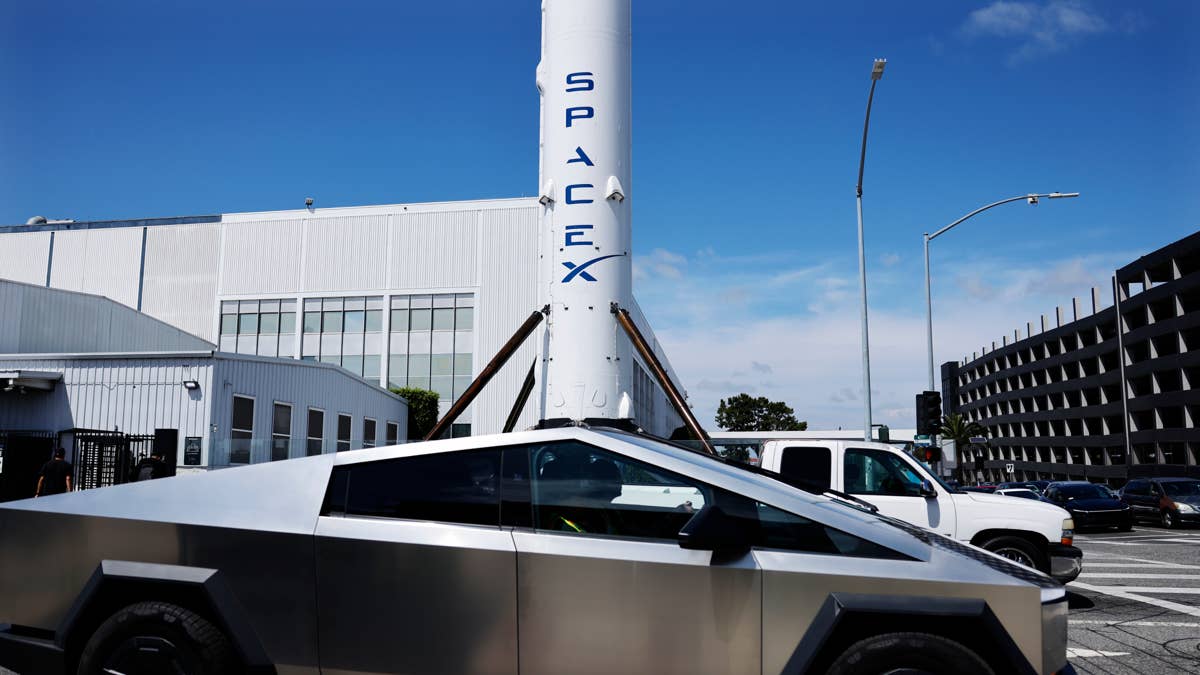
SpaceX and Tesla already do plenty of business together. SpaceX bought Megapack batteries that brought Tesla $480 million in revenue over the first nine months of 2026, including $151 million in the third quarter alone.Mario Tama / Getty Images
What Tesla shareholders could get
Everything hinges on the exchange ratio, which hasn’t been agreed yet. SpaceX is reportedly valued at approximately $2 trillion and Tesla at about $1.5 trillion, though those are rough figures rather than deal prices.
Wall Street can’t agree on the premium, either. In an October Reuters analysis, estimates for what Tesla holders might receive ranged from little or nothing to about 35% above market value. That’s a huge spread for a deal of this size, and it shows how early the talks still are.
HSBC has put numbers on the possibilities. Tyndall calculated a possible purchase price of $507 per share, a 33% premium to Tesla’s 30-day average, while valuing Tesla on its own at as little as $212, as reported by The Motley Fool. That gap shows how Tesla’s current price already leans heavily on a deal getting done.
More Elon Musk:
Elon Musk reportedly invests $1 billion in media giant
Elon Musk makes an odd new promise about the Tesla Roadster
Elon Musk doubles down on the Roadster with SpaceX thrusters
Investors should also look hard at what they’d be buying into. SpaceX earned $4.4 billion last quarter, its first profit since going public, but spent $19.6 billion on capital projects, more than its revenue.
The company expects to spend even more in the fourth quarter as it builds out its AI ambitions.
Hurdles before any merger deal closes
Regulators may have plenty to say. SpaceX’s U.S. defense contracts and Tesla’s reliance on China could complicate any combination. A company that builds rockets for the Pentagon and cars in Shanghai is bound to draw close attention in Washington.
Not everyone is buying the excitement. Gary Black of Future Fund warned that Tesla shares could jump on a merger announcement and then give back the gains quickly. He said arbitrageurs would whittle down SpaceX’s share price after a stock-for-stock deal, shrinking the premium Tesla holders receive to well below what was advertised.
Some well-known skeptics are staying away entirely. “Big Short” investor Steve Eisman said he is not a fan of either company, pointing to Tesla’s four straight years of declining earnings and SpaceX’s surging capital spending, which ran at more than twice its revenue in the first quarter of 2026.
For shareholders, the real question is whether a bigger Musk empire is worth handing him an even firmer grip on it.
Related: Jim Cramer sends a strong signal to Google stock investors