

Larry Page hasn’t said much in public since he stepped back from running Google. One number he reportedly tossed out in a private conversation is now doing the talking for him.
That number is 99.999%, and Tesla and SpaceX CEO Elon Musk says his old friend got it right.
“Larry Page has made many accurate predictions and this is one of them,” Musk wrote in a Nov. 8 post on X, sharing a clip posted by writer Hosun Chung. The compliment carries extra weight because the two men haven’t been on friendly terms in roughly a decade.
Musk and Page were once close enough that Page said he would sooner leave his fortune to Musk than to a charity, since Musk’s companies were chasing goals he believed in. That friendship fell apart over AI around 2015, when Musk helped launch OpenAI and recruited researcher Ilya Sutskever away from Google.
“At one point he called me a speciesist for being pro-human,” Musk said on the “Lex Fridman Podcast” in 2023. He said he’d like to be friends with Page again, and he brought up the rift once more in April while testifying in his lawsuit against OpenAI.
The prediction has nothing to do with search engines or self-driving cars. It’s about where the world’s computing power will physically sit in the future, and Page’s reported answer wasn’t anywhere on the ground.
Read more: Elon Musk says treasury should just ‘issue people checks’ rather than taxing the rich
Page’s data-center forecast took the scenic route
The forecast surfaced on the Nov. 4 episode of the “Invest Like the Best” podcast. Host Patrick O’Shaughnessy passed along a story he had heard from someone else.
“Someone asked Larry Page how much of compute will be orbital, and he said five-nines,” O’Shaughnessy said on the podcast.
Orbital means in space. Five nines is 99.999%, which would leave just 1 out of every 100,000 units of computing power on Earth.
O’Shaughnessy said Page’s reasoning came down to “it’s just physics.” Page hasn’t publicly confirmed the figure, so it remains a secondhand account.
The episode’s guest, Andreessen Horowitz general partner Martin Casado, offered a more down-to-earth explanation.
“It’s just basically regulatory,” Casado said.
He pointed to roughly 500 proposed pieces of legislation in the U.S. aimed at stopping data-center construction, including in Texas.
Communities across the country have pushed back on the massive facilities over the power and water they use, and every new restriction on the ground makes the sky look a little more open for business.
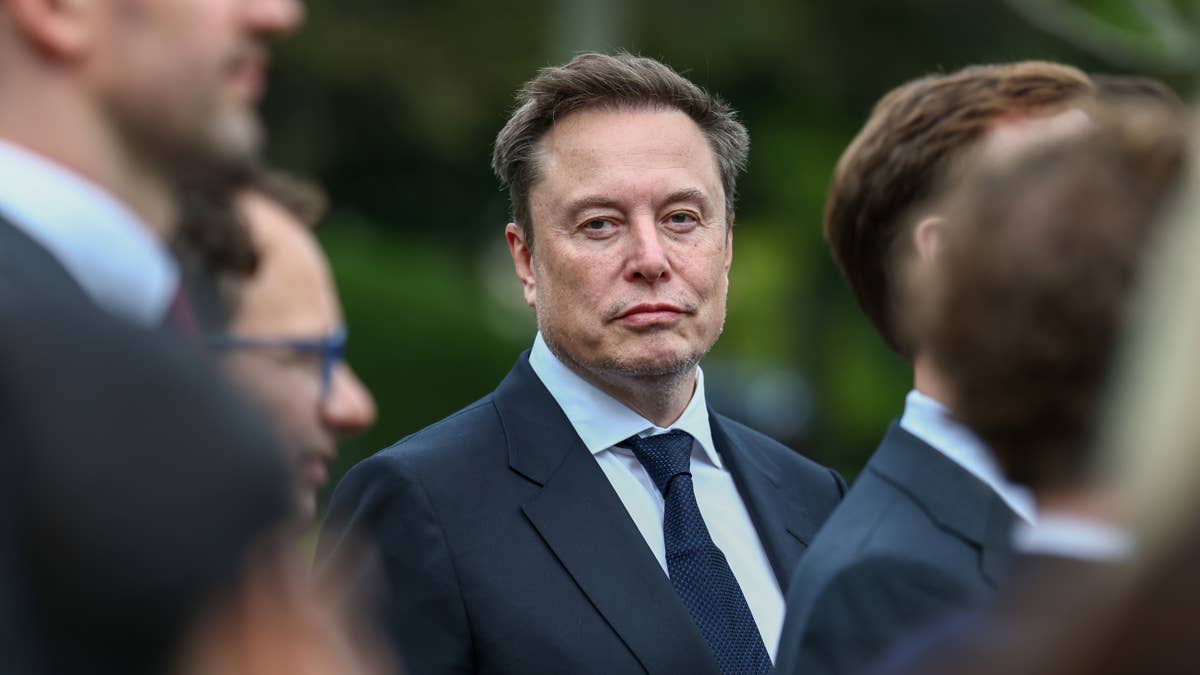
Elon Musk co-signs Larry Page’s AI prediction as “accurate.”KENT NISHIMURA / Getty Images
Musk isn’t cheering from the sidelines
Musk has been pitching AI in orbit for most of the year, and he has put a short clock on it.
“The lowest cost place to put AI will be space,” Musk said at the World Economic Forum in Davos in January. He predicted that would hold true within two to three years.
SpaceX has also asked the Federal Communications Commission for permission to put up to 1 million satellites into orbit as data centers. The company already rents out AI computing power from data centers on the ground, and it has signed a string of AI hosting deals this year.
More Elon Musk:
Elon Musk delivers 6-word warning on future of employment
Elon Musk once backed Buffett’s 5-minute fix for national debt: ‘This is the way’
How much SPCX stock does SpaceX CEO Elon Musk actually own?
In its IPO filing, SpaceX said Anthropic agreed to pay $1.25 billion per month through May 2029, though either side can walk away with 90 days’ notice. Anthropic’s own IPO filing earlier this month, on Nov. 2, put the expected bill at about $3.1 billion a month once all the capacity is delivered.
Musk has said SpaceX’s first Starmind satellites, which work as small data centers in space, could launch in late 2027. The company’s IPO prospectus was more cautious, pointing to as early as 2028. Getting that hardware up there cheaply is the hard part.
On Nov. 14, SpaceX caught its Starship upper stage with the launch tower’s mechanical arms after a trip to orbit, though the booster on the same flight exploded over the Gulf of Mexico.
So when Musk calls Page’s forecast accurate, he isn’t just complimenting an old friend. He’s backing a bet his own company is making with billions of dollars.
Page’s old company already has chips circling the planet
Google isn’t sitting this one out. The company launched a prototype satellite for its Project Suncatcher research effort on Oct. 1, riding aboard a SpaceX Falcon 9 from Vandenberg Space Force Base in California.
The satellite, built with Earth-imaging company Planet, carries four of Google’s tensor processing units, the custom chips it designed for AI work.
On Oct. 30, Google said the satellite had finished its commissioning checklist and run early machine learning tests. Its first AI response from orbit was a haiku about being in space. Thermal and radiation tests come next, followed by a two-satellite experiment planned for 2027.
Google called Suncatcher a long-term research moonshot, not a replacement for the data centers it runs on Earth.
Amazon founder Jeff Bezos is in the race, too. His space company, Blue Origin, filed plans in March with the Federal Communications Commission to deploy 51,600 data center satellites under an initiative called Project Sunrise.
Bezos has called data centers in space a “very realistic” outcome, but he said the two- to three-year timeline often tossed around is “a little ambitious,” CNBC reported. That puts him on a slower clock than Musk.
Not everyone is ready to ship the server racks to space
The skeptics have plenty to say. Bank of America analysts flagged unsolved problems for orbital data centers, including how to get rid of heat in space and how AI chips hold up once they’re up there.
A former NASA engineer writing under the pseudonym Taranis went further, arguing that orbital data centers would “offer mediocre performance at best.”
The debate matters well beyond Silicon Valley. Musk has pitched orbital data centers as a way to ease the strain AI servers put on power grids here on Earth, E&E News reported. Anyone paying a utility bill in a town with a new data center going up has a stake in how that argument plays out.
In tech, five nines usually describes a system that almost never goes down. Page reportedly used it to describe where nearly all computing will go up.
Whether Musk’s “accurate” label holds depends on rockets that come home in one piece and chips that keep working in orbit. Until then, the most talked-about prediction in AI is still a story someone heard from someone else.
Related: Elon Musk says Larry Page’s ‘five nines’ AI prediction is right — despite their decade-long feud