


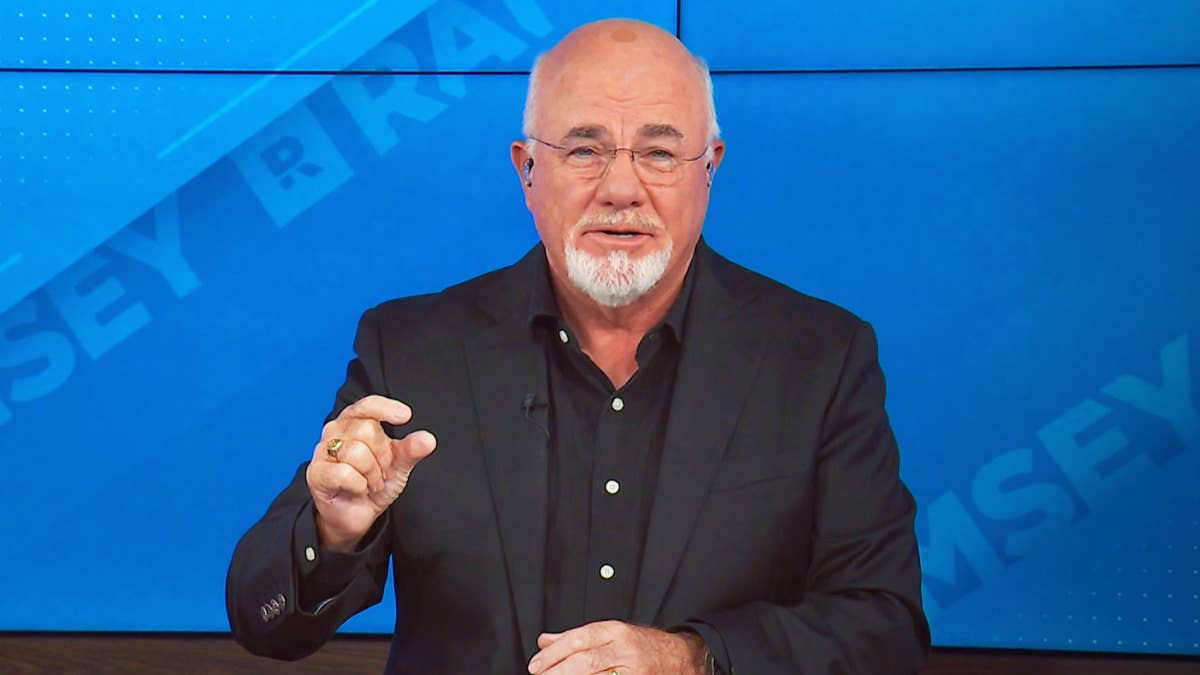
Radio host and bestselling personal finance author Dave Ramsey has a straightforward recommendation for retirement savers considering 401(k)s and IRAs. “A traditional 401(k) and a Roth IRA are two of the most powerful tools you can use to save for retirement,” he wrote for Ramsey Solutions. “For most people, the best strategy is to use both a Roth IRA and traditional 401(k) to save for retirement.” And Ramsey offers a specific approach to help Americans begin their retirement savings accounts.”Start by contributing enough to your 401(k) to get the full employer match, then max out a Roth IRA for tax-free growth,” he wrote. “After that, you can return to your 401(k) to increase contributions.”Ramsey explains the advantages of Roth IRAs and traditional 401(k)s.”A Roth IRA is an account that allows you to save a certain amount each year for retirement,” he explained. “But what makes a Roth IRA one of the best retirement savings options is that it includes tax-free growth and tax-free withdrawals once you retire.”Ramsey clarifies that a traditional 401(k) is a retirement savings plan that’s sponsored by one’s employer. In many cases, the employer will match employee contributions, up to a certain percentage of their income.”With a traditional 401(k), you decide how much of your paycheck to invest, and it’s automatically deposited into your account,” he wrote. “The money you put in is tax-deferred, meaning you won’t pay income taxes on it … yet.” “But years from now, when you retire and start pulling from your 401(k) savings, that money will be taxed at whatever your income tax rate is at the time.”Vanguard explains 2026 401(k) plan contributionsOffered through one’s employer, a 401(k) allows people to set aside money for the future straight from their paycheck. Since companies set their own rules and not every workplace provides one, it’s important that employees check their specific workplace benefits to see what their options are, Vanguard emphasizes.”At a minimum, it can benefit you to contribute enough to receive the full employer match,” wrote Vanguard. “Otherwise, you’re passing up extra compensation that’s already offered and can significantly strengthen your long‑term savings.”More on personal finance:Charles Schwab, Fidelity alert workers to forced 401(k) ruleDave Ramsey warns Americans on 401(k)s, IRAs (he’s not wrong)Congress research arm warns Americans on 401(k), IRA penaltyIn 2026, the annual 401(k) contribution limit for individuals is $24,500, with an additional catch-up allowance raising the limit to $32,500 for those 50 and older, according to the Internal Revenue Service (IRS). Certain employers may also allow an enhanced catch-up threshold for workers between 60 and 63. These caps apply solely to personal contributions, not to any matching funds provided by a company.Charles Schwab clarifies Roth IRA rulesA Roth IRA is a personal retirement account funded with post-tax dollars, explains Charles Schwab. Because one pays taxes upfront, investments accumulate earnings tax-free, and a person can pull out their growth completely tax- and penalty-free once they hit age 59½ and have held the account for at least five years.”A Roth IRA can be a good savings option for those who expect to be in a higher tax bracket in the future, making tax-free withdrawals even more advantageous,” wrote Schwab.For 2026, the total contributions one makes each year to Roth IRAs can’t be more than $7,500 ($8,600 for those age 50 or older), according to the IRS.The IRA contribution limit does not apply to rollover contributions.”If you have a 401(k) with a previous employer, you may be able to transfer those assets into a rollover IRA,” wrote Fidelity Investments. “Transferring an old 401(k) into a rollover IRA doesn’t count toward your annual IRA contribution limit.”Dave Ramsey spells out Roth IRA income limitsRamsey notes an important rule regarding Roth IRAs in 2026.”As amazing as the Roth IRA is, there’s a chance you might not even be eligible to put money into one,” he wrote.As amazing as the Roth IRA is, there’s a chance you might not even be eligible to put money into one.”That’s because if one’s modified adjusted gross income (MAGI) is more than $168,000 as a single person or $252,000 as a married couple filing jointly, they are unable to contribute to a Roth IRA, according to the IRS.”But don’t worry, the traditional IRA is still an option — and it’s better than nothing,” Ramsey stressed.
Shutterstock
Ramsey highlights the Roth IRA 5-year ruleThere is another important consideration to keep in mind regarding Roth IRAs: the 5-year rule.”This won’t be an issue for most folks, but the five-year rule says you can’t take any investment earnings out of your Roth IRA until it’s been at least five years since you first contributed to the account,” Ramsey wrote.”You can withdraw contributions at any time, but that would be a bad idea,” he added. “You’ll get hit with taxes and penalties if you break that rule (so don’t do that).”Related: Fidelity 401(k) change seen on unexpected move