


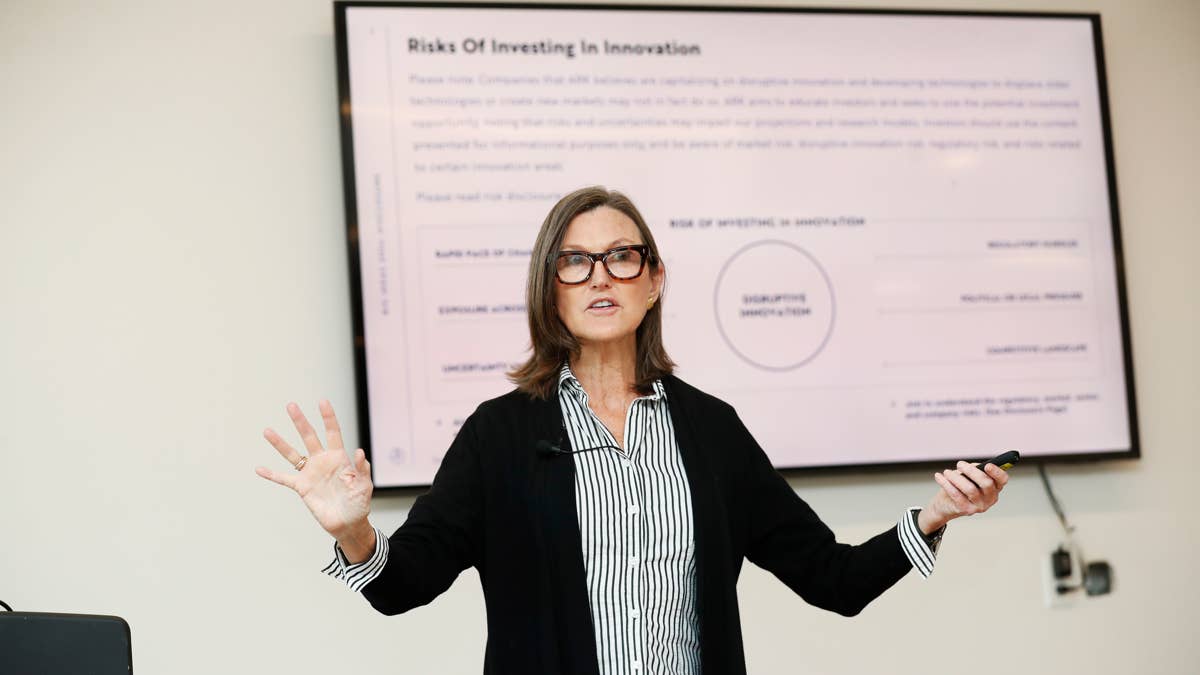
Cathie Wood, chief of Ark Investment Management, likes to double down on her favorite tech stocks, especially when the prices are falling.That’s what she just did, buying a megacap tech stock amid a broader market sell-off.In 2025, the flagship Ark Innovation ETF gained 35.49%, far outpacing the S&P 500’s return of 17.88% in the same period. So far this year, Wood’s flagship Ark Innovation ETF (ARKK) is down 1.48% year to date, while the S&P 500 surged 7.49%, Yahoo Finance data shows.Wood gained a reputation after the Ark Innovation ETF delivered a 153% return in 2020. But her style also brings painful losses in bearish markets, as seen in 2022, when the Ark Innovation ETF tumbled more than 60%.Those swings have weighed on Wood’s long-term gains. As of June 23, the Ark Innovation ETF has delivered a five-year annualized return of -8.95%, while the S&P 500 has an annualized return of 11.27% over the same period, according to data from Morningstar.Cathie Wood flags “the deflationary impact” of tech innovationWood focuses on high-tech companies across artificial intelligence, blockchain, biomedical technology, and robotics. She thinks these businesses have strong growth potential, though their volatility often causes fluctuations in the Ark’s funds.According to Morningstar analyst Bella Albrecht, two of Wood’s Ark funds were among the worst-performing ETFs in the first quarter of 2026. The Ark Next Generation Internet ETF (ARKW) ranked second on the list, while the ARK Innovation ETF placed fifth.
Over the past 12 months through June 23, the ARK Innovation ETF saw roughly $1.08 billion in net outflows.Getty Images
From 2014 to 2024, the Ark Innovation ETF wiped out $7 billion in investor wealth, according to a March 2025 analysis by Morningstar’s analyst Amy Arnott. That made it the third-biggest wealth destroyer among mutual funds and ETFs in Arnott’s ranking. The analyst hasn’t updated her ranking.Wood believes investors have been focusing on the wrong signals as they assess the outlook for inflation, interest rates, and stocks.In a June 5 post on X, the ARK Invest founder said the bond market is increasingly reflecting the deflationary impact of technological innovation, particularly artificial intelligence, rather than the inflation risks many investors still fear.Related: Cathie Wood buys $52 million of surging tech stockWood pointed to the continued flattening of the Treasury yield curve despite a sharp rise in oil prices over the past year. In previous cycles, she noted, an energy shock of that magnitude would have pushed long-term yields higher. Wood believes the bond market is “discounting something much more powerful: the deflationary impact of technological innovation, particularly artificial intelligence, which is beginning to increase productivity across broad swaths of the economy. ”She also said easing tensions with Iran and a decline in oil prices could push inflation even lower.”The next phase of this cycle could be characterized by accelerating growth, declining inflation, falling interest rates, and a strengthening U.S. dollar,” Wood said. “That combination would create a remarkably supportive backdrop for innovation-led equities and the technologies driving the next productivity boom.”Not all investors agree with Wood’s optimism. Over the past 12 months through June 23, the ARK Innovation ETF saw roughly $1.08 billion in net outflows, according to data from ETF research firm VettaFi. Cathie Wood buys $9.6 million of Amazon stockOn June 23, Wood’s Ark funds bought 41,141 shares of Amazon.com, Inc. (AMZN), according to Ark’s daily trade information. These shares are valued at approximately $9.6 million based on the latest closing price of $234.27. U.S. tech stocks fell earlier this week, with semiconductor and AI-related shares leading the decline. Chipmakers such as Micron, AMD, Qualcomm, and Intel came under heavy pressure, dragging down the semiconductor sector. Related: Bank of America resets Intel stock price targetStill, Morgan Stanley’s portfolio manager Andrew Slimmon said the pullback reflects crowded AI trades and described it as a healthy correction, CNBC reported.”The AI beneficiaries are the sell-off, and I don’t think they’re expensive, but they’re crowded,” said Slimmon. “It’s captured kind of the zeitgeist of the momentum traders, and when that happens, you’re going to have sharp sell-offs like we’re having. I’d argue it’s healthy.”Shares of Amazon have gained roughly 1.5% year to date, trailing the S&P 500 index.On April 29, the e-commerce giant reported better-than-expected first-quarter 2026 earnings and revenue, with earnings of $2.78 a share on revenue of $181.52 billion, topping Wall Street estimates of $1.64 a share and $177.30 billion in revenue.Amazon Web Services revenue rose 28% from a year earlier to $37.59 billion, its fastest growth rate in more than three years and above Wall Street’s $36.64 billion expectation. Like other Big Tech companies, Amazon has been ramping up spending on artificial intelligence. CEO Andy Jassy said in February that the company expects capital expenditures to reach $200 billion in 2026. The company has already expanded its AI investments this year, announcing plans to invest up to $25 billion in Anthropic in April after revealing a $50 billion investment in OpenAI in February.Amazon is also looking to turn its AI technology into a business of its own. In May, the company said it would package its “Alexa for Shopping” AI assistant for other retailers, allowing them to launch AI-powered shopping assistants tailored to their own stores and products.Bank of America estimates Amazon’s AI shopping tools could generate more than $200 billion in incremental gross merchandise volume and profits by 2035, making AI a key growth driver for its retail business. “As usage increases, AfS should benefit from a flywheel effect in which better personalization drives higher conversion and incremental engagement,” an analyst wrote in a research note. “We believe AfS can ultimately drive higher conversion rates than Rufus alone, making AfS a Retail sales driver as usage scales.”Bank of America maintained its Buy rating and $310 price target on Amazon stock. The firm also estimates Amazon Prime Day will generate about $22 billion in sales and expects second-quarter revenue to land at or above the high end of the company’s guidance, “based on solid 2Q retail spend data and AWS momentum.”Amazon is not a top 10 holding in either the Ark Innovation ETF.Top 10 holdings of the Ark Innovation ETF as of June 18, 2026:Tesla Inc. (TSLA) 9.73%CRISPR Therapeutics AG (CRSP) 5.07%Tempus AI Inc. (TEM) 4.92%Robinhood Markets Inc. (HOOD) 4.81%Advanced Micro Devices Inc. (AMD) 4.69%Space Exploration Technologies Corp. (SPCX) 4.24%Shopify Inc. (SHOP) 4.15%Coinbase Global Inc. (COIN) 3.78%Twist Bioscience Corp. (TWST) 3.50%Beam Therapeutics Inc. (BEAM) 3.36%Other than buying Amazon shares, Wood’s recent trades included adding to positions in Alphabet (GOOG), Tesla (TSLA), Palantir Technologies (PLTR), CoreWeave (CRWV), and Cerebras Systems (CBRS). She also trimmed holdings in Roku (ROKU) and Strata Critical Medical (SRTA).Related: Cathie Wood sells $8.7 million of tumbling AI stock