

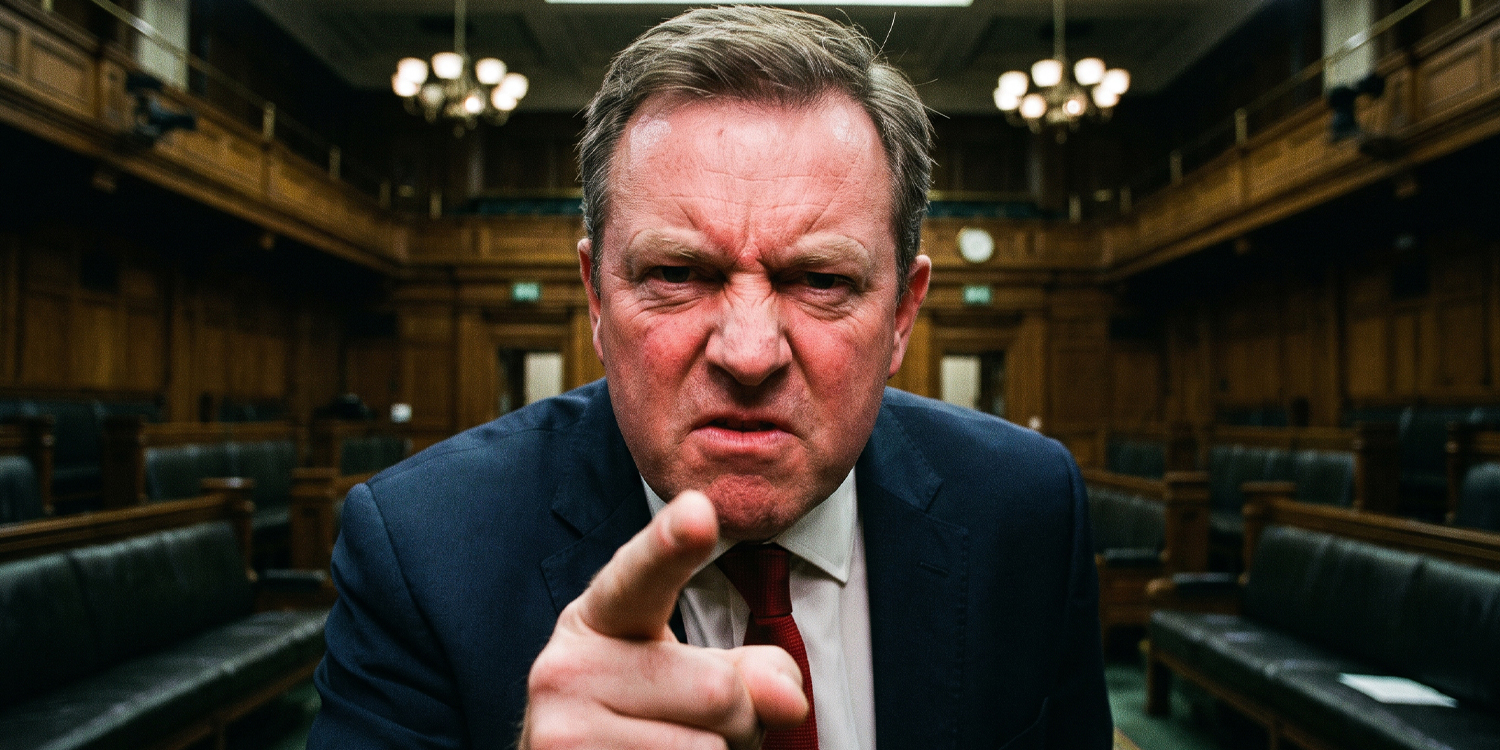
The specific emotions that political issues stir up in voters may subtly shift the physical traits they look for in a leader. A new study published in Cognition and Emotion indicates that when people think about a policy problem that makes them angry, they lean slightly more toward dominant-looking leaders than when they think about one that makes them afraid. Fear, by contrast, appears to put more weight on whether a leader’s face looks trustworthy.
When people look at a stranger’s face, they form instantaneous impressions about that person’s character. As a 2008 behavioral and computer modeling study found, these rapid evaluations boil down to two main facial qualities: trustworthiness and dominance. Trustworthiness is an impression of a person’s intentions, signaling whether they appear warm, cooperative, and safe to approach. Dominance is an impression of physical strength and assertiveness, signaling a person’s capacity to impose their will or confront rivals.
These split-second facial judgments influence real-world voting decisions, and the traits voters prefer often depend on the surrounding political environment and their own personal beliefs. For instance, a 2025 study by members of the team behind the new research, covered by PsyPost, found that people who are generally distrustful of information from others tend to hold more rigid, dogmatic beliefs and more conservative views, which in turn predicts a preference for dominant, authoritarian-looking leaders. Broader contexts matter as well, with voters generally favoring dominant faces during wartime or conflict and trustworthy faces during peaceful periods.
Different emotional reactions to the same crisis can also pull people in different directions. Although anger and fear are both unpleasant, high-stress emotions, a 2001 study on emotion and risk showed that they trigger opposing mindsets: anger makes people feel certain and willing to take risks, whereas fear makes people feel vulnerable and cautious.
In the political arena, a 2025 panel study of Ukrainians conducted during the Russian invasion found that citizens who reacted to the war with aggressive, angry emotions showed stronger preferences for dominant leaders (and for the other leader traits measured, such as warmth and competence), while those who reacted with fear showed little change in their preferences.
Most research on these emotional dynamics has focused on wars, terrorist attacks, or major geopolitical crises. Far less is known about how anger and fear shape leader evaluations during everyday domestic politics, where citizens routinely react to policy debates over the economy, healthcare, or public safety. The research was led by Mariana von Mohr, a lecturer in social and affective neuroscience at the University of Kent, and conducted at the Centre for the Politics of Feelings at the School of Advanced Study, University of London, which is directed by co-author Manos Tsakiris, a professor at Royal Holloway, University of London.
“Political issues often evoke strong emotions, which can shape political behavior in different ways,” von Mohr told PsyPost. “For example, anger can increase support for tougher, more confrontational political action, whereas fear can lead people to seek reassurance and favor responses that promise greater safety and protection. Here we wanted to understand whether these emotions also shape who people would prefer to vote for when dealing with the issues that concern them most, simply based on how dominant or trustworthy a potential leader looks.”
To investigate this, the researchers recruited 201 American participants through the online platform Prolific, ensuring the group was evenly split between people who identified with or leaned toward the Democratic Party and those who identified with or leaned toward the Republican Party. After removing four individuals who did not pass attention checks during the tasks, the final sample consisted of 197 participants.
The experiment used a within-subjects design, meaning every participant went through both the anger condition and the fear condition in a randomized order. In the anger section, participants viewed a list of 16 major national problems taken from a Pew Research Center survey, such as inflation, gun violence, illegal immigration, and climate change. They were asked to select the single issue that made them feel the most angry, defined as an issue that upsets or annoys them and brings up hostility, and to rate the intensity of their anger on a scale from 0 to 100.
Immediately after reflecting on that issue, participants completed a leader choice task consisting of 36 rapid rounds. In each round, two computer-generated faces appeared side by side on the screen for up to three seconds, and participants had to click on the leader they believed would be most capable of handling their chosen political issue. These nine digital faces were drawn from a standardized scientific database and had been systematically altered to represent different combinations of facial dominance and facial trustworthiness.
In the fear section, the same participants went through an identical process, but this time they selected the political issue from the list that made them feel the most afraid, defined as an issue that worries them a lot and feels like a frightening threat. After rating their fear on the 0 to 100 scale, they completed the 36-round face selection task again to pick the best leader to address that frightening issue.
Across the sample, both emotions were felt intensely, with average intensity ratings of 86.51 out of 100 for anger and 81.95 for fear. The issues most frequently selected for anger were illegal immigration (19.3 percent), gun violence (17.8 percent), and inflation (15.2 percent). For fear, participants most commonly selected climate change (15.2 percent), illegal immigration (14.2 percent), and domestic terrorism (11.2 percent).
The researchers first combined each participant’s choices into an overall index measuring the probability of picking a more dominant and less trustworthy-looking leader. Statistical analyses accounting for emotional intensity and specific policy issues showed that participants had a 49.5 percent probability of choosing a dominant-looking leader when angry, compared to a 46.5 percent probability when fearful, meaning participants on average leaned slightly toward the more trustworthy-looking face in both conditions. How intensely participants felt the emotion was unrelated to their choices. While this 3 percentage point absolute shift between anger and fear is modest, the authors note that even small emotional shifts could matter across an entire population during elections, when campaigns frequently amplify fear- and anger-inducing issues.
To see what drove this shift, the authors broke down the choices round by round to look at how participants weighed dominance cues and trustworthiness cues separately. When participants were in the fear condition, a face’s level of trustworthiness increased the likelihood that it would be chosen, whereas a face’s level of dominance had no statistically significant effect on their choices. When participants were in the anger condition, the positive pull of facial trustworthiness dropped, while facial dominance gained a stronger positive influence on their selections.
“Our findings suggest that how we feel about political issues can influence the kinds of leaders we find appealing, even based on something as simple as their facial appearance,” von Mohr explained. “When angry, people placed greater importance on facial cues of dominance (appearing strong and assertive) and less on trustworthiness. When afraid, they placed more importance on trustworthiness (appearing reliable and benevolent).”
The findings are in line with research covered by PsyPost in 2022, which similarly found that anger increased participants’ preferences for dominant-looking leaders over trustworthy ones. However, that earlier study examined anger triggered by non-political frustrations, whereas the new study suggests that anger tied to real-world policy issues is linked to a similar shift while directly contrasting it against political fear.
The researchers also examined the role of political party affiliation. Consistent with previous studies, Republicans showed a higher overall preference for dominant-looking leaders (52.5 percent probability) than Democrats did (43.5 percent probability), representing a 9 percentage point partisan gap. That gap was about three times as large as the 3-point difference between anger and fear. Even though Democrats and Republicans tended to pick different policy issues as their top concerns, the difference between anger and fear did not vary significantly by party, suggesting the emotions influenced leader choices in similar ways for both groups.
The emotion effects did not vary by participants’ gender and held when accounting for the order in which participants completed the tasks. When the researchers statistically controlled for the exact political issue each participant selected in the round-by-round analysis, the distinct effects of anger and fear on how participants weighed dominance and trustworthiness cues remained stable. In the overall-preference analysis, entering each specific issue as a separate factor left the anger-versus-fear difference about the same size but made the estimate less precise.
As with all research, there are some caveats to consider when interpreting these findings. Because participants were allowed to choose whichever political issue personally angered or frightened them the most, the study cannot completely separate the effect of the emotion from the nature of the policy issue itself. Although the researchers used statistical controls to account for the different issues selected, future experiments that induce anger or fear while keeping the policy topic identical for everyone would help isolate the pure effect of the emotion. The study also compared anger only with fear, without a neutral condition, so it cannot say whether anger made dominant faces more appealing, fear made them less appealing, or both.
Additionally, the faces used in the task were standardized, computer-generated avatars rather than photographs of real politicians. While digital faces allow scientists to precisely adjust facial structure without interference from a person’s hairstyle, age, race, or gender, real-world elections involve all of those visual factors alongside party labels and campaign rhetoric. Finally, the study only tested American voters, so it is not known whether the same patterns hold in other countries. Future research could also examine whether other political emotions, such as hope or disgust, shape leader preferences.
The study, “Political emotions shape preferences for leaders’ facial traits: anger favours dominance, fear favours trustworthiness,” was authored by Mariana Von Mohr and Manos Tsakiris.