


Alibaba’s reported ban on Anthropic’s Claude Code looks, on the surface, like an IT decision at a company.It’s probably bigger than that.A Chinese tech giant has warned staff not to use Anthropic’s AI coding helper at work and has directed them toward its own coding platform, Qoder, Reuters reported, citing a person familiar with the directive. Reuters said the development came when Claude Code features that could assist in identifying users with links to China came under examination.For investors, the more profound problem isn’t whether Alibaba (BABA) engineers are using this or that tool.The question is whether the AI competition is expanding from model performance to control of the entire developer stack.That’s important because coding assistants are becoming one of the first areas that enterprises are turning AI into meaningful productivity improvements. If Chinese enterprises determine that U.S. tools pose a legal, compliance or national security concern, they could speed their migration to homegrown models and developer platforms.That might aid Alibaba’s AI ambitions.It might also make a U.S.-China rift over AI tougher to undo.Alibaba is not just trying to build better AI models. It is trying to make sure the developers using those models never leave its ecosystem.“For national security reasons, Anthropic does not currently offer commercial access to Claude in China,” the company said in a February post on detecting and preventing distillation attacks.Alibaba’s Claude Code ban points to a developer-stack fightClaude Code is not your typical chatbot.Anthropic refers to Claude Code as an “agentic coding system,” which can read a codebase, make changes across files, run tests and provide committed code. This makes it more of an AI software engineer than a basic text assistant.And that’s why the Alibaba report matters.When the best AI technologies are embedded in development processes, controlling those workflows is a strategic priority. The company that owns the coding assistance, the model family, the cloud platform, and the billing relationship gets more than just usage revenue.It is distributed.Reuters stated that Alibaba staff were told to use its coding environment, Qoder, rather than Claude Code. Qoder bills itself as an agentic platform with tools like the Qoder Desktop, Qoder CLI, cloud agents and a terminal-native AI coding partner.Related: Anthropic quietly joins the race to build its own chipsTiming is key since Alibaba is already beginning with a bigger AI developer drive.Qwen Code is a terminal-based AI coding tool that connects to Alibaba Cloud Model Studio through pay-as-you-go, Coding Plan or token plan choices. This means Alibaba is not just generating models, but also packaging them into developer tools that it can sell and maintain via its cloud business.Alibaba Cloud also offers an AI Coding Plan that supports Qwen models, Qwen Code and other popular coding tools. The proposal incorporates the Qwen-series models, including qwen3.5-plus, qwen3-max, qwen3-coder-next and qwen3-coder-plus, as well as third-party models.That’s the investor tip.Alibaba’s restriction on Claude Code could minimize its reliance on a U.S. competitor, but it could also force more developers further into Alibaba’s own AI and cloud offerings.Anthropic’s Alibaba dispute raises the stakesThe Alibaba-Anthropic battle is more than a matter of access.Anthropic also called out Alibaba for its alleged “distillation” effort, in which a less powerful model is trained on the outputs of a more proficient one, Reuters reported. Anthropic made the assertion in a letter to two U.S. senators.Anthropic has been publicly warning of distillation attacks. The business noted in a February post that labs can employ proxy services to access frontier models and generate enormous quantities of prompts targeted to extract specific skills. At one time, one proxy network had almost 20,000 bogus accounts, Anthropic stated.More AI:The new Chinese AI model rattling U.S. tech investorsAnthropic restores access to Mythos 5 for select organizationsSoftBank CEO offers stinging critique of Musk’s AI betThat goes some way to explaining why Claude Code became such a flashpoint.Developers told Reuters Claude Code had algorithms that evaluated user contexts, including time zone and proxy-related information, and included subtle marks in prompts sent to Anthropic’s servers. The function was an experiment launched in March to avoid account abuse by unauthorized resellers and prevent model distillation, an Anthropic staffer wrote on X, Reuters said.But the main point is that AI tools are no longer products. They are becoming managed infrastructure.In its supported areas site, Anthropic notes it reserves the right to deny products or services to entities whose predominant ownership may be traced back to countries not covered by its approved regions policy. Anthropic said in September 2025 that it was tightening limitations to bar companies controlled from countries where its products are banned, including China, regardless of where they operate.This puts big firms in a bind.Individual users may be able to circumvent the restrictions. But companies have legal, cybersecurity, and compliance teams. They have vendor risk policies. They have boards and regulators.So the Alibaba restriction could matter more than a regular software policy change.Alibaba’s AI business could get a tailwind.And Alibaba already has a financial incentive to keep AI activities more in its own ecosystem.Revenue at its Cloud Intelligence Group soared 36% to 43.28 billion yuan, or $6.19 billion, in the March quarter, the company said, supported by AI-related product revenue that posted triple-digit growth for the 10th straight quarter.Alibaba also announced its Qwen model family has become the most widely used open source model family in the world, with more than 1 billion total downloads on Hugging Face as of Jan. 21, 2026. The company said as of February, its consumer-facing Qwen app had over 300 million monthly active users across platforms.Those data help explain why the narrative of the Claude Code has a market angle.Alibaba doesn’t need Qwen to dominate every AI benchmark to count. It requires developers, enterprises and consumers to utilize its products frequently enough that the utilization strengthens Alibaba Cloud and related AI services.This is the point where coding helpers come in.Developers are sticky users. They create procedures, tools and habits around the systems they use daily. Once a corporation has standardized on a coding assistant, the model supplier might become part of the software-development process.
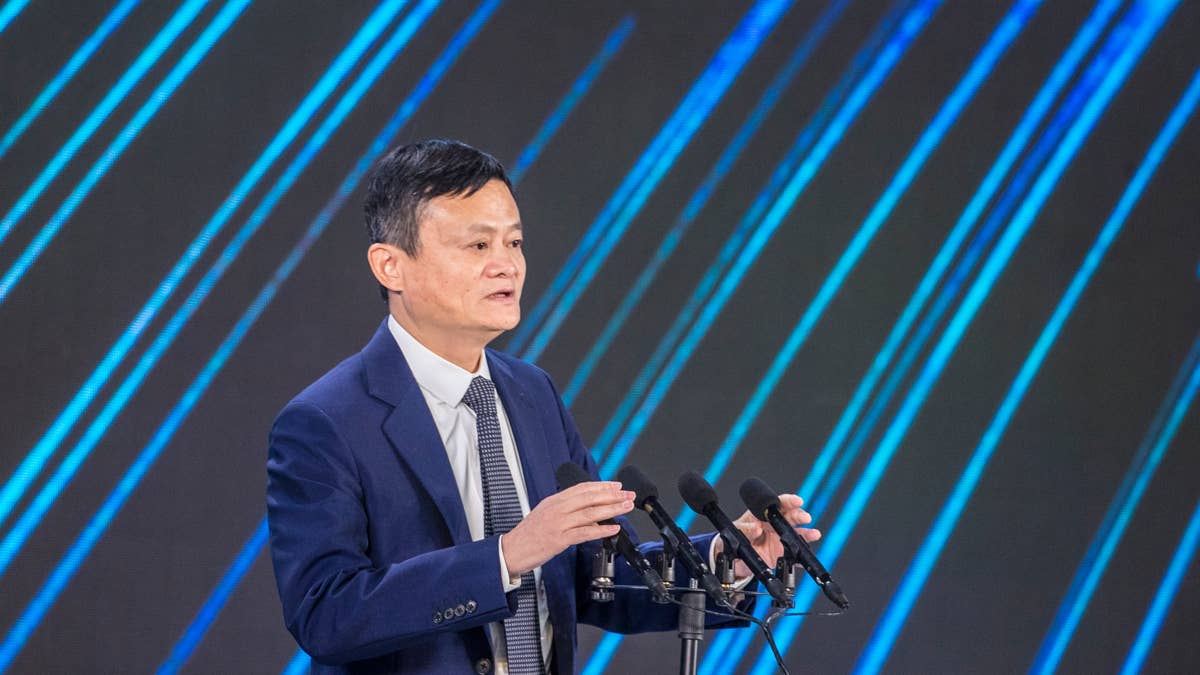
Alibaba’s AI fight shows where the real money is.VCG / Getty Images
Alibaba-Anthropic dispute: Key investor takeawaysAlibaba reportedly banned employees from using Anthropic’s Claude Code at work.The company is reportedly directing employees toward Qoder, its own coding platform.Anthropic has accused Alibaba of distilling Claude capabilities, according to Reuters.Anthropic says it does not currently offer commercial Claude access in China.Alibaba Cloud’s AI-related product revenue has delivered triple-digit growth for 10 consecutive quarters.Alibaba said its Qwen family has amassed over 1 billion cumulative downloads on Hugging Face.That is a clear strategic message.U.S. AI firms want to safeguard access to models. Chinese AI companies seek to cut dependence on U.S. tools. The developers are right in the middle.For Alibaba, it represents both potential and risk.The upside is that a push towards local AI technologies could boost Alibaba’s cloud and Qwen ecosystem. The problem is that the same geopolitical division could lead to a more fragmented, more regulated, and more expensive competition for AI.Alibaba’s real AI test is control, not just capabilityAlibaba’s alleged restriction on Claude Code is not the greatest AI story in itself.But the real story is what it tells us.The race to build artificial intelligence is going deeper into the plumbing of software development. It’s not about who has the smartest chatbot or the most spectacular benchmark anymore. It’s about who owns the tools that developers use to write, test and deploy code.That’s why this fight is important to investors.Alibaba has been pouring money into AI and cloud infrastructure. And it has a method to translate those investments into daily developer usage through its Qwen models, Qwen Code and the Qoder platform. If restrictions on access by other Chinese firms mean a flight from U.S. AI technologies, Alibaba would have a more captive domestic market due to concerns about surveillance or compliance risk.But there’s a catch.A more fractured AI industry might also mean the cost of competing worldwide is higher. U.S. developers may be more wary of Chinese models. Chinese developers may be pushed to local stacks. Cloud providers will need to provide more localized, compliant versions of the same core capabilities.That is to say, the potential for Alibaba’s AI has a sharper geopolitical edge.The company is set to benefit from China’s push for autonomous AI. But the same trend could make it harder to develop the global AI sector across borders.The message for Alibaba investors is simple.Claude Code could be the spark. The true prize is control of the developer stack.Related: The secret letter triggering a U.S.-China AI showdown