

Steep drops from all-time highs can make fallen tech leaders look cheap, particularly after a market leader has declined sharply from its high. But a lower stock price doesn’t mean the industry’s heavy financial bets will pay off — or that the broader market selloff is over.
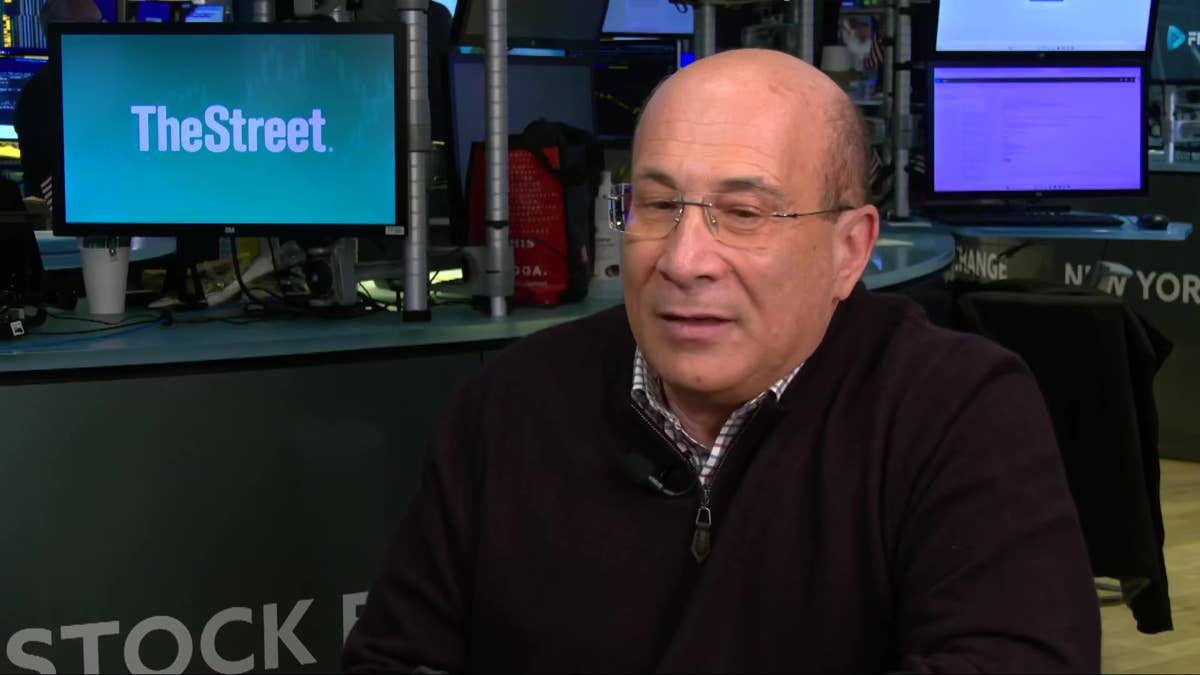
Ron Insana, CEO of Insana Information Partners, is encouraging investors with heavy tech exposure to rebalance their portfolios, raise cash, and wait for clearer market signals. He suggests parking cash in three- and six-month U.S. Treasury bills for the time being, and favors companies like Berkshire Hathaway, Apple, Microsoft, and J. M. Smucker over the debt-heavy parts of the AI trade.
That strategy is intended for investors with overly concentrated portfolios or near-term cash needs. For long-term, buy-and-hold investors who have retirement money and decades before they plan to tap their funds, Insana takes a different view.
Here is how Insana, who spoke in an interview with TheStreet’s Caroline Woods, separates near-term liquidity needs from long-term exposure to technology and stocks.
Why the S&P 500 can mask a deeper stock market decline
Insana’s immediate concern is that major market indexes can look far healthier than the average stock. Since momentum peaked in June, he noted, roughly 40% to 50% of S&P 500 companies have fallen by 20% or more — the measure of an individual stock entering bear market territory — even while the broader index held up relatively well.
Insana argues that weakness spreads from the bottom up. If financial and tech shares falter as more stocks are already falling, the large-cap companies propping up the major indexes could be next. Still, he notes this is only a possibility. He acknowledged that his bearish call in March was wrong because the economy and market proved far more resilient than he anticipated.
For investors whose index funds have outperformed their individual stocks, Insana suggested trimming some S&P 500 exposure to reduce risk without panic-selling the stocks that have already fallen. He frames the move not as an all-or-nothing market call, but as routine rebalancing to bring a portfolio back in line with an investor’s risk tolerance.
Why AI debt matters more than a lower Nvidia share price
Insana, a former anchor on CNBC, sees the central risk in AI financing rather than in a single stock’s valuation. He pointed to uncertainty over whether data-center revenue and return on invested capital, or the profit produced by money put into a business, will be sufficient to support the debt used to build AI infrastructure. He also cited growing losses at OpenAI and Anthropic despite rapidly rising revenue.
For Insana, a former CNBC anchor, the real threat isn’t any individual stock’s valuation — it’s how AI is being financed. He flagged doubts over whether data-center revenue and return on invested capital — the profit earned on money put into the business — will cover the debt taken on to build AI infrastructure, noting that OpenAI and Anthropic face widening losses even as their revenues soar.
I think the bubble’s on the debt side, not the equity side.
Ron Insana, when asked whether the AI trade could trigger a larger market crash
Insana was concerned that commitments can prove less durable in a downturn than investors expect. Beyond the $1.3 trillion in debt sitting on the balance sheets of hyperscalers and other companies, he pointed to $4 trillion in off-balance-sheet liabilities, such as leases and chip-purchase agreements. These obligations don’t show up as standard debt.
That thesis helps explain why Insana isn’t rushing to buy Nvidia just because the stock has dropped roughly 38% from its peak. He also pointed to legal and export-control uncertainties surrounding Nvidia’s Blackwell chips. More broadly, he emphasized that a company with a strong long-term business can still suffer a severe downturn during a tech bust. He cited Amazon’s 95% decline after the dot-com bubble burst in 2000 before it became one of the world’s largest companies.
Why Insana favors Treasury bills and selected defensive stocks
When parking cash temporarily, Insana prefers three- or six-month U.S. Treasury bills — short-term government debt that were yielding roughly 3% to 4% at the time of the interview. The intention isn’t to hold cash as a permanent strategy, he explained, but to keep funds liquid while waiting for clearer market signals.
His stock picks come down to different strengths on the balance sheet and in the underlying businesses. He pointed out that Microsoft was still producing positive free cash flow — the money left over after covering operating and capital expenses. At the same time, Apple hadn’t committed the same level of spending on AI infrastructure. Berkshire Hathaway is his top pick because of its massive $370 billion cash hoard, which gives CEO Greg Abel plenty of flexibility to snap up bargains. As for J. M. Smucker, Insana sees it as a steady, countertrend defensive stock that could become a takeover target.
Still, those picks are no guarantee that defensive stocks will climb during a broad market downturn. Rather, they illustrate how Insana separated companies with strong cash generation and financial flexibility from those heavily reliant on ongoing, debt-funded AI spending. He also dismissed Bitcoin as a safe haven, noting it failed to hold up as one during the selloff.
The takeaway for investors weighing AI exposure and cash needs
For your portfolio, start by dividing your portfolio based on purpose: long-term investing, a near-term expense, or a tactical cash reserve — and keep those buckets separate. Under Insana’s framework, long-term buy-and-hold investors should not let a market correction alone derail a retirement plan, whereas those actively drawing down funds should consider scaling back their stock exposure.
Next, evaluate your portfolio’s concentration and time horizon. If technology holdings make up the bulk of your investments, rebalancing can help limit losses from a prolonged downturn. For cash earmarked for a home down payment or near-term living expenses, Insana’s rule is straightforward: keep it out of the stock market. Going forward, monitor whether AI revenues, cash flows, borrowing costs, and broader credit-market stress support or challenge the broader thesis.
Some or all of this content may have been generated by AI. While we strive for accuracy, AI can occasionally produce incorrect information. If you buy something via one of our links, we may earn a commission.