


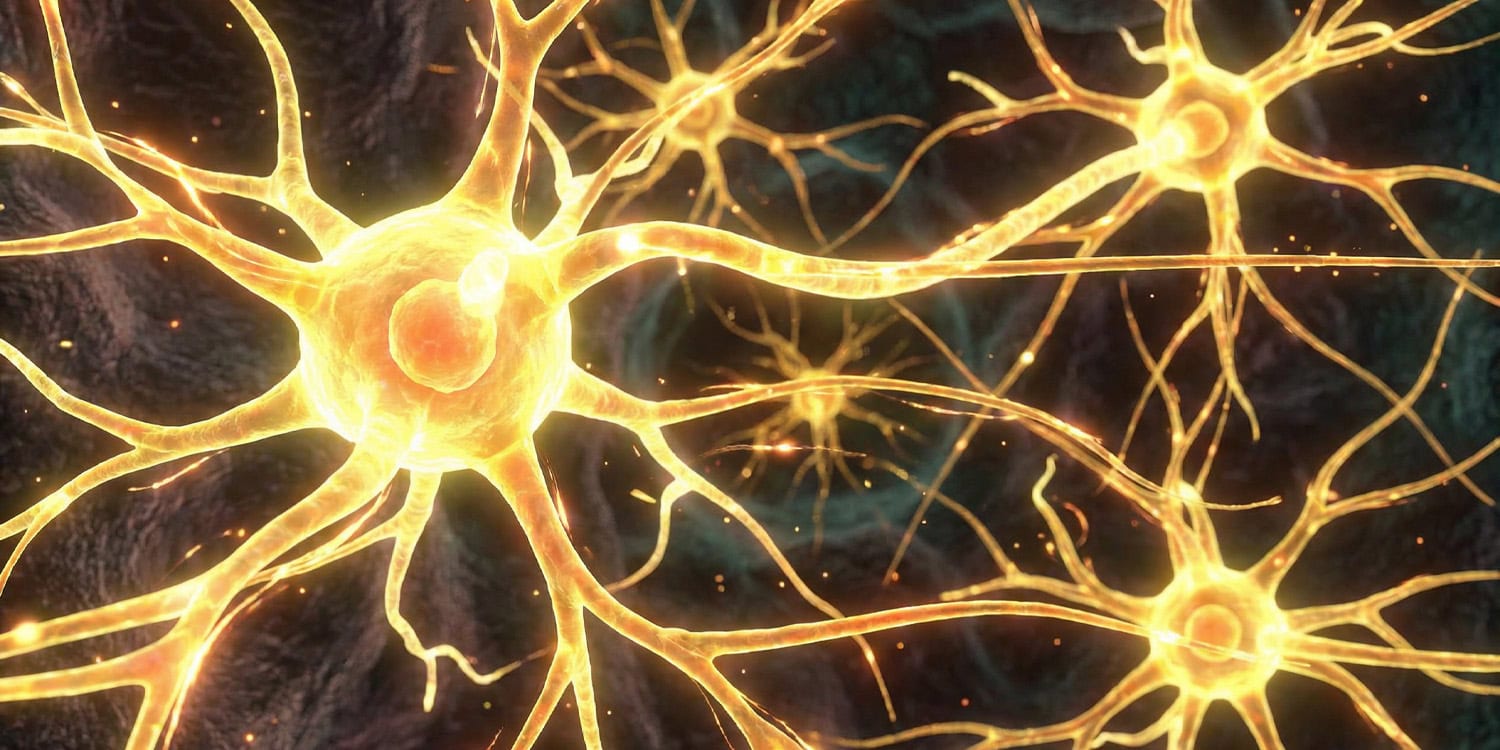
Recent evidence suggests that a single dose of the psychedelic compound psilocybin reduces the drive to seek out rewards, providing evidence for its potential to treat substance use disorders. A new study published in the European Journal of Neuroscience reveals that this decreased motivation is linked to the increased activity of specific inhibitory brain cells surrounded by protective nets. These findings help explain how psychedelics might induce long-lasting changes in the brain circuits that govern decision making and addiction.
Substance use disorders involve a pattern of escalating drug intake and difficulty resisting urges. A primary feature of these conditions is choice impulsivity. This psychological concept describes a tendency to overvalue small immediate rewards over larger rewards that require waiting. People and animals with high choice impulsivity tend to struggle with addiction and are at a higher risk of relapse.
The dorsomedial prefrontal cortex is a region in the brain that plays a primary role in processing reward cues and regulating decision making based on the value of those rewards. This brain area is highly enriched with specific serotonin receptors. These receptors act as the main cellular targets for classic psychedelic drugs like psilocybin. When someone consumes psilocybin, the compound binds to these receptors to produce its varied effects.
Within this brain region, there are fast-firing cells called parvalbumin interneurons. These cells act as inhibitors, meaning they calm down or suppress the activity of other brain circuits. Many of these inhibitory cells are wrapped in specialized structures called perineuronal nets. These microscopic nets are part of an extracellular matrix, which is a web of proteins and sugars that provides structural support and regulates how brain cells adapt and change over time.
Prior clinical trials indicate that a single session of psilocybin-assisted therapy helps reduce alcohol and nicotine consumption in humans. Animal models also show a reduced relapse risk after a single dose of the compound. However, the exact biological mechanisms behind these sustained behavioral shifts remain relatively unknown.
Alberto Del Arco, an associate professor at the University of Mississippi’s School of Applied Sciences and director of the Neurophysiology and Behavior Laboratory, wanted to understand these prolonged effects. “Recent research in animal models and clinical trials suggest that psilocybin could be a useful treatment for substance use disorders,” Del Arco said. “Yet, there is a critical gap in our knowledge regarding how this psychedelic drug alters reward-seeking behavior.”
To investigate this process, the authors used adult male Long Evans rats. The scientists placed the animals on a mild food restriction diet a few days before training began to ensure they were motivated to participate. “To address this gap, we trained rats in a decision-making reward-seeking task where they chose (i.e., press a lever) between small rewards NOW (1 sugar pellet after 1 second) or large rewards LATER (3 sugar pellets after 10 or 20 seconds),” Del Arco explained.
This delay discounting task took place in a sound-attenuated chamber equipped with two retractable levers and a food dispenser. The daily sessions included forced choice trials, where only one lever was active, to ensure the rats paid attention to the rules and experienced the time delays. The sessions also included free choice trials, where both levers were active. This setup allowed the researchers to observe the natural preferences of the rats as the wait times increased.
The training continued for about twelve days until the animals showed stable and predictable decision patterns. Once the rats mastered the task, the scientists divided them into two groups. Six rats received a single injection of psilocybin at a dose of one milligram per kilogram of body weight into their abdominal cavity, while the remaining eight rats received an injection of a simple saline solution to act as a control group.
After the injections, the researchers placed the rats in transparent boxes and recorded their behavior for sixty minutes. They counted the number of head twitches each rat displayed, a standard behavioral marker in rodents indicating a psychedelic drug has successfully activated the targeted serotonin receptors in the brain. As anticipated, the rats given psilocybin showed a significant increase in head twitches compared to the control group.
“Then we injected rats with a single dose of psilocybin 1 mg/kg, i.p. (or vehicle) and tested animals in this task 24 and 48 hours after injection,” Del Arco told PsyPost. Testing the animals days later allowed the drug to completely leave their biological systems. At the twenty-four hour mark, the psilocybin group and the saline group performed similarly.
However, the outcomes shifted at the forty-eight hour mark. “The long-term effects, 48 hours after psilocybin administrations, were somehow surprising,” Del Arco noted. “We found that psilocybin was effective 48 hours after injection decreasing the number of times that animals chose large rewards.”
The rats given psilocybin showed a noticeable decrease in their preference for the large reward, and they took significantly longer to press the lever for the large reward compared to the control group. Because this decreased preference did not depend on the length of the wait time, the behavior did not reflect a change in impulsivity. The rats simply seemed less driven to pursue the large reward in general. They also maintained their accuracy during the forced choice trials, which suggests the drug did not impair their attention or basic motor skills.
After the final behavioral test, the researchers euthanized the animals and extracted their brains for microscopic analysis. They used specialized chemical markers to highlight the inhibitory parvalbumin cells, the surrounding perineuronal nets, and a specific protein called c-Fos, which indicates recent cellular activity. “We also analyzed the brains of these animals 48 hours after psilocybin and found an activation of one type of cortical inhibitory neurons (parvalbumin) as well as changes in the extracellular matrix (structural elements involved in brain plasticity),” Del Arco explained.
In the deep layers of the prefrontal cortex, the rats treated with psilocybin had a higher density of active inhibitory cells that were wrapped in perineuronal nets. The scientists also found a direct mathematical relationship between the brain tissue and the behavior. The rats with the highest number of these active, net-wrapped cells were the ones that chose the large reward the least.
These findings suggest that psilocybin enhances the function of specific inhibitory cells in the prefrontal cortex. Because these cells act to suppress other brain signals, their increased activity likely turns down the volume on the brain pathways that drive reward-seeking behavior. “Our results suggest that psilocybin decreases incentive motivation,” Del Arco said. “We believe that psilocybin decreases the value that animals assign to reward cues and consequently decreases their motivation to pursue rewards.”
“Our results also suggest that these changes in motivation are related to long-term changes in the activity of parvalbumin inhibitory interneurons in the prefrontal cortex,” Del Arco added. “The prefrontal cortex regulates reward-seeking behavior and drug taking.”
“The take home message is that psilocybin might alter how the brain processes reward cues which ultimately decreases motivation for rewards,” Del Arco said. “These findings provide new insights about the mechanisms by which psilocybin could be a useful treatment for substance abuse and relapse.”
While the study provides new insights into the brain, the authors note some limitations to consider. The behavioral task was primarily designed to measure choice impulsivity rather than pure motivation. “Keep in mind that we are talking about basic research,” Del Arco cautioned. “Our study does not demonstrate that psilocybin is a good treatment for substance abuse. At this point we are just looking at potential mechanisms of action of the drug in the brain.”
The experiment also only included male rats, which means the findings might not apply equally to female animals. Biological sex can influence how psychedelic compounds interact with brain chemistry and behavior. Regarding the impact of the findings, Del Arco noted, “The effects are significant but moderate. I think our study is indicating a research pathway for future studies that will identify novel mechanisms of psilocybin in the brain reward system.”
The definition of a long-term effect in this study is limited to forty-eight hours. While this represents a sustained shift compared to the immediate effects of the drug, it does not capture changes that might last for weeks or months. “Currently, we are carrying out follow up studies by utilizing a different behavioral paradigm to provide a proof-of-concept regarding psilocybin altering incentive motivation,” Del Arco said. “Our long-term goal is to identify the long-term mechanisms of psilocybin in the brain reward system.”
“In this study, like in general, in other scientific fields, research collaborations were critical,” Del Arco added. “Our study involved different labs and techniques that provide a more complete picture of psilocybin’s effects on the brain, from plasticity to behavior.”
The study, “Psilocybin Decreases Preference for Large Rewards Accompanied by Increased Activity of Parvalbumin Neurons With Perineuronal Nets in the Medial Prefrontal Cortex“, was authored by Jenna Houff, Andrew Williams, Obie Allen IV, Barbara Gisabella, Harry Pantazopoulos, and Alberto Del Arco.