

Treasury yields can rise gradually for years without fundamentally changing how investors value equities. But when a key round number is breached, the shift can quickly alter the calculations underpinning stock valuations across the market.
The 10-year yield briefly touched 5% on September 14, 2026, reaching its highest point since October 2023, a threshold that forces investors to reconsider what their stocks are worth relative to bonds, CNBC reported.
Warren Buffett built a framework nearly a decade ago to understand how rising rates affect the price investors will pay for equities.
He compared interest rates to gravity, arguing that higher yields pull stock valuations downward the same way physical force pulls objects toward the earth.
Buffett offered that analogy in a 2017 CNBC interview, and he has not commented publicly on where yields are today. The comparison he drew, however, has rarely been this easy to test against live market data.
How a 5% Treasury coupon becomes a stock-market valuation test
Buffett’s framework starts with a simple inversion, treating a bond’s yield the same way investors treat a stock’s earnings to produce a comparable multiple.
In 2017, he pointed to a 10-year Treasury yielding 2.15% and translated that into a price-to-earnings (P/E) equivalent of 46.5 times earnings for a fixed income stream.
The critical distinction he drew is that a company can grow into an expensive P/E multiple over time, while a Treasury coupon is permanently fixed. At a 5% yield, the same inversion produces a multiple of 20 times earnings on a government bond having zero credit risk.
The rule is blunt: when a risk-free bond has a lower earnings multiple than the equity market, every dollar going into stocks pays a premium for taking on additional risk.
The S&P 500 index had a trailing P/E of about 25.9 as of September 11, 2026, GuruFocus data confirmed. This means investors are paying roughly 30% more per dollar of earnings than a guaranteed government security now offers.
Goldman Sachs and surging oil push Treasury yields past the 5% mark
Bond yields continued their ascent as Brent crude rose to $109 a barrel, stoking inflation concerns and leading investors to price in tighter monetary policy ahead of this week’s Federal Reserve decision, Yahoo Finance reported.
Goldman Sachs revised its September 2026 forecast from a pause to a 25-basis-point rate increase after the August 2026 Consumer Price Index (CPI) report showed core inflation running above expectations.
More Warren Buffett:
Warren Buffett reveals he broke his own investing pattern
Warren Buffett has a blunt take on today’s market
Warren Buffett pulls no punches on stock market for 2026
Goldman Sachs economists report that the Federal Open Market Committee (FOMC) would be reluctant to surprise markets already pricing in a strong likelihood of a hike.
The Chicago Mercantile Exchange (CME) Group FedWatch tool placed the probability of a September rate increase at 94.5% as of September 15, 2026.
A rate hike on September 16, 2026, would be the Fed’s first increase since July 2023, lifting the federal funds rate from its current target range of 3.5% to 3.75%.
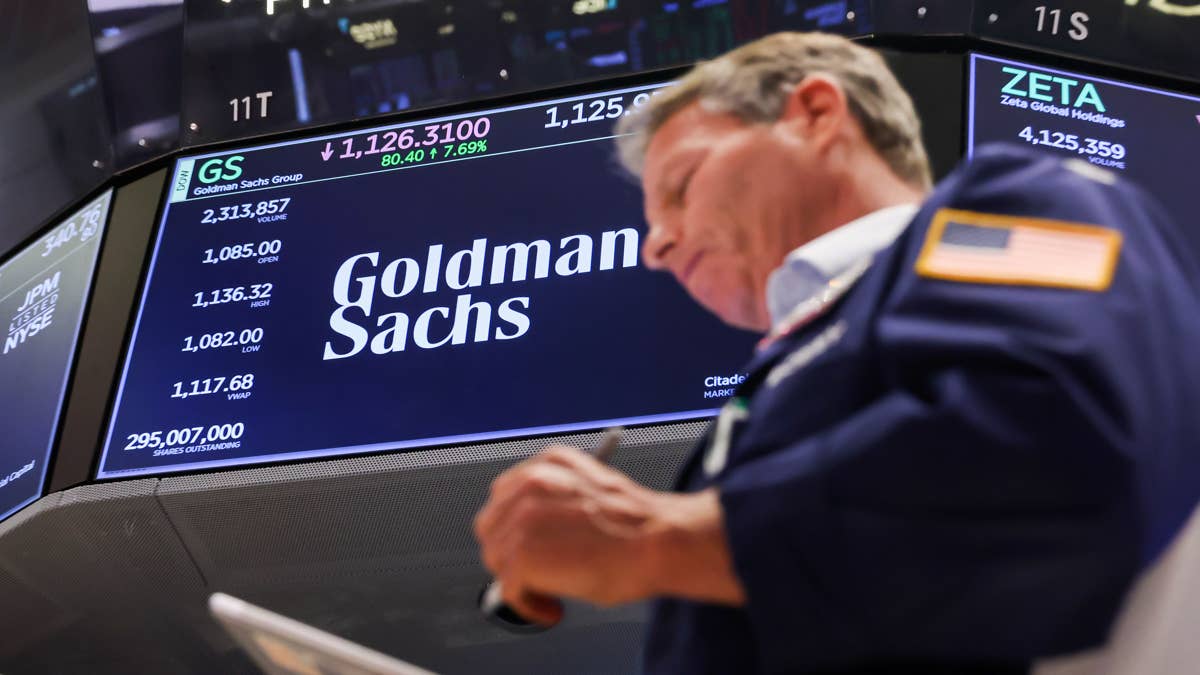
Oil’s rise and Goldman Sachs’ rate-hike call are driving Treasury yields above 5%, raising fresh concerns over inflation and monetary policy.Bloomberg / Getty Images
Yardeni calls 5% yields a confidence signal as Berkshire sits on record cash
Not every strategist views the 5% threshold as a headwind for equities, and the split on Wall Street reveals how differently analysts are reading the same yield data.
Edward Yardeni, President of Yardeni Research, told CNBC he is not alarmed by borrowing costs at this level, describing the milestone as a sign of economic resilience.
Berkshire Hathaway’s capital allocation reinforces the gravity framework that Yardeni’s optimism pushes against. The company ended the first quarter of 2026 with record cash levels concentrated in short-term Treasury bills and equivalents, the company’s quarterly filing confirmed.
Edward Yardeni said strong corporate profit growth has so far absorbed pressure from surging global yields and rising oil prices without fracturing the equity rally, Yahoo Finance reported.
<strong>Either development would normally be enough to break a global bull market in stocks. Neither has so far. That’s because corporate earnings keep climbing</strong>
Those holdings generated annualized interest income of about $12 billion at yields around 3.7%. CEO Greg Abel also remained a net seller of equities during the quarter, extending a multi-quarter pattern of trimming, according to the company’s filing.
What the valuation flip means for investors deciding between stocks and Treasuries
Investors reallocating this quarter face a spread that widens or narrows sharply depending on the earnings yardstick they use.
Goldman Sachs Research offered a forward-looking counterweight to Buffett’s trailing-P/E comparison, noting the S&P 500‘s forward earnings yield stood at 5.2% as of September 2026.
That figure exceeds the real 10-year Treasury yield of 2.6%, a spread suggesting stocks still compensate investors for bearing risk on a forward basis even as the trailing comparison tilts toward bonds.
Goldman Sachs Research puts the forward equity risk premium at 270 basis points, meaning stocks still compensate for risk if projected earnings hold up.
Berkshire Hathaway’s $397.4 billion cash position and $8.1 billion in Q1 net equity sales show how one of the largest allocators is positioning around the same math.
Under Buffett’s gravity framework, positions carrying forward multiples above 20 times now need company-specific earnings growth to justify the premium over a guaranteed government coupon.
A dynamic that makes earnings revisions the variable, Goldman Sachs’s forward-yield data points investors toward through year-end.
Related: Abel reversed Buffett’s two biggest convictions in six months